Search
Agrisera
Tic40/Inner envelope membrane translocon complex protein (chloroplast) Polyclonal Antibody
{{$productOrderCtrl.translations['antibody.pdp.commerceCard.promotion.promotions']}}
{{$productOrderCtrl.translations['antibody.pdp.commerceCard.promotion.viewpromo']}}
{{$productOrderCtrl.translations['antibody.pdp.commerceCard.promotion.promocode']}}: {{promo.promoCode}} {{promo.promoTitle}} {{promo.promoDescription}}. {{$productOrderCtrl.translations['antibody.pdp.commerceCard.promotion.learnmore']}}
Additional Information:
{{banner.description}}
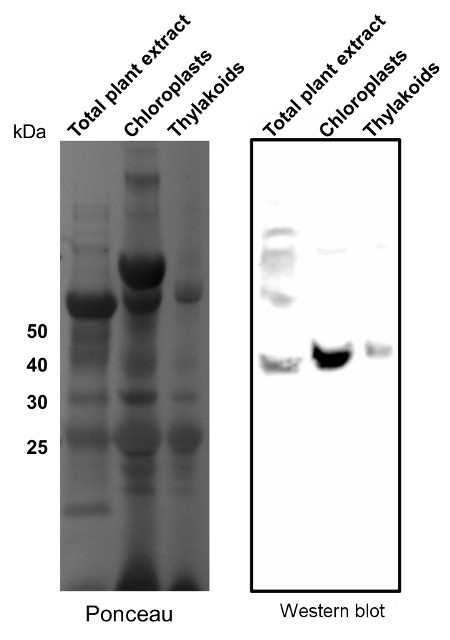
图: 1 / 2
Tic40/Inner envelope membrane translocon complex protein (chloroplast) Antibody (AS10-709) in WB
10-15 µg of chlorophyll from isolated total plant material (Arabidopsis thaliana), chloroplasts and thylakoids extracted with a buffer containing (25 m M Tricine-Na OH, p H 7.8,330 m M sorbitol, 1 m M EDTA, 10 m M KCl, 0.15% [w/v] bovine serum albumin, 4 m M sodium ascorbate, and 7 m M L-Cys) were separated on 12% SDS-PAGE and blotted 1 h to PVDF using semi-dry transfer. Blots were blocked with 10% milk for... View More


产品信息
AS10-709
产品规格
种属反应
Plant
宿主/亚型
Rabbit
分类
Polyclonal
类型
Antibody
抗原
KLH-conjugated synthetic peptide derived from available plant sequences of Tic40.
偶联物
形式
Lyophilized
保存液
whole serum
内含物
no preservative
保存条件
-20°C, Avoid Freeze/Thaw Cycles
运输条件
Ambient (domestic); Wet ice (international)
产品详细信息
Store lyophilized/reconstituted at -20°C; once reconstituted make aliquots to avoid repeated freeze-thaw cycles. Please remember to spin the tubes briefly prior to opening them to avoid any losses that might occur from material adhering to the cap or sides of the tube.
For reconstitution add 50 µL of sterile water.
Specific Species Reactivity: Arabidosps thaliana, Catharantus roseus, Nicotiana benthamiana, Nicotiana tabacum, Oryza sativa, Physcomitrium patens, Solanum lycopersicum, Triticum aestivum, Zea mays, Vitis vinifera
靶标信息
Tic40 encodes a nucleus-derived chloroplast preprotein import factor that is targeted to the chloroplast envelope and resides as a single-pass, inner envelope membrane-anchored component of the TIC translocon, with a short N-terminal membrane anchor and a large hydrophilic C-terminal domain exposed to the stroma. Structurally, the stromal domain contains a tetratricopeptide repeat (TPR) region followed by a C-terminal module with similarity to the Sti1/Hop and Hip classes of co-chaperones, consistent with a role in organizing chaperone interactions at the import site. Functionally, Tic40 acts during the translocation step across the inner envelope rather than initial precursor binding, physically and functionally coupling core TIC components such as Tic110 with stromal chaperone machinery including Hsp93 (Hsp100 family) to facilitate efficient pulling and/or handoff of incoming preproteins into the stroma; loss of Tic40 reduces import efficiency and impairs chloroplast biogenesis, yielding chlorotic, slow-growing plants.
仅用于科研。不用于诊断过程。未经明确授权不得转售。
篇参考文献 (0)
您是否在文献中引用过该产品?请点击下方按钮邮件告知我们。
生物信息学
蛋白别名: ATTIC40; MTG13.14; MTG13_14; PDE120; pigment defective embryo; TIC40
Disclaimer

Clicking the images or links will redirect you to a website hosted by BenchSci that provides third-party scientific content. Neither the content nor the BenchSci technology and processes for selection have been evaluated by us; we are providing them as-is and without warranty of any kind, including for use or application of the Thermo Fisher Scientific products presented.

