Search
Abnova
UBB Recombinant Rabbit Monoclonal Antibody
{{$productOrderCtrl.translations['antibody.pdp.commerceCard.promotion.promotions']}}
{{$productOrderCtrl.translations['antibody.pdp.commerceCard.promotion.promocode']}}: {{promo.promoCode}} {{promo.promoTitle}} {{promo.promoDescription}}. {{$productOrderCtrl.translations['antibody.pdp.commerceCard.promotion.learnmore']}}
{{$ctrl.translations['antibody.pdp.skuNotes.additionalInformation']}}:
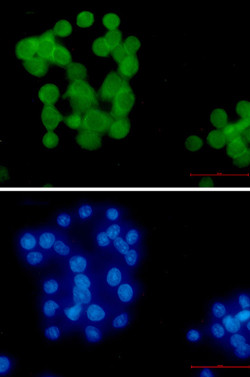
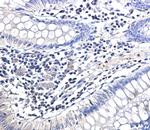
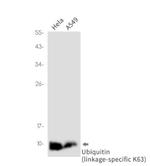
Please note: We are reviewing Western blot images included in the antibody testing data in our catalog, including those provided by third parties. Unless expressly labeled or annotated as “raw-unedited”, Western blot images included in the antibody testing data in our catalog may have been edited, optimized or otherwise adjusted for presentation.


产品信息
RAB01335
应用
建议稀释比
已发表文章
产品规格
种属反应
Human
宿主/亚型
Rabbit
/ IgG
Expression System
CHO cells
分类
Recombinant Monoclonal
类型
Antibody
抗原
Recombinant protein corresponding to human UBB.
偶联物
Unconjugated
Unconjugated
Unconjugated
形式
Liquid
纯化类型
Affinity chromatography
保存液
50mM tris glycine, pH 7.4, with 40% glycerol, 0.05% BSA, 150mM NaCl
内含物
0.01% sodium azide
保存条件
Store at 4°C short term. For long term storage, store at -20°C, avoiding freeze/thaw cycles.
运输条件
Ambient (domestic); Wet ice (international)
靶标信息
Ubiquitin is a highly conserved protein of about 8.5 kDa molecular weight, which has an ATP dependent role in the targeting of proteins for proteolytic degradation. To perform this function, the protein to be degraded is first covalently attached to the C terminus of ubiquitin, and the ubiquitinated complex is then recognized by a complex of degradative enzymes. Interestingly, ubiquitin also becomes covalently bonded to many types of pathological inclusions, which appear to be resistant to normal degradation. Therefore, ubiquitin antibodies are very useful for studies of these inclusions. For example, the neurofibrillary tangles and paired helical filaments diagnostic of Alzheimer's disease, Lewy bodies seen in Parkinson's disease, and Pick bodies found in Pick's disease are all heavily ubiquitinated and can be readily visualized with ubiquitin antibodies.
仅用于科研。不用于诊断过程。未经明确授权不得转售。
篇参考文献 (0)
您是否在文献中引用过该产品?请点击下方按钮邮件告知我们。
生物信息学
蛋白别名: epididymis secretory protein Li 50; HUBCEP52; MGC127041; polyubiquitin B; RPL40; unnamed protein product
基因别名: HEL-S-50
UniProt ID: (Human) P0CG47
Entrez Gene ID: (Human) 7314
protein ubiquitination
modification-dependent protein catabolic process
positive regulation of protein ubiquitination
regulation of neuron apoptotic process
mitochondrion transport along microtubule
neuron projection morphogenesis
protein homotetramerization
regulation of mitochondrial membrane potential
regulation of proteasomal protein catabolic process
positive regulation of intrinsic apoptotic signaling pathway by p53 class mediator
positive regulation of protein monoubiquitination
Disclaimer

Clicking the images or links will redirect you to a website hosted by BenchSci that provides third-party scientific content. Neither the content nor the BenchSci technology and processes for selection have been evaluated by us; we are providing them as-is and without warranty of any kind, including for use or application of the Thermo Fisher Scientific products presented.

