Search
Agrisera
V-PPase/vacuolar H-pyrophosphatase Polyclonal Antibody
{{$productOrderCtrl.translations['antibody.pdp.commerceCard.promotion.promotions']}}
{{$productOrderCtrl.translations['antibody.pdp.commerceCard.promotion.viewpromo']}}
{{$productOrderCtrl.translations['antibody.pdp.commerceCard.promotion.promocode']}}: {{promo.promoCode}} {{promo.promoTitle}} {{promo.promoDescription}}. {{$productOrderCtrl.translations['antibody.pdp.commerceCard.promotion.learnmore']}}
Additional Information:
{{banner.description}}
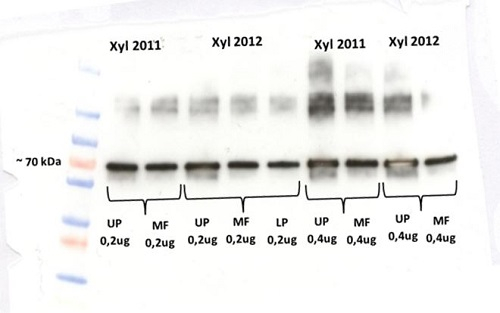
图: 1 / 1
V-PPase/vacuolar H-pyrophosphatase Antibody (AS12-1849) in WB
Different amounts (depending of the tissue) of membrane proteins from developing xylem tissue of Norway spruce were separated in a gradient (4-15%) SDS-PAGE gel and blotted 30 min to nitrocellulose membrane using a standard semi-dry Trans-Blot ® Turbo ™ (Bio-Rad) system. Blots were blocked with 5% non-fat milk protein for 1 h at room temperature (RT) with agitation. Blot was incubated in the primary antibod... View More

产品信息
AS12-1849
产品规格
种属反应
Algae,
Plant
宿主/亚型
Rabbit
分类
Polyclonal
类型
Antibody
抗原
KLH-conjugated synthetic peptide derived from Arabidopsis thaliana V-Ppase.
偶联物
Unconjugated
Unconjugated
Unconjugated
形式
Lyophilized
保存液
whole serum
内含物
no preservative
保存条件
-20°C, Avoid Freeze/Thaw Cycles
运输条件
Ambient (domestic); Wet ice (international)
产品详细信息
Store lyophilized/reconstituted at -20°C; once reconstituted make aliquots to avoid repeated freeze-thaw cycles. Please remember to spin the tubes briefly prior to opening them to avoid any losses that might occur from material adhering to the cap or sides of the tube.
For reconstitution add 50 µL of sterile water.
Specific Species Reactivity: Arabidopsis thaliana, Cucumis sativus, Dunaliella bardawil, Hordeum vulgare, Nicotiana tabacum, Picea abies, Vitis vinifera
靶标信息
AVP1, also called vacuolar H plus pyrophosphatase, is a plant membrane proton pump that uses inorganic pyrophosphate to drive protons into the vacuole, generating and sustaining the proton motive force for secondary transport. By acidifying the vacuolar lumen, AVP1 supports ion and metabolite sequestration, osmoregulation, and pH homeostasis, and it can also localize to the plasma membrane in some tissues to aid phloem loading and root development. Overexpression of AVP1 enhances drought and salinity tolerance, biomass, and nutrient use efficiency by improving root architecture and long distance transport, while loss of function impairs vacuolar transport and stress resilience. AVP1 activity interfaces with sucrose and auxin transport, cellular energy balance, and membrane trafficking, making it a key regulator of growth and adaptation in diverse plant species.
仅用于科研。不用于诊断过程。未经明确授权不得转售。
篇参考文献 (0)
您是否在文献中引用过该产品?请点击下方按钮邮件告知我们。
生物信息学
蛋白别名: ARABIDOPSIS THALIANA V-PPASE 3; AtAVP1; ATAVP3; AtVHP1;1; AVP-3; F7H2.3; F7H2_3; FUGU5; VACUOLAR H+-PYROPHOSPHATASE AVP-3; VHP1
Disclaimer

Clicking the images or links will redirect you to a website hosted by BenchSci that provides third-party scientific content. Neither the content nor the BenchSci technology and processes for selection have been evaluated by us; we are providing them as-is and without warranty of any kind, including for use or application of the Thermo Fisher Scientific products presented.

