Search
Invitrogen
Vimentin Monoclonal Antibody (J144)
{{$productOrderCtrl.translations['antibody.pdp.commerceCard.promotion.promotions']}}
{{$productOrderCtrl.translations['antibody.pdp.commerceCard.promotion.promocode']}}: {{promo.promoCode}} {{promo.promoTitle}} {{promo.promoDescription}}. {{$productOrderCtrl.translations['antibody.pdp.commerceCard.promotion.learnmore']}}
{{$ctrl.translations['antibody.pdp.skuNotes.additionalInformation']}}:
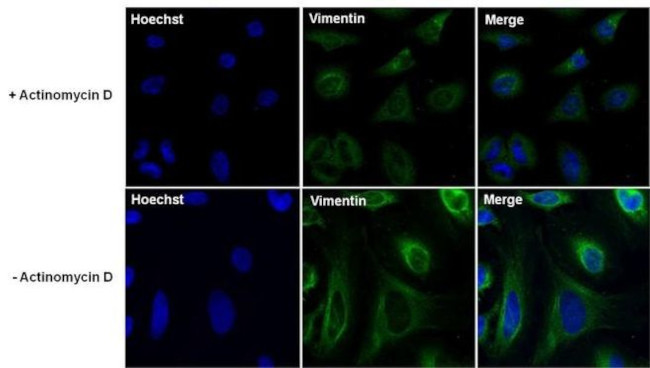
图: 1 / 24
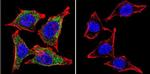
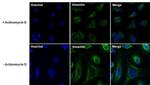
Vimentin Antibody (MA3-745) in ICC/IF
Immunofluorescent analysis of Vimentin (green) in HeLa cells untreated or treated with 1uM Actinomycin D for 19 hours. The cells were fixed with 4% Paraformaldehyde for 15 minutes, permeabilized with 0.1% Triton X-100 for 10 minutes, and blocked with 3% BSA for 30 minutes at room temperature. Cells were stained with a Vimentin mouse monoclonal antibody (Product # MA3-745) at a dilution of 1:100 in blocking buffer for 1 hour at room temperature, and then incubated with a Goat anti-Mouse IgG (H+L) Secondary Antibody, Alexa Fluor Plus 488 con... View More
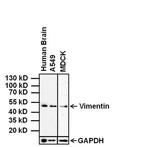
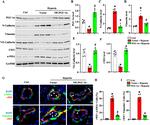
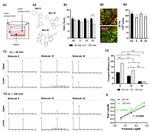
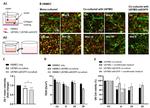
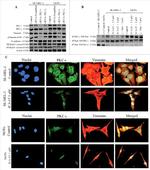
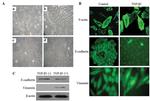
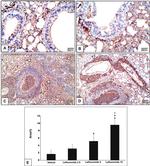
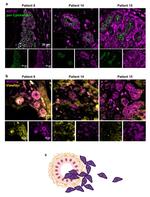
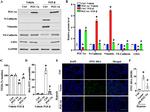
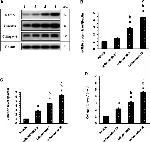
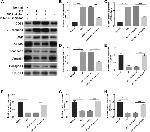

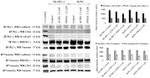
Please note: We are reviewing Western blot images included in the antibody testing data in our catalog, including those provided by third parties. Unless expressly labeled or annotated as “raw-unedited”, Western blot images included in the antibody testing data in our catalog may have been edited, optimized or otherwise adjusted for presentation.


产品信息
MA3-745
应用
建议稀释比
已发表文章
产品规格
种属反应
Dog,
Human,
Mouse,
Rat
已发表种属
Human,
Mouse
宿主/亚型
Mouse
/ IgM
分类
Monoclonal
类型
Antibody
克隆号
J144
抗原
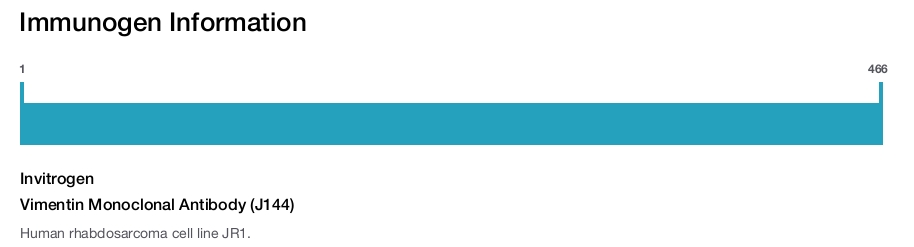
Human rhabdosarcoma cell line JR1.
偶联物
Unconjugated
Unconjugated
Unconjugated
形式
Liquid
浓度
Conc. Not Determined
保存液
ascites
内含物
0.05% sodium azide
保存条件
-20°C, Avoid Freeze/Thaw Cycles
运输条件
Ambient (domestic); Wet ice (international)
RRID
产品详细信息
MA3-745 detects human, rat, and mouse vimentin and has been successfully used in HELA-S3, HEK-293, rat brain, and rat kidney cells.
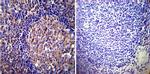
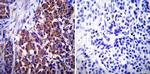
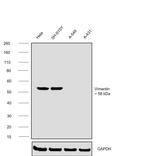
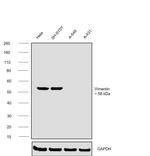
MA3-745 has been successfully used in Western blot, immunohistochemical and immunofluorescence procedures. By Western blot, this antibody detects an ~57 kDa protein representing vimentin from HELA-S3 cells. Immunohistochemical staining of vimentin using MA3-745 can be performed.
The MA3-745 immunogen was human rhabdosarcoma cell line JR1.
靶标信息
Vimentin is a developmentally regulated intermediate filament protein (IFP) found in cells of mesenchymal origin. It is believed to be involved with the intracellular transport of proteins between the nucleus and plasma membrane. Unlike other IFP proteins, vimentin is expressed, along with desmin, during the early stages of cellular development. During the development process, vimentin is exchanged for new, tissue-specific IFPs. Vimentin has been implicated to be involved in the rate of steroid synthesis via its role as a storage network for steroidogenic cholesterol containing lipid droplets. Vimentin phosphorylation by a protein kinase causes the breakdown of intermediate filaments and activation of an ATP and myosin light chain dependent contractile event. This results in cytoskeletal changes that facilitate the interaction of the lipid droplets within mitochondria, and subsequent transport of cholesterol to the organelles leading to an increase in steroid synthesis.
仅用于科研。不用于诊断过程。未经明确授权不得转售。
生物信息学
蛋白别名: epididymis secretory sperm binding protein; FLJ36605; Hel113; RP11-124N14.1; unnamed protein product; VIM; VIME; vimentin; vimentin protein
UniProt ID: (Human) P08670, (Dog) A0A8C0N8E3, (Mouse) P20152, (Rat) P31000
Entrez Gene ID: (Human) 7431, (Dog) 477991, (Mouse) 22352, (Rat) 81818
RNA binding
double-stranded RNA binding
structural constituent of cytoskeleton
structural constituent of eye lens
protein binding
protein domain specific binding
identical protein binding
binding, bridging
scaffold protein binding
keratin filament binding
kinase binding
protein phosphatase 2A binding
protein tyrosine kinase binding
structural molecule activity
positive regulation of gene expression
positive regulation of epithelial cell migration
negative regulation of neuron projection development
astrocyte development
positive regulation of collagen biosynthetic process
regulation of mRNA stability
intermediate filament-based process
intermediate filament organization
positive regulation of axon extension
regulation of axonogenesis
Bergmann glial cell differentiation
positive regulation of glial cell proliferation
lens fiber cell development
cellular response to lipopolysaccharide
cellular response to muramyl dipeptide
cellular response to interferon-gamma
regulation of Schwann cell migration
positive regulation of cellular protein localization
response to zinc ion
response to selenium ion
response to estradiol
response to vitamin D
skeletal muscle tissue regeneration
cellular response to fibroblast growth factor stimulus
fat cell differentiation
decidualization
Disclaimer

Clicking the images or links will redirect you to a website hosted by BenchSci that provides third-party scientific content. Neither the content nor the BenchSci technology and processes for selection have been evaluated by us; we are providing them as-is and without warranty of any kind, including for use or application of the Thermo Fisher Scientific products presented.

