Search
Agrisera
WHIRLY1 Polyclonal Antibody
{{$productOrderCtrl.translations['antibody.pdp.commerceCard.promotion.promotions']}}
{{$productOrderCtrl.translations['antibody.pdp.commerceCard.promotion.viewpromo']}}
{{$productOrderCtrl.translations['antibody.pdp.commerceCard.promotion.promocode']}}: {{promo.promoCode}} {{promo.promoTitle}} {{promo.promoDescription}}. {{$productOrderCtrl.translations['antibody.pdp.commerceCard.promotion.learnmore']}}
Additional Information:
{{banner.description}}
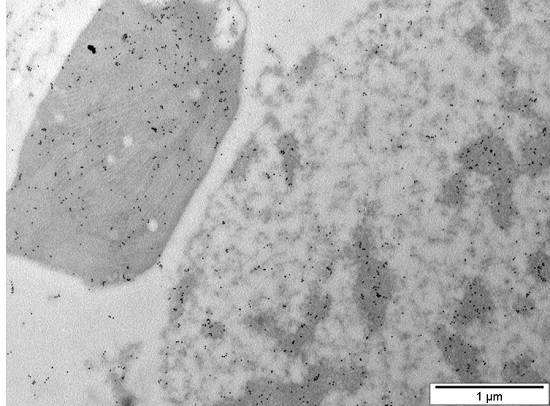
图: 1 / 1
WHIRLY1 Antibody (AS16-3953) in IHC (PFA)
Material: Barley(flag leaves), fixed in 4% formaldehyde (from paraformaldehyde), embedded in LR White Samples: ultrathin sections on Au-Grids Immunogold labelling: 1. Blocking 30 min RT in PBS (p H 7,4) + 0,2% BSA + 0,2% fish gelatin (= blocking buffer) sterile filtrated 2. Incubation over night at 4°C anti-W 1 (goat) 1:200 in blocking buffer 3. Washing: 4 x 3 min PBS + 0,1% BSA (= washing buffer) 4. Incuba... View More
Please note: We are reviewing Western blot images included in the antibody testing data in our catalog, including those provided by third parties. Unless expressly labeled or annotated as “raw-unedited”, Western blot images included in the antibody testing data in our catalog may have been edited, optimized or otherwise adjusted for presentation.

产品信息
AS16-3953
产品规格
种属反应
Plant
宿主/亚型
Goat
分类
Polyclonal
类型
Antibody
抗原
KLH-conjugated peptide derived from HvWHIRLY1 protein sequence.
偶联物
Unconjugated
Unconjugated
Unconjugated
形式
Lyophilized
规格
50 µg
纯化类型
Antigen affinity chromatography
保存液
PBS, pH 7.4
内含物
no preservative
保存条件
-20°C, Avoid Freeze/Thaw Cycles
运输条件
Ambient (domestic); Wet ice (international)
产品详细信息
Lyophilized antibody can be stored at -20°C for up to 3 years. Re-constituted antibody can be stored at 4°C for several days to weeks. Once reconstituted make aliquots to avoid repeated freeze-thaw cycles. Please remember to spin the tubes briefly prior to opening them to avoid any losses that might occur from material adhering to the cap or sides of the tube.
Specific Species Reactivity: Hordeum vulgare
靶标信息
WHIRLY1 encodes a plant Whirly-family nucleic-acid-binding protein that is predominantly associated with chloroplast nucleoids (including the transcriptionally active chromosome fraction) and can also be detected in the nucleus, consistent with a role in plastid-nucleus communication. It is synthesized as a nuclear-encoded precursor bearing an N-terminal plastid transit peptide and accumulates in developing chloroplasts where it associates with thylakoid-attached nucleoid DNA. Structurally, WHIRLY proteins form higher-order oligomers (commonly tetramers) and bind single-stranded DNA in a largely sequence-independent manner, while also exhibiting RNA-binding activity to subsets of plastid transcripts. Functionally, WHIRLY1 acts as a major architectural component of chloroplast nucleoids that promotes proper nucleoid organization and DNA compaction, influencing plastid DNA metabolism and coordinating chloroplast gene expression programs needed for chloroplast biogenesis (including effects on plastid ribosome accumulation and balanced assembly of plastid- and nucleus-encoded photosynthetic complexes). In the nucleus, WHIRLY1 can bind promoter regions of specific target genes to modulate transcriptional outputs linked to development and stress responses (e.g., regulation of senescence-associated pathways), supporting its proposed dual organelle-nucleus regulatory role.
仅用于科研。不用于诊断过程。未经明确授权不得转售。
篇参考文献 (0)
您是否在文献中引用过该产品?请点击下方按钮邮件告知我们。
生物信息学
蛋白别名: ATWHY1; p24; PTAC1; WHY1
Disclaimer

Clicking the images or links will redirect you to a website hosted by BenchSci that provides third-party scientific content. Neither the content nor the BenchSci technology and processes for selection have been evaluated by us; we are providing them as-is and without warranty of any kind, including for use or application of the Thermo Fisher Scientific products presented.

