Search
Invitrogen
beta Lactamase Monoclonal Antibody (8A5.A10)
{{$productOrderCtrl.translations['antibody.pdp.commerceCard.promotion.promotions']}}
{{$productOrderCtrl.translations['antibody.pdp.commerceCard.promotion.promocode']}}: {{promo.promoCode}} {{promo.promoTitle}} {{promo.promoDescription}}. {{$productOrderCtrl.translations['antibody.pdp.commerceCard.promotion.learnmore']}}
{{$ctrl.translations['antibody.pdp.skuNotes.additionalInformation']}}:
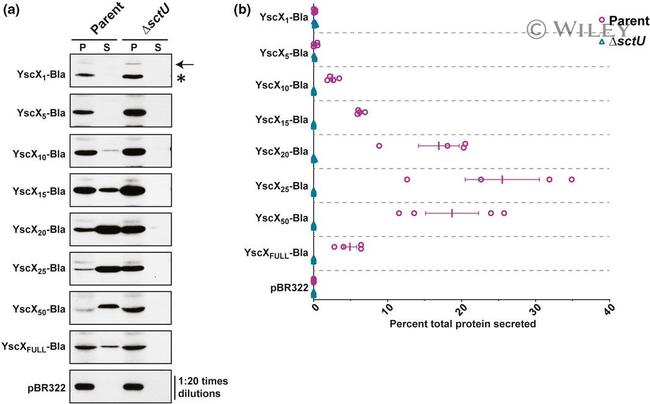
图: 1 / 1
beta Lactamase Antibody (MA1-20370) in WB
Molecular microbiology 2022 -
1 FIGURE T3S of a beta-lactamase reporter by appending the YscX N-terminus. Derivatives of pMMB208 contained yscX-bla translational fusions placed under control of an IPTG inducible promoter. These constructs were maintained in parental (YPIII/pIB102) and Delta sctU null mutant (YPIII/pIB75) bacteria. Overnight cultures of these bacteria were sub-cultured into BHI broth lacking calcium and then grown at 26d... View More
Please note: We are reviewing Western blot images included in the antibody testing data in our catalog, including those provided by third parties. Unless expressly labeled or annotated as “raw-unedited”, Western blot images included in the antibody testing data in our catalog may have been edited, optimized or otherwise adjusted for presentation.

产品信息
MA1-20370
产品规格
种属反应
Bacteria
已发表种属
Bacteria,
Yeast
宿主/亚型
Mouse
/ IgG1
分类
Monoclonal
类型
Antibody
克隆号
8A5.A10
抗原
5'-His-tagged E. coli 205 TEM-1 Rand beta-lactamase.
偶联物
Unconjugated
Unconjugated
Unconjugated
形式
Liquid
浓度
1.8 mg/mL
规格
500 µg
纯化类型
Protein G
保存液
PBS, pH 7.4
内含物
no preservative
保存条件
Store at 4°C short term. For long term storage, store at -20°C, avoiding freeze/thaw cycles.
运输条件
Ambient (domestic); Wet ice (international)
RRID
产品详细信息
Store product as a concentrated solution. Centrifuge briefly prior to opening the vial.
Sequence: MSIQHFRVAL IPFFAAFCLP VFAHPETLVK VKDAEDQLGA RVGYIELDLN SGKILESFRP EERFPMMSTF KVLLCGAVLS RVDAGQEQLG RRIHYSQNDL VEYSPVTEKH LTDGMTVREL CSAAITMSDN TAANLLLTTI GGPKELTAFL HNMGDHVTRL DRWEPELNEA IPNDERDTTM PAAMATTLRK LLTGELLTLA SRQQLIDWME ADKVAGPLLR SALPAGWFIA DKSGAGERGS RGIIAALGPD GKPSRIVVIY TTGSQATMDE RNRQIAEIGA SLIKHW
靶标信息
The beta lactam antibiotics (penicillins and cephalosporins) are the most frequently used antimicrobial agents. All of the beta lactams are structurally related through the presence of a core beta lactam ring. Bacterial resistance to beta lactams continues to increase, primarily due to the production of beta lactamases. Beta lactamases catalyze the hydrolysis of the beta lactam bond, which destroys antibacterial activity. Bacteria that produce TEM type or SHV type beta lactamases have point mutations in structural genes that have extended the substrate specificity of these beta lactamases. As a result, many of the beta lactamase producing Gram negative pathogens have become multidrug resistant.
仅用于科研。不用于诊断过程。未经明确授权不得转售。
生物信息学
蛋白别名: blaCTX-M-14; FLJ14902; G24; MRPL56
Disclaimer

Clicking the images or links will redirect you to a website hosted by BenchSci that provides third-party scientific content. Neither the content nor the BenchSci technology and processes for selection have been evaluated by us; we are providing them as-is and without warranty of any kind, including for use or application of the Thermo Fisher Scientific products presented.

