Search
Abnova
ANGPTL4 Monoclonal Antibody (1A12)
{{$productOrderCtrl.translations['antibody.pdp.commerceCard.promotion.promotions']}}
{{$productOrderCtrl.translations['antibody.pdp.commerceCard.promotion.promocode']}}: {{promo.promoCode}} {{promo.promoTitle}} {{promo.promoDescription}}. {{$productOrderCtrl.translations['antibody.pdp.commerceCard.promotion.learnmore']}}
{{$ctrl.translations['antibody.pdp.skuNotes.additionalInformation']}}:
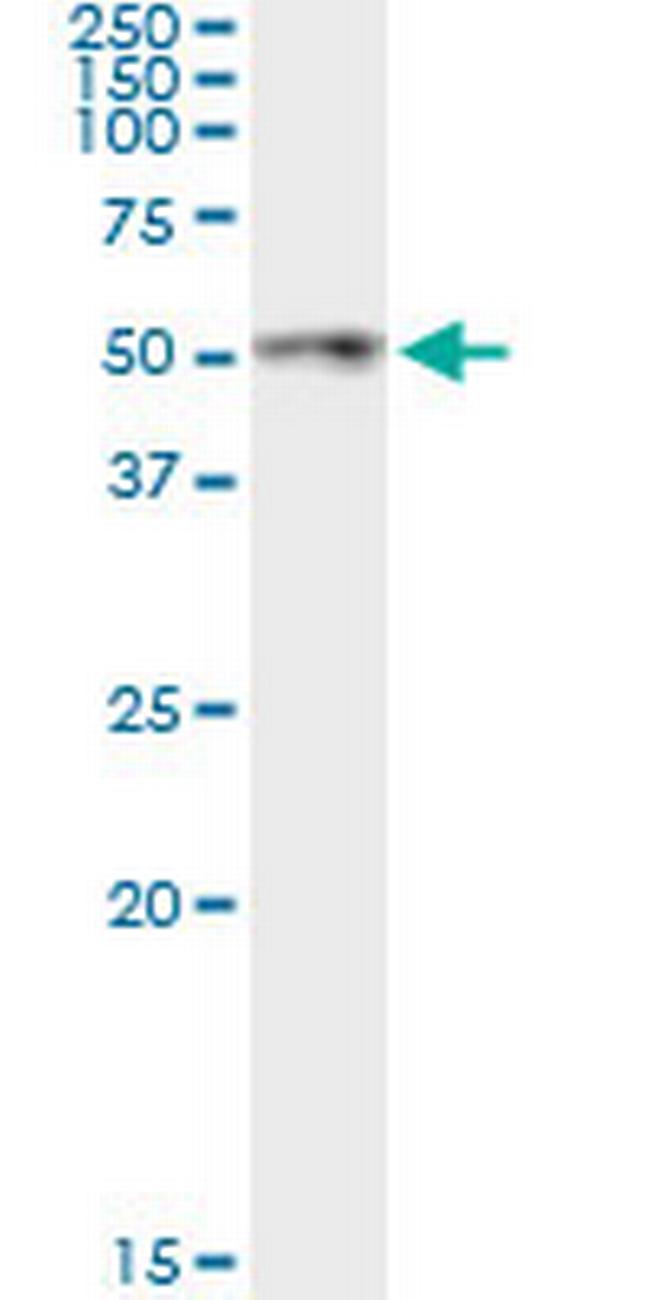
Please note: We are reviewing Western blot images included in the antibody testing data in our catalog, including those provided by third parties. Unless expressly labeled or annotated as “raw-unedited”, Western blot images included in the antibody testing data in our catalog may have been edited, optimized or otherwise adjusted for presentation.

产品信息
H00051129-M02
产品规格
种属反应
Human
宿主/亚型
Mouse
/ IgG1, kappa
分类
Monoclonal
类型
Antibody
克隆号
1A12
抗原
ANGPTL4 (AAH23647.1, 26 a.a. approximately 406 a.a) full-length recombinant protein with GST tag. MW of the GST tag alone is 26 KDa.
偶联物
Unconjugated
Unconjugated
Unconjugated
形式
Liquid
浓度
0.45 mg/mL
规格
100 µg
纯化类型
Protein A
保存液
PBS, pH 7.4
内含物
no preservative
保存条件
-20°C, Avoid Freeze/Thaw Cycles
运输条件
Ambient (domestic); Wet ice (international)
产品详细信息
Immunogen sequence: GPVQSKSPRF ASWDEMNVLA HGLLQLGQGL REHAERTRSQ LSALERRLSA CGSACQGTEG STDLPLAPES RVDPEVLHSL QTQLKAQNSR IQQLFHKVAQ QQRHLEKQHL RIQHLQSQFG LLDHKHLDHE VAKPARRKRL PEMAQPVDPA HNVSRLHRLP RDCQELFQVG ERQSGLFEIQ PQGSPPFLVN CKMTSDGGWT VIQRRHDGSV DFNRPWEAYK AGFGDPHGEF WLGLEKVHSI TGDRNSRLAV QLRDWDGNAE LLQFSVHLGG EDTAYSLQLT APVAGQLGAT TVPPSGLSVP FSTWDQDHDL RRDKNCAKSL SGGWWFGTCS HSNLNGQYFR SIPQQRQKLK KGIFWKTWRG RYHPLQATTM LIQPIAAEAA S
靶标信息
Angiopoietin-like protein 4 (ANGPTL4), is a secreted protein selectively expressed in adipose tissue, liver, and placenta1-3 that plays a variety of roles in vivo, ranging from adipogenesis to angiogenesis to carcinogenesis. The expression of ANGPTL4 is also under nutritional and hormonal control. ANGPTL4 has been observed to induce a strong pro-angiogenic response independent of vascular endothelial growth factor (VEGF), and its expression has been described in hypoxic human tissues as well as a variety of cancers, including liposarcoma, hepatocellular carcinoma, and conventional renal cell carcinoma.
仅用于科研。不用于诊断过程。未经明确授权不得转售。
篇参考文献 (0)
您是否在文献中引用过该产品?请点击下方按钮邮件告知我们。
生物信息学
蛋白别名: ANGPTL2; contains fibrinogen-like domain; Fasting-i; fasting-induced adipose factor; hepatic angiopoietin-related protein; hepatic fibrinogen/angiopoietin-related protein; peroxisome proliferator-activated receptor (PPAR) gamma induced angiopoietin-related protein; PPARG angiopoietin related protein; unnamed protein product
基因别名: ARP4; FIAF; HARP; HFARP; NL2; PGAR; pp1158; TGQTL; UNQ171
UniProt ID: (Human) Q9BY76
Entrez Gene ID: (Human) 51129
response to hypoxia
blood coagulation
negative regulation of very-low-density lipoprotein particle remodeling
negative regulation of apoptotic process
protein unfolding
negative regulation of fatty acid biosynthetic process
positive regulation of angiogenesis
positive regulation of multicellular organismal process
triglyceride homeostasis
regulation of chylomicron remodeling
regulation of triglyceride transport
Disclaimer

Clicking the images or links will redirect you to a website hosted by BenchSci that provides third-party scientific content. Neither the content nor the BenchSci technology and processes for selection have been evaluated by us; we are providing them as-is and without warranty of any kind, including for use or application of the Thermo Fisher Scientific products presented.

