Search
Invitrogen
ANKRD26P1 Recombinant Mouse Monoclonal Antibody (K40073_16B3)
{{$productOrderCtrl.translations['antibody.pdp.commerceCard.promotion.promotions']}}
{{$productOrderCtrl.translations['antibody.pdp.commerceCard.promotion.viewpromo']}}
{{$productOrderCtrl.translations['antibody.pdp.commerceCard.promotion.promocode']}}: {{promo.promoCode}} {{promo.promoTitle}} {{promo.promoDescription}}. {{$productOrderCtrl.translations['antibody.pdp.commerceCard.promotion.learnmore']}}
Additional Information:
{{banner.description}}
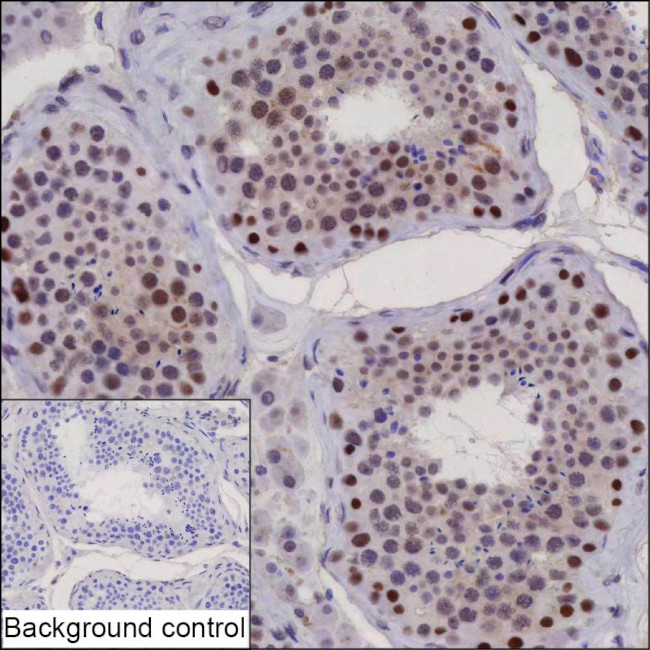
图: 1 / 1
ANKRD26P1 Antibody (MA564426) in IHC (P)
Immunohistochemistry (Paraffin) analysis of ANKRD26P1 in formalin-fixed paraffin-embedded testis tissue. Samples were incubated with ANKRD26P1 recombinant monoclonal (Product # MA564426) using a dilution of 4.9 µg/mL at room temperature for 1 hr followed by Poly-peroxidase conjugated goat anti-mouse IgG. Antigen was retrieved through addition of boiling Tris/EDTA buffer pH 9 in a pressure cooker for 3 min. ... View More
Please note: We are reviewing Western blot images included in the antibody testing data in our catalog, including those provided by third parties. Unless expressly labeled or annotated as “raw-unedited”, Western blot images included in the antibody testing data in our catalog may have been edited, optimized or otherwise adjusted for presentation.

产品信息
MA564426
产品规格
种属反应
Human
宿主/亚型
Mouse
/ IgG2a
Expression System
CHO cells
分类
Recombinant Monoclonal
类型
Antibody
克隆号
K40073_16B3
抗原
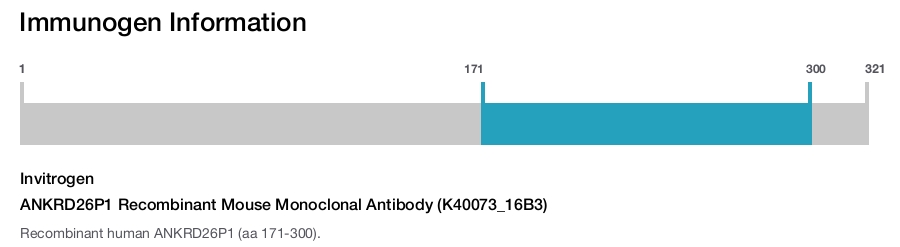
Recombinant human ANKRD26P1 (aa 171-300).
偶联物
Unconjugated
Unconjugated
Unconjugated
形式
Liquid
浓度
1 mg/mL
规格
100 µg
纯化类型
Protein A
保存液
PBS with 0.5% BSA, 50% glycerol
内含物
0.09% sodium azide
保存条件
Maintain refrigerated at 2-8°C for up to 1 month. For long term storage store at -20°C
运输条件
Ambient (domestic); Wet ice (international)
RRID
产品详细信息
Immunogen sequence: HHANIESANK DELTPFLLAV HEQKQQMEDF LRKQKENLTA VKLESIHQVM SEYKENETPR NPQNSNPEGT SNKMACLGEG AAGAKVDEIP GNPVKRLFNK PSIDDSRPMS ANEDFDFDTE EKATEPANGK
Highest antigen sequence identity to the following orthologs: Mouse - 39%, Pig - 46%, Cynomolgus monkey - 95%.
靶标信息
ANKRD26P1 is a pseudogene closely related to the ANKRD26 gene, which is located on chromosome 10 and is characterized by having ankyrin repeat domains. The ANKRD26 gene plays a vital role in signal transduction and is implicated in hematological disorders, including inherited thrombocytopenia. This gene is involved in the regulation of type I cytokine receptor signaling, contributing to the maintenance of blood platelet levels and the immune response. Its mutations are associated with thrombocytopenia 2 (THC2), a condition marked by low platelet counts and an increased risk of developing hematologic malignancies. While ANKRD26 is actively transcribed and translated into a functional protein, ANKRD26P1, being a pseudogene, does not produce a protein product. Pseudogenes like ANKRD26P1 are sequences in the genome that resemble known genes but are typically non-functional due to mutations or lack of regulatory features necessary for expression. The presence of pseudogenes can still be biologically relevant, as they may play roles in gene regulation and evolution despite not encoding proteins.
仅用于科研。不用于诊断过程。未经明确授权不得转售。
篇参考文献 (0)
您是否在文献中引用过该产品?请点击下方按钮邮件告知我们。
生物信息学
Entrez Gene ID: (Human) 124149
Disclaimer

Clicking the images or links will redirect you to a website hosted by BenchSci that provides third-party scientific content. Neither the content nor the BenchSci technology and processes for selection have been evaluated by us; we are providing them as-is and without warranty of any kind, including for use or application of the Thermo Fisher Scientific products presented.

