Search
Invitrogen
ATP7A Polyclonal Antibody
{{$productOrderCtrl.translations['antibody.pdp.commerceCard.promotion.promotions']}}
{{$productOrderCtrl.translations['antibody.pdp.commerceCard.promotion.viewpromo']}}
{{$productOrderCtrl.translations['antibody.pdp.commerceCard.promotion.promocode']}}: {{promo.promoCode}} {{promo.promoTitle}} {{promo.promoDescription}}. {{$productOrderCtrl.translations['antibody.pdp.commerceCard.promotion.learnmore']}}
Additional Information:
{{banner.description}}
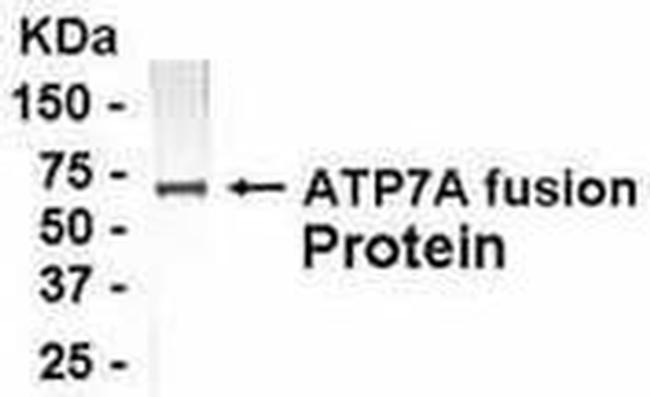
图: 1 / 1
ATP7A Antibody (PA1-20840) in WB
Western blot of ATP7A in E. coli derived fusion protein using an ATP7A polyclonal antibody (Product # PA1-20840) at a dilution of 1:2000 followed by detection using a Goat anti-IgY-HRP secondary antibody at a dilution of 1:1000 and Colorimetric signal development.

产品信息
PA1-20840
产品规格
宿主/亚型
Chicken
/ IgY
分类
Polyclonal
类型
Antibody
抗原
Recombinant fragment, corresponding to amino acids 1407-1500 of Human ATP7A.
偶联物
Unconjugated
Unconjugated
Unconjugated
形式
Liquid
浓度
1 mg/mL
规格
50 µg
保存条件
Store at 4°C short term. For long term storage, store at -20°C, avoiding freeze/thaw cycles.
运输条件
Wet ice
RRID
产品详细信息
PA1-20840 detects ATP7A in human, mouse and rat samples.
PA1-20840 has been successfully used in Western blot procedures.
The PA1-20840 immunogen is a recombinant fragment, corresponding to amino acids 1407-1500 of Human ATP7A..
靶标信息
ATP7A (also known as Copper-transporting ATPase 1) functions as a transmembrane copper-translocating P-type ATPase and plays a vital role in systemic copper absorption in the gut and copper reabsorption in the kidney. Polarized epithelial cells such as Madin-Darby canine kidney cells are a physiologically relevant model for systemic copper absorption and reabsorption in vivo. Although ATP7A is not detectable in most normal tissues, it is expressed in a considerable fraction of many common tumor types. Increased expression of ATP7A renders cells resistant to cisplatin and carboplatin. Mutations in the ATP7A gene result in Menkes disease, which is fatal in early childhood.
仅用于科研。不用于诊断过程。未经明确授权不得转售。
篇参考文献 (0)
您是否在文献中引用过该产品?请点击下方按钮邮件告知我们。
Disclaimer

Clicking the images or links will redirect you to a website hosted by BenchSci that provides third-party scientific content. Neither the content nor the BenchSci technology and processes for selection have been evaluated by us; we are providing them as-is and without warranty of any kind, including for use or application of the Thermo Fisher Scientific products presented.

