Search
Disclaimer

Clicking the images or links will redirect you to a website hosted by BenchSci that provides third-party scientific content. Neither the content nor the BenchSci technology and processes for selection have been evaluated by us; we are providing them as-is and without warranty of any kind, including for use or application of the Thermo Fisher Scientific products presented.
Invitrogen
Adecatumumab Recombinant Human Monoclonal Antibody
{{$productOrderCtrl.translations['antibody.pdp.commerceCard.promotion.promotions']}}
{{$productOrderCtrl.translations['antibody.pdp.commerceCard.promotion.viewpromo']}}
{{$productOrderCtrl.translations['antibody.pdp.commerceCard.promotion.promocode']}}: {{promo.promoCode}} {{promo.promoTitle}} {{promo.promoDescription}}. {{$productOrderCtrl.translations['antibody.pdp.commerceCard.promotion.learnmore']}}


产品信息
MA5-41784
产品规格
种属反应
Human
宿主/亚型
Human
/ IgG1
Expression System
CHO cells
分类
Recombinant Monoclonal
类型
Antibody
抗原
Human EPCAM
偶联物
形式
Liquid
浓度
3.09 mg/mL
纯化类型
Protein A/G
保存液
0.94mM citric acid/16.7mM sodium citrate/PBS, pH 6.5, with 0.01% Tween 80, 6.2% sucrose
内含物
no preservative
保存条件
-20°C, Avoid Freeze/Thaw Cycles
运输条件
Ambient (domestic); Wet ice (international)
RRID
产品详细信息
Endotoxin level < 0.01EU/µg by LAL method
Use a manual defrost freezer and avoid repeated freeze thaw cycles. Store at 2 to 8 °C for one week. Store at -20 to -80 °C for twelve months from the date of receipt.
靶标信息
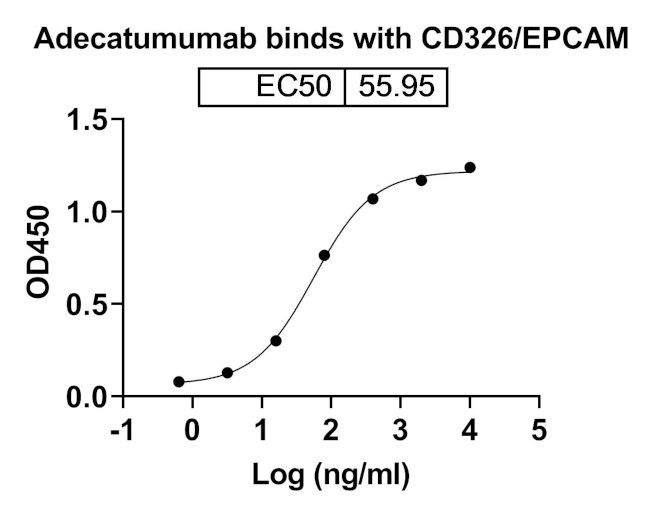
Adecatumumab is a recombinant human monoclonal antibody of the IgG1 subclass with a binding specificity to epithelial cell adhesion molecule (EpCAM). EpCAM (CD326) is a cell surface protein that is frequently expressed at high level on most solid tumor types, including prostate, breast, colon, gastric, ovarian, pancreatic and lung cancer. Adecatumumab (MT201) is a recombinant human monoclonal antibody of the IgG1 subclass with a binding specificity to epithelial cell adhesion molecule (EpCAM). EpCAM (CD326) is a cell surface protein that is frequently expressed at high level on most solid tumor types, including prostate, breast, colon, gastric, ovarian, pancreatic and lung cancer. Overexpression of EpCAM has been shown to promote the proliferation, migration and invasiveness of breast cancer cells. Moreover, expression of EpCAM is associated with decreased survival in a number of cancer indications, including breast, gall bladder, bile duct, ovarian and ampullary pancreatic cancer. EpCAM has recently been shown to be expressed on cancer stem cells from breast, prostate, colon and pancreatic cancer. Clinical studies have shown a favorable safety profile and that clinical activity depends on the EpCAM target expression.
仅用于科研。不用于诊断过程。未经明确授权不得转售。
篇参考文献 (0)
您是否在文献中引用过该产品?请点击下方按钮邮件告知我们。

