Search
Invitrogen
BRD4 Recombinant Mouse Monoclonal Antibody (23476)
{{$productOrderCtrl.translations['antibody.pdp.commerceCard.promotion.promotions']}}
{{$productOrderCtrl.translations['antibody.pdp.commerceCard.promotion.viewpromo']}}
{{$productOrderCtrl.translations['antibody.pdp.commerceCard.promotion.promocode']}}: {{promo.promoCode}} {{promo.promoTitle}} {{promo.promoDescription}}. {{$productOrderCtrl.translations['antibody.pdp.commerceCard.promotion.learnmore']}}
Additional Information:
{{banner.description}}
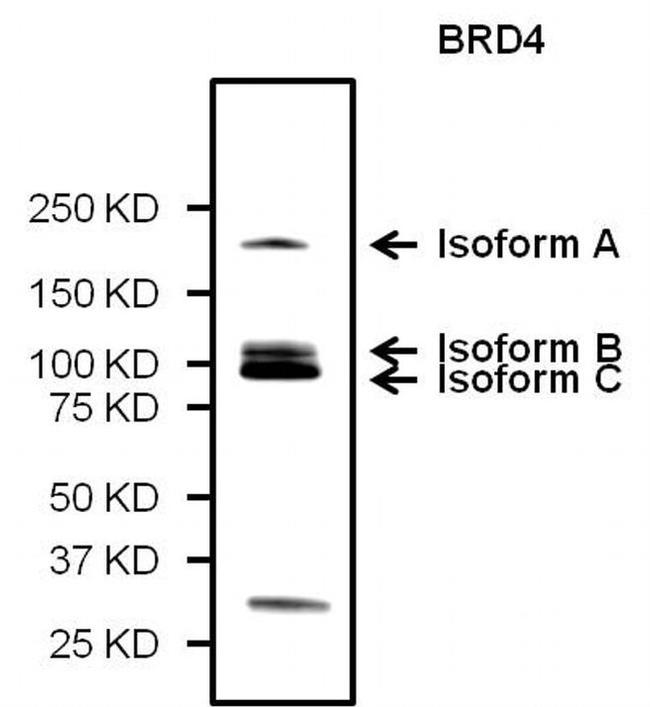
图: 1 / 3
BRD4 Antibody (730007) in WB
J-Lat Full Length cell lysate 40 µg was loaded on 4-15% gel and transferred to 0.45 µm PVDF Membrane. BRD4 Monoclonal Antibody (Product # 730007) was diluted at 1:500 in 1xTBST buffer with 5% non fat milk and incubated overnight at 4C. Goat anti-mouse HRP-conjugated secondary antibody was diluted at 1:2000 in 1xTBST buffer with 5% non fat milk and incubated for 1 hour at 21C.


产品信息
730007
应用
建议稀释比
已发表文章
产品规格
已发表种属
Human
宿主/亚型
Mouse
/ IgG1
分类
Recombinant Monoclonal
类型
Antibody
克隆号
23476
抗原
333-460 of 1362 of BRD4 Protein.
偶联物
Unconjugated
Unconjugated
Unconjugated
形式
Liquid
浓度
0.5 mg/mL
规格
100 µg
保存条件
Maintain refrigerated at 2-8°C for up to 1 month. For long term storage store at -20°C
运输条件
Wet ice
RRID
产品详细信息
Recombinant antibodies are produced using specific genes that code for the desired antibodies. These genes are cloned into an expression vector and expressed in vitro. The advantages of recombinant antibodies include: better specificity, animal origin-free formulation, and more lot-to-lot consistency.
靶标信息
BRD4, a ubiquitously expressed nuclear phosphoprotein, is a member of BET protein family. It is a human homolog of mouse MCAP and consists of 2 N-terminal bromodomains, a central ET-domain, and several kinase-like motifs in its N-terminus. It is expressed as 2 isoforms; the longer variant has a C-terminus region with a praline and glutamine-rich domains. BRD4 is a chromatin-binding protein whose expression is induced in response to growth stimuli. BRD4 acts at different stages of the cell cycle by interacting with proteins including RFC and SPA-1 and regulates cell growth. It also has a role in regulating chromosomal dynamics during mitosis. BRD4 functions as a cellular target for E2 protein of papillomavirus.
仅用于科研。不用于诊断过程。未经明确授权不得转售。
Disclaimer

Clicking the images or links will redirect you to a website hosted by BenchSci that provides third-party scientific content. Neither the content nor the BenchSci technology and processes for selection have been evaluated by us; we are providing them as-is and without warranty of any kind, including for use or application of the Thermo Fisher Scientific products presented.

