Search
Proteintech
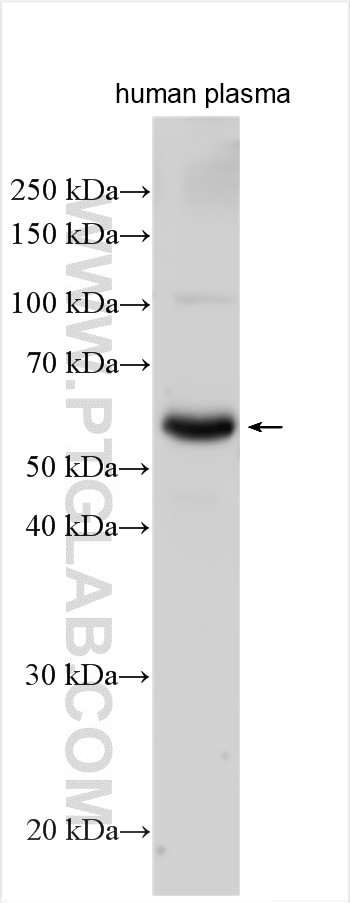
C9 Polyclonal Antibody
{{$productOrderCtrl.translations['antibody.pdp.commerceCard.promotion.promotions']}}
{{$productOrderCtrl.translations['antibody.pdp.commerceCard.promotion.viewpromo']}}
{{$productOrderCtrl.translations['antibody.pdp.commerceCard.promotion.promocode']}}: {{promo.promoCode}} {{promo.promoTitle}} {{promo.promoDescription}}. {{$productOrderCtrl.translations['antibody.pdp.commerceCard.promotion.learnmore']}}
Additional Information:
{{banner.description}}

产品信息
25891-1-AP
产品规格
种属反应
Human
宿主/亚型
Rabbit
/ IgG
分类
Polyclonal
类型
Antibody
抗原
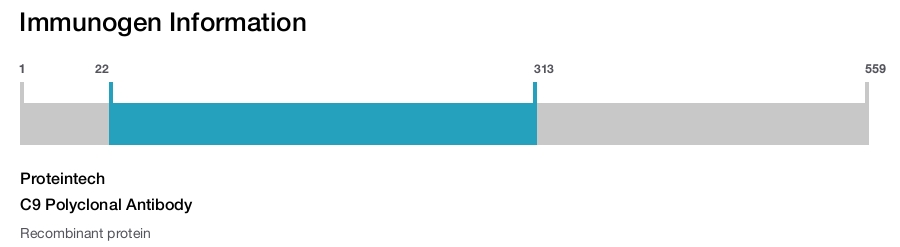
Recombinant protein
偶联物
形式
Liquid
纯化类型
Antigen affinity chromatography
保存液
PBS with 50% glycerol
内含物
0.02% sodium azide
保存条件
-20°C
运输条件
Wet ice
产品详细信息
Immunogen sequence: QYTTSYDPEL TESSGSASHI DCRMSPWSEW SQCDPCLRQM FRSRSIEVFG QFNGKRCTDA VGDRRQCVPT EPCEDAEDDC GNDFQCSTGR CIKMRLRCNG DNDCGDFSDE DDCESEPRPP CRDRVVEESE LARTAGYGIN ILGMDPLSTP FDNEFYNGLC NRDRDGNTLT YYRRPWNVAS LIYETKGEKN FRTEHYEEQI EAFKSIIQEK TSNFNAAISL KFTPTETNKA EQCCEETASS ISLHGKGSFR FSYSKNETYQ LFLSYSSKKE KMFLHVKGEI HLGRFVMRNR DV
靶标信息
C5b-9 membrane attack complexes are assembled from five precursor molecules in the serum. Proteolytic cleavage of C5 by C5 convertase generates C5b which initiates assembly of the C5b-9 complex. The last step of C5b-9 complex formation involves polymerization of C9 which accompanies insertion of the complex into the cell membrane. During formation of C5b-8 and C9 polymerization, neoantigens are generated which are unique to the C5b-9 complex and are not present on any of the individual native complex components. The complement regulatory proteins CD59 and complement S-protein can both prevent C5b-9 insertion into the cell membrane. The formed SC5b-9 complex is unable to attach to cells and is cytolytically inactive. C5b-9 is involved in the progression of chronic proteinuric renal disease by mediating continuous tubulointerstitial damage. Early tubulointerstitial injury in the remnant kidney can be improved when C5b-9 complex forming is abrogated.
仅用于科研。不用于诊断过程。未经明确授权不得转售。
篇参考文献 (0)
您是否在文献中引用过该产品?请点击下方按钮邮件告知我们。
生物信息学
蛋白别名: C9 complement protein; complement component 9; Complement component C9; unnamed protein product
基因别名: ARMD15; C9; C9D
UniProt ID: (Human) P02748
Entrez Gene ID: (Human) 735
cell killing
immune system process
immune response
complement activation
complement activation, alternative pathway
complement activation, classical pathway
killing of cells of other organism
innate immune response
positive regulation of immune response
protein homooligomerization
complement activation, GZMK pathway
Disclaimer

Clicking the images or links will redirect you to a website hosted by BenchSci that provides third-party scientific content. Neither the content nor the BenchSci technology and processes for selection have been evaluated by us; we are providing them as-is and without warranty of any kind, including for use or application of the Thermo Fisher Scientific products presented.

