Search
Invitrogen
CD138 Polyclonal Antibody
{{$productOrderCtrl.translations['antibody.pdp.commerceCard.promotion.promotions']}}
{{$productOrderCtrl.translations['antibody.pdp.commerceCard.promotion.viewpromo']}}
{{$productOrderCtrl.translations['antibody.pdp.commerceCard.promotion.promocode']}}: {{promo.promoCode}} {{promo.promoTitle}} {{promo.promoDescription}}. {{$productOrderCtrl.translations['antibody.pdp.commerceCard.promotion.learnmore']}}
Additional Information:
{{banner.description}}


产品信息
PA1-21165
产品规格
宿主/亚型
Rabbit
/ IgG
分类
Polyclonal
类型
Antibody
抗原
Recombinant fragment, corresponding to N terminal amino acids 18-218 of Human Syndecan.
偶联物
Unconjugated
Unconjugated
Unconjugated
形式
Liquid
浓度
0.2 mg/mL
规格
100 µg
保存条件
4°C, do not freeze
运输条件
Wet ice
RRID
产品详细信息
PA1-21165 detects Syndecan in Human samples.
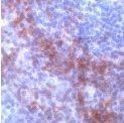
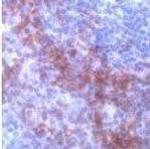
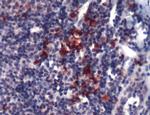
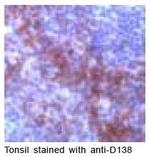
PA1-21165 has been successfully used in Immunohistochemistry (Paraffin) procedures. Staining of formalin-fixed tissues requires boiling tissue sections in 10 mM citratee buffer, pH 6.0 for 10 minutes followed by cooling at room temperature for 20 minutes.
PA1-21165 immunogen corresponds to Recombinant fragment, corresponding to N terminal amino acids 18-218 of Human Syndecan..
靶标信息
CD138 (syndecan 1) is a transmembrane proteoglycan that can bind a variety of cytokines and modulate their activity, as well as the activity of extracellular matrix components and influence many developmental processes. CD138 is expressed mainly in differentiating keratinocytes and is transiently upregulated in all layers of the epidermis upon tissue injury. It is also highly expressed on plasma cells and can be detected even on fibroblasts, vascular smooth muscle cells and endothelial cells. Up-regulation and down-regulation of CD138 on the cell surface often correlates with the gain of cancerous characteristics. Serum levels of the shedded soluble sCD138 are used as a prognostic factor of cancerogenesis.
仅用于科研。不用于诊断过程。未经明确授权不得转售。
篇参考文献 (0)
您是否在文献中引用过该产品?请点击下方按钮邮件告知我们。
Disclaimer

Clicking the images or links will redirect you to a website hosted by BenchSci that provides third-party scientific content. Neither the content nor the BenchSci technology and processes for selection have been evaluated by us; we are providing them as-is and without warranty of any kind, including for use or application of the Thermo Fisher Scientific products presented.

