Search
Disclaimer

Clicking the images or links will redirect you to a website hosted by BenchSci that provides third-party scientific content. Neither the content nor the BenchSci technology and processes for selection have been evaluated by us; we are providing them as-is and without warranty of any kind, including for use or application of the Thermo Fisher Scientific products presented.
Invitrogen
CD202b (TIE2) Monoclonal Antibody (33.1), eBioscience™
{{$productOrderCtrl.translations['antibody.pdp.commerceCard.promotion.promotions']}}
{{$productOrderCtrl.translations['antibody.pdp.commerceCard.promotion.viewpromo']}}
{{$productOrderCtrl.translations['antibody.pdp.commerceCard.promotion.promocode']}}: {{promo.promoCode}} {{promo.promoTitle}} {{promo.promoDescription}}. {{$productOrderCtrl.translations['antibody.pdp.commerceCard.promotion.learnmore']}}
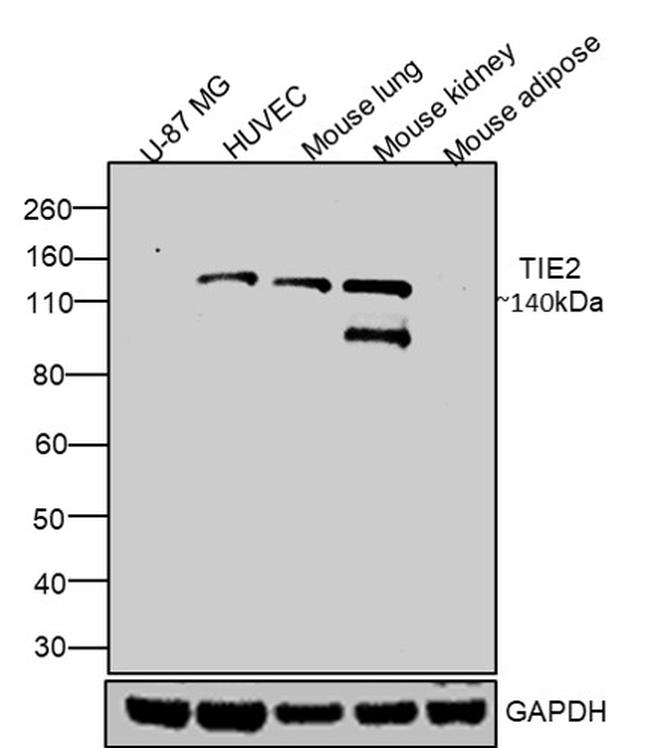
图: 1 / 2
CD202b (TIE2) Antibody (14-2029-80) in WB
Western blot was performed using CD202b (TIE2) Monoclonal Antibody (33.1), eBioscience™ (Product # 14-2029-82) and a 140 kDa band corresponding to TEK/TIE2 was observed across cell lines and tissues tested except U-87 MG and Mouse adipose which are reported to be negative. Whole cell extracts (30 µg lysate) of U-87 MG (Lane 1), HUVEC (Lane 2), Mouse lung (Lane 3), Mouse kidney (Lane 4), Mouse adipose (Lane 5) were electrophoresed using NuPAGE® 4-12 % Bis-Tris gel (Product # NP0321BOX). Resolved proteins were then transferred onto a nitroce... View More


产品信息
14-2029-80
产品规格
已发表种属
Mouse
宿主/亚型
Mouse
/ IgG1, kappa
分类
Monoclonal
类型
Antibody
克隆号
33.1
偶联物
形式
Liquid
浓度
0.5 mg/mL
保存条件
4°C
运输条件
Wet ice
RRID
产品详细信息
Description: This 33.1 monoclonal antibody reacts with human, mouse, rabbit, rat, pig, and zebrafish CD202b. Also known as Tie-2, this molecule is a member of the tyrosine kinase receptor family. CD202b is expressed on endothelial and a subset of hematopoietic cells and is believed to play a role in both angiogenesis and hematopoiesis during development of the mouse embryo. In fetal liver and adult bone marrow, Tie-2 is expressed by a subpopulation of hematopoietic progenitor cells characterized as Lineage markers-, c-Kit+, Sca1+ cells. Long-term multilineage repopulating cells were detected in Tie-2+, Lineage-, c-Kit+, Sca1+ cells but not in Tie-2-, Lineage-, c-Kit+, Sca1+ cells.
Applications Reported: This 33.1 antibody has been reported for use in western blotting.
Applications Tested: This 33.1 antibody has been tested by immunoblotting of reduced cell lysate prepared from the bEND3 cell line at less than or equal to 5 µg/mL. It is recommended that the antibody be carefully titrated for optimal performance in the assay of interest.
Purity: Greater than 90%, as determined by SDS-PAGE.
Aggregation: Less than 10%, as determined by HPLC.
Filtration: 0.2 µm post-manufacturing filtered.
靶标信息
The TEK receptor tyrosine kinase is expressed almost exclusively in endothelial cells. TEK signaling appears to be critical for endothelial cell-smooth muscle cell communication in venous morphogenesis, and defects in TEK are associated with inherited venous malformations. The ligand angiopoietin-1 binds to this receptor and mediates a signaling pathway that functions in embryonic vascular development. Immunoblotting showed that TIE2 expression was increased by thyroid-stimulating hormone and agents that increased intracellular cAMP. HSCs expressing the receptor tyrosine kinase TIE2 are quiescent and antiapoptotic and comprise a side population of HSCs that adhere to osteoblasts in the bone marrow niche.
仅用于科研。不用于诊断过程。未经明确授权不得转售。

