Search
Disclaimer

Clicking the images or links will redirect you to a website hosted by BenchSci that provides third-party scientific content. Neither the content nor the BenchSci technology and processes for selection have been evaluated by us; we are providing them as-is and without warranty of any kind, including for use or application of the Thermo Fisher Scientific products presented.
Invitrogen
CD254 (RANK Ligand) Polyclonal Antibody
{{$productOrderCtrl.translations['antibody.pdp.commerceCard.promotion.promotions']}}
{{$productOrderCtrl.translations['antibody.pdp.commerceCard.promotion.viewpromo']}}
{{$productOrderCtrl.translations['antibody.pdp.commerceCard.promotion.promocode']}}: {{promo.promoCode}} {{promo.promoTitle}} {{promo.promoDescription}}. {{$productOrderCtrl.translations['antibody.pdp.commerceCard.promotion.learnmore']}}
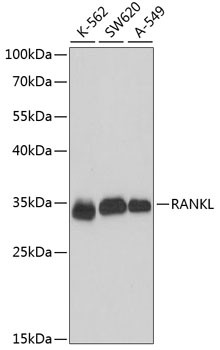
图: 1 / 1
CD254 (RANK Ligand) Antibody (PA5-120439) in WB
Western blot analysis of CD254 (RANK Ligand) in extracts of various cell lines. Samples were incubated with CD254 (RANK Ligand) Polyclonal antibody (Product # PA5-120439) using a dilution of 1:500, followed by HRP Goat Anti-Rabbit IgG (H+L) at a dilution of 1:10,000. Lysates/proteins: 25 µg per lane. Blocking buffer: 3% nonfat dry milk in TBST. Detection: ECL Basic Kit. Exposure time: 5 min.

产品信息
PA5-120439
产品规格
宿主/亚型
Rabbit
/ IgG
分类
Polyclonal
类型
Antibody
抗原
Recombinant fusion protein containing a sequence corresponding to amino acids 78-317 of human RANKL (NP_003692.1).
偶联物
形式
Liquid
浓度
0.04 mg/mL
保存条件
-20°C, Avoid Freeze/Thaw Cycles
运输条件
Ambient (domestic); Wet ice (international)
RRID
产品详细信息
Positive test controls include: K-562, SW620, A-549. The target is usually found in the following locations: Cell membrane, Cytoplasm, Secreted, Single-pass type II membrane protein, Single-pass type II membrane protein.
Immunogen sequence: RISEDGTHCI YRILRLHENA DFQDTTLESQ DTKLIPDSCR RIKQAFQGAV QKELQHIVGS QHIRAEKAMV DGSWLDLAKR SKLEAQPFAH LTINATDIPS GSHKVSLSSW YHDRGWAKIS NMTFSNGKLI VNQDGFYYLY ANICFRHHET SGDLATEYLQ LMVYVTKTSI KIPSSHTLMK GGSTKYWSGN SEFHFYSINV GGFFKLRSGE EISIEVSNPS LLDPDQDATY FGAFKVRDID
靶标信息
This gene encodes a member of the tumor necrosis factor (TNF) cytokine family which is a ligand for osteoprotegerin and functions as a key factor for osteoclast differentiation and activation. This protein was shown to be a dentritic cell survival factor and is involved in the regulation of T cell-dependent immune response. T cell activation was reported to induce expression of this gene and lead to an increase of osteoclastogenesis and bone loss. This protein was shown to activate antiapoptotic kinase AKT/PKB through a signaling complex involving SRC kinase and tumor necrosis factor receptor-associated factor (TRAF) 6, which indicated this protein may have a role in the regulation of cell apoptosis. Targeted disruption of the related gene in mice led to severe osteopetrosis and a lack of osteoclasts. The deficient mice exhibited defects in early differentiation of T and B lymphocytes, and failed to form lobulo-alveolar mammary structures during pregnancy. Two alternatively spliced transcript variants have been found.
仅用于科研。不用于诊断过程。未经明确授权不得转售。
篇参考文献 (0)
您是否在文献中引用过该产品?请点击下方按钮邮件告知我们。

