Search
Disclaimer

Clicking the images or links will redirect you to a website hosted by BenchSci that provides third-party scientific content. Neither the content nor the BenchSci technology and processes for selection have been evaluated by us; we are providing them as-is and without warranty of any kind, including for use or application of the Thermo Fisher Scientific products presented.
Invitrogen
CD262 (DR5) Monoclonal Antibody (DJR2-4 (7-8)), eBioscience™
{{$productOrderCtrl.translations['antibody.pdp.commerceCard.promotion.promotions']}}
{{$productOrderCtrl.translations['antibody.pdp.commerceCard.promotion.viewpromo']}}
{{$productOrderCtrl.translations['antibody.pdp.commerceCard.promotion.promocode']}}: {{promo.promoCode}} {{promo.promoTitle}} {{promo.promoDescription}}. {{$productOrderCtrl.translations['antibody.pdp.commerceCard.promotion.learnmore']}}
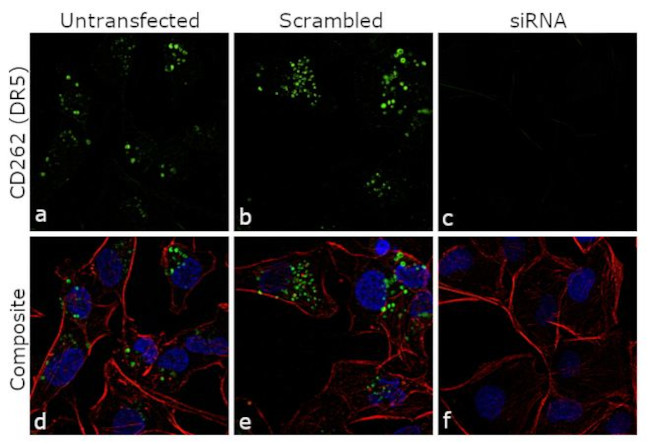
图: 1 / 15
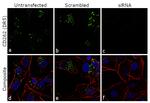
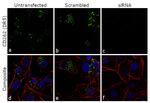
CD262 (DR5) Antibody (14-9908-80) in ICC/IF
Knockdown of CD262 (DR5) was achieved by transfecting MDA-MB-231 cells with CD262 (DR5) specific siRNA (Silencer® select Product # s16756). Immunofluorescence analysis was performed using untransfected MDA-MB-231 cells (panels a, d), transfected with non-specific scrambled siRNA (panels b,e) and transfected with CD262 (DR5) specific siRNAs (panel c,f). Cells were fixed, permeabilized, and probed with CD262 ... View More
-Flow-20170216130641.jpg?time=20220826)
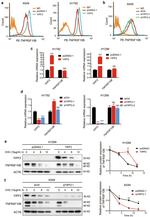
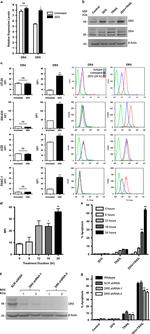
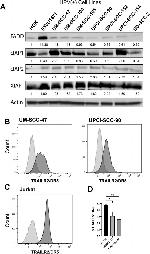
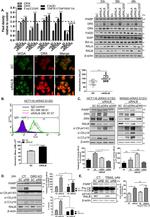
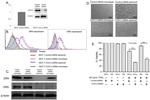
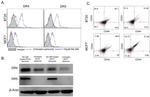
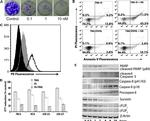
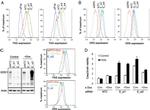
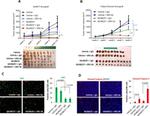
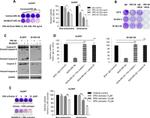


-Flow-20170216130641.jpg?time=20220826?time=20220826 "CD262 (DR5) Antibody (14-9908-80) in Flow")


产品信息
14-9908-80
应用
建议稀释比
已发表文章
产品规格
已发表种属
Human
宿主/亚型
Mouse
/ IgG1, kappa
分类
Monoclonal
类型
Antibody
克隆号
DJR2-4 (7-8)
偶联物
形式
Liquid
浓度
0.5 mg/mL
保存条件
4°C
运输条件
Wet ice
RRID
产品详细信息
Description: The DJR2-4 monoclonal antibody reacts with human DR5, also known as TRAIL-R2, Apo2, TRICK2 and KILLER. DR5 binds to TRAIL, activates NF-kappaB, and induces TRAIL-mediated apoptosis. DR5 is expressed broadly by normal tissues as well as several tumor cells.
Applications Reported: The DJR2-4 (a.k.a. 7-8) antibody has been reported for use in flow cytometric analysis.
Applications Tested: The DJR2-4 (a.k.a. 7-8) antibody has been tested by flow cytometric analysis of human MOLT-4 cell line and human DR5-transfected cells. This can be used at less than or equal to 1 µg per test. A test is defined as the amount (µg) of antibody that will stain a cell sample in a final volume of 100 µL. Cell number should be determined empirically but can range from 10^5 to 10^8 cells/test. It is recommended that the antibody be carefully titrated for optimal performance in the assay of interest.
Purity: Greater than 90%, as determined by SDS-PAGE.
Aggregation: Less than 10%, as determined by HPLC.
Filtration: 0.2 µm post-manufacturing filtered.
靶标信息
DR5 (Apo2, TRAIL-R2, TRICK2, KILLER) is a recently identified death domain containing receptor for TRAIL, which mediates TRAIL induced apoptosis. DR5 is a member of the TNF-receptor superfamily, and contains an intracellular death domain. DR5 can be activated by tumor necrosis factor-related apoptosis inducing ligand (TNFSF10/TRAIL/APO-2L), and transduces an apoptosis signal. Studies with FADD-deficient mice suggested that FADD, a death domain containing adaptor protein, is required for the apoptosis mediated by DR5. Two transcript variants encoding different isoforms of DR5 and one non-coding transcript have been found. Overexpression of DR5 induces apoptosis and activates NF-kappa-B. DR5 is expressed in a number of cell types, and to particularly high levels in lymphocytes and spleen. Diseases associated with DR5 dysfunction include squamous cell carcinoma, and diffuse infiltrative lymphocytosis syndrome.
仅用于科研。不用于诊断过程。未经明确授权不得转售。

