Search
Rockland
CDK4 Polyclonal Antibody
{{$productOrderCtrl.translations['antibody.pdp.commerceCard.promotion.promotions']}}
{{$productOrderCtrl.translations['antibody.pdp.commerceCard.promotion.viewpromo']}}
{{$productOrderCtrl.translations['antibody.pdp.commerceCard.promotion.promocode']}}: {{promo.promoCode}} {{promo.promoTitle}} {{promo.promoDescription}}. {{$productOrderCtrl.translations['antibody.pdp.commerceCard.promotion.learnmore']}}
Additional Information:
{{banner.description}}
产品信息
100-401-162
产品规格
种属反应
Human,
Mouse,
Rat
宿主/亚型
Rabbit
/ IgG
分类
Polyclonal
类型
Antibody
抗原
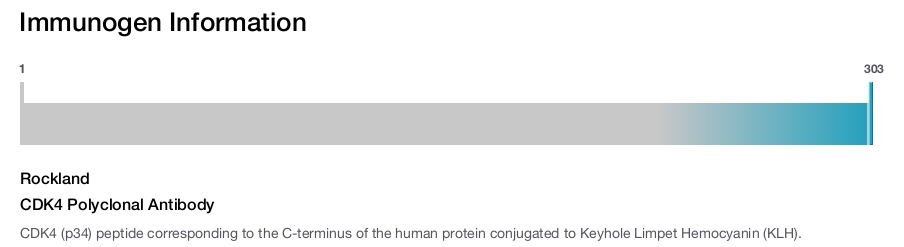
CDK4 (p34) peptide corresponding to the C-terminus of the human protein conjugated to Keyhole Limpet Hemocyanin (KLH).
偶联物
形式
Liquid
浓度
85 mg/mL
规格
8.5 mg
保存液
whole serum
内含物
0.01% sodium azide
保存条件
-20°C, Avoid Freeze/Thaw Cycles
运输条件
Ambient (domestic); Wet ice (international)
产品详细信息
Store vial at -20° C prior to opening. Aliquot contents and freeze at -20° C or below for extended storage. Avoid cycles of freezing and thawing. Centrifuge product if not completely clear after standing at room temperature. This product is stable for several weeks at 4° C as an undiluted liquid. Dilute only prior to immediate use.
Antiserum will specifically react with a 34 kDa cdk4 (p34) protein from human, rat and mouse tissue. No reaction was observed against other related cyclin dependent kinases. Cross reactivity with cdk4 (p34) from other species has not been determined.
靶标信息
CDK4/cyclin D3 serine/threonine kinase is dimeric protein complex. CDK4 is a member of the cyclin-dependent protein kinase family and is involved in the control of cell proliferation during the G1 phase of cell cycle. CDK4 forms a complex with the D-type cyclins and is inhibited by p16 (cyclin-dependent kinase inhibitor-2). CDK4 can mediate phosphorylation of the C-terminal region of Rb protein leading to an active transcriptional repression of E2F complex. CDC37 and HSP90 can preferentially associate with the fraction of CDK4 not bound to D-type cyclins. SMAD3 is a major physiologic substrate of the G1 cyclin-dependent kinases CDK4 and CDK2. Although CDK6 and CDK4 can both phosphorylate multiple residues in the Rb protein, they do so with different residue selectivity in vitro; CDK6 phosphorylates Thr821 while CDK4 phosphorylates Thr826 on Rb protein.
仅用于科研。不用于诊断过程。未经明确授权不得转售。
篇参考文献 (0)
您是否在文献中引用过该产品?请点击下方按钮邮件告知我们。
生物信息学
蛋白别名:
CDK4; Cell division protein kinase 4; CRK3; cyclin dependent kinase 4; Cyclin-dependent kinase 4; MGC14458; orf; p34
基因别名: CDK4; CMM3; Crk3; PSK-J3
UniProt ID: (Human) P11802, (Rat) P35426, (Mouse) P30285
Entrez Gene ID: (Human) 1019, (Rat) 94201, (Mouse) 12567
nucleotide binding
protein kinase activity
protein serine/threonine kinase activity
cyclin-dependent protein serine/threonine kinase activity
protein binding
ATP binding
kinase activity
cyclin-dependent protein serine/threonine kinase regulator activity
transferase activity
cyclin binding
protein serine kinase activity
protein complex binding
transferase activity, transferring phosphorus-containing groups
non-receptor serine/threonine protein kinase
G1/S transition of mitotic cell cycle
signal transduction
positive regulation of cell proliferation
response to xenobiotic stimulus
regulation of G2/M transition of mitotic cell cycle
regulation of gene expression
positive regulation of G2/M transition of mitotic cell cycle
positive regulation of fibroblast proliferation
cell division
regulation of cell cycle
regulation of transcription initiation from RNA polymerase II promoter
regulation of type B pancreatic cell proliferation
cellular response to lipopolysaccharide
cellular response to interleukin-4
cellular response to phorbol 13-acetate 12-myristate
cellular response to ionomycin
lens development in camera-type eye
protein phosphorylation
circadian rhythm
response to toxic substance
response to organic substance
response to lead ion
organ regeneration
response to testosterone
regulation of cell proliferation
response to drug
positive regulation of apoptotic process
positive regulation of translation
positive regulation of cell size
response to hyperoxia
negative regulation of cell cycle arrest
cell cycle
phosphorylation
Disclaimer

Clicking the images or links will redirect you to a website hosted by BenchSci that provides third-party scientific content. Neither the content nor the BenchSci technology and processes for selection have been evaluated by us; we are providing them as-is and without warranty of any kind, including for use or application of the Thermo Fisher Scientific products presented.

