Search
Bioss
CEP104 Polyclonal Antibody
{{$productOrderCtrl.translations['antibody.pdp.commerceCard.promotion.promotions']}}
{{$productOrderCtrl.translations['antibody.pdp.commerceCard.promotion.viewpromo']}}
{{$productOrderCtrl.translations['antibody.pdp.commerceCard.promotion.promocode']}}: {{promo.promoCode}} {{promo.promoTitle}} {{promo.promoDescription}}. {{$productOrderCtrl.translations['antibody.pdp.commerceCard.promotion.learnmore']}}
Additional Information:
{{banner.description}}
产品信息
BS-12283R
应用
建议稀释比
已发表文章
产品规格
种属反应
Human,
Mouse,
Rat
宿主/亚型
Rabbit
/ IgG
分类
Polyclonal
类型
Antibody
抗原
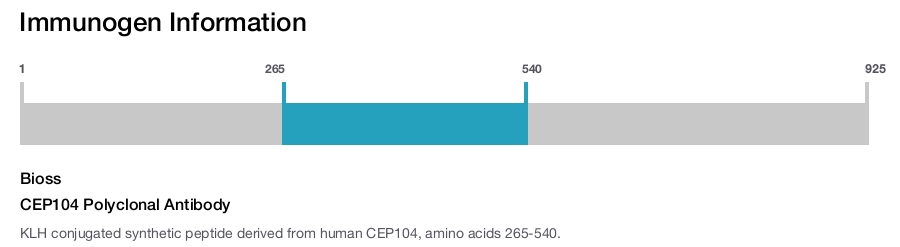
KLH conjugated synthetic peptide derived from human CEP104, amino acids 265-540.
偶联物
形式
Liquid
浓度
1 mg/mL
规格
100 µg
纯化类型
Protein A
保存液
0.01M TBS, pH 7.4, with 1% BSA, 50% glycerol
内含物
0.02% ProClin 300
保存条件
-20°C
运输条件
Ambient (domestic); Wet ice (international)
靶标信息
Chromosome 1 is the largest human chromosome spanning about 260 million base pairs and making up 8% of the human genome. There are about 3,000 genes on chromosome 1, and considering the great number of genes there are also a large number of diseases associated with chromosome 1. Notably, the rare aging disease Hutchinson-Gilford progeria is associated with the LMNA gene which encodes lamin A. When defective, the LMNA gene product can build up in the nucleus and cause characteristic nuclear blebs. The mechanism of rapidly enhanced aging is unclear and is a topic of continuing exploration. The MUTYH gene is located on chromosome 1 and is partially responsible for familial adenomatous polyposis. Stickler syndrome, Parkinsons, Gaucher disease and Usher syndrome are also associated with chromosome 1. A breakpoint has been identified in 1q which disrupts the DISC1 gene and is linked to schizophrenia. Aberrations in chromosome 1 are found in a variety of cancers including head and neck cancer, malignant melanoma and multiple myeloma. The KIAA0562 gene product has been provisionally designated KIAA0562 pending further characterization.
仅用于科研。不用于诊断过程。未经明确授权不得转售。
篇参考文献 (0)
您是否在文献中引用过该产品?请点击下方按钮邮件告知我们。
生物信息学
蛋白别名: centrosomal protein 104kDa; Centrosomal protein of 104 kDa; Cep104; Gly-, L-Glu and TCP-binding protein; Glycine-, glutamate- and thienylcyclohexylpiperidine-binding protein; glycine-, glutamate-, thienylcyclohexylpiperidine-binding protein; likely ortholog of H. sapiens glycine-, glutamate-, thienylcyclohexylpiperidine-binding protein; unnamed protein product
基因别名: A930027E11; AI115523; CEP104; CFAP256; GlyBP; JBTS25; KIAA0562; mKIAA0562; MRT77; ROC22
UniProt ID: (Human) O60308, (Rat) D3Z8X7, (Mouse) Q80V31
Entrez Gene ID: (Human) 9731, (Rat) 246295, (Mouse) 230967
Disclaimer

Clicking the images or links will redirect you to a website hosted by BenchSci that provides third-party scientific content. Neither the content nor the BenchSci technology and processes for selection have been evaluated by us; we are providing them as-is and without warranty of any kind, including for use or application of the Thermo Fisher Scientific products presented.

