Search
Abnova
CNNM3 Polyclonal Antibody, MaxPab™
{{$productOrderCtrl.translations['antibody.pdp.commerceCard.promotion.promotions']}}
{{$productOrderCtrl.translations['antibody.pdp.commerceCard.promotion.promocode']}}: {{promo.promoCode}} {{promo.promoTitle}} {{promo.promoDescription}}. {{$productOrderCtrl.translations['antibody.pdp.commerceCard.promotion.learnmore']}}
{{$ctrl.translations['antibody.pdp.skuNotes.additionalInformation']}}:
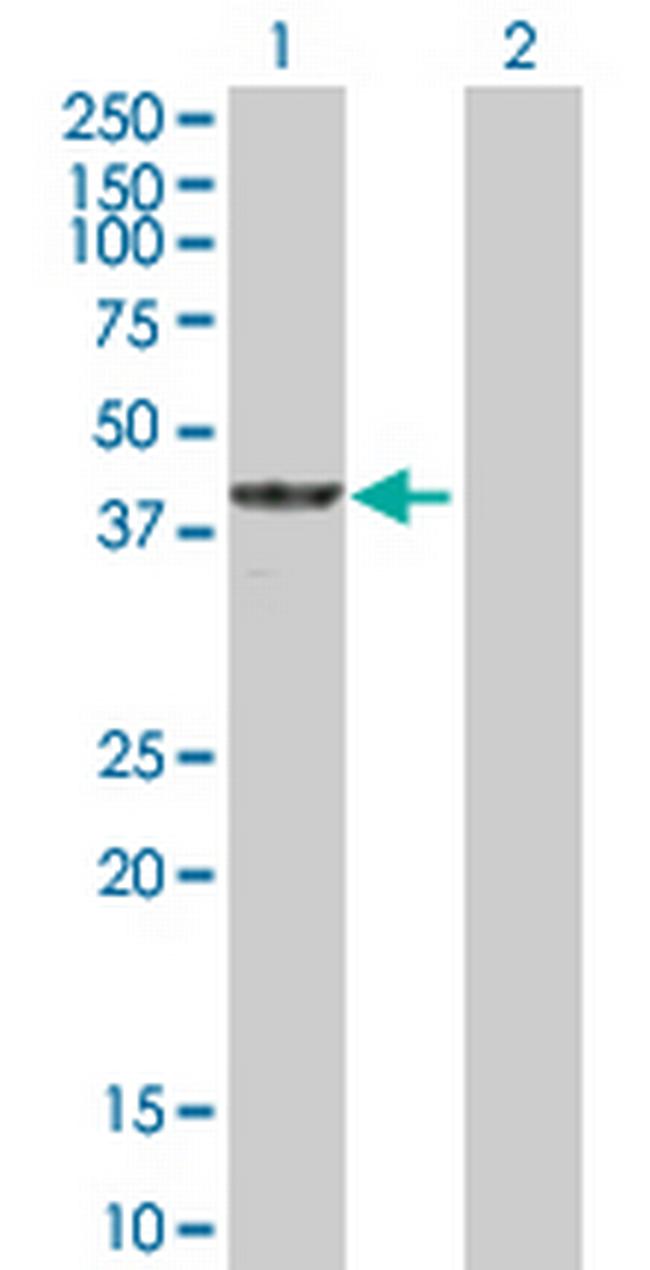
Please note: We are reviewing Western blot images included in the antibody testing data in our catalog, including those provided by third parties. Unless expressly labeled or annotated as “raw-unedited”, Western blot images included in the antibody testing data in our catalog may have been edited, optimized or otherwise adjusted for presentation.

产品信息
H00026505-B01P
产品规格
种属反应
Human
宿主/亚型
Mouse
/ IgG
分类
Polyclonal
类型
Antibody
抗原
CNNM3 (AAH07199, 1 a.a. approximately 355 a.a) full-length human protein.
偶联物
Unconjugated
Unconjugated
Unconjugated
形式
Liquid
浓度
0.5-1 mg/mL
规格
50 µg
纯化类型
Protein A
保存液
PBS, pH 7.4
内含物
no preservative
保存条件
-20°C, Avoid Freeze/Thaw Cycles
运输条件
Ambient (domestic); Wet ice (international)
产品详细信息
Product may be used with Western Blot (Transfected lysate).
The Isotype of this product is composed of an IgG Mixture.
Immunogen sequence: MLDASTVLDF GVLASIMQSG HTRIPVYEEE RSNIVDMLYL KDLAFVDPED CTPLSTITRF YNHPLHFVFN DTKLDAVLEE FKRGDTVVKR KPASLMAPLK RKEEFSLFKV SDDEYKVTIS PQLLLATQRF LSREVDVFSP LRISEKVLLH LLKHPSVNQE VRFDESNRLA THHYLYQRSQ PVDYFILILQ GRVEVEIGKE GLKFENGAFT YYGVSALTVP SSVHQSPVSS LQPIRHDLQP DPGDGTHSSA YCPDYTVRAL SDLQLIKVTR LQYLNALLAT RAQNLPQSPE NTDLQVIPGS QTRLLGEKTT TAAGSSHSRP SLPLLPRGRD SAAYSDSDLF GLSHLVSAVT AFVWP
靶标信息
CNNM3, also known as cyclin M3, is part of the CNNM family of proteins that play a critical role in magnesium ion transport across cellular membranes. This gene is notably expressed in the proximal tubule of the kidney, and its protein product localizes to the lateral membrane, suggesting its involvement in magnesium homeostasis. The structural analysis of the CNNM3 protein reveals it contains a cyclic nucleotide-binding homology domain with a characteristic beta-roll structure capped by an α-helical bundle, which is typical of cyclic nucleotide-binding domains. CNNM proteins were originally discovered in bacteria and are conserved across various organisms, indicating their fundamental biological importance. CNNM3 has been studied for its ability to decrease whole cellular magnesium content and free intracellular magnesium activity when expressed in model systems such as Xenopus laevis oocytes.
仅用于科研。不用于诊断过程。未经明确授权不得转售。
篇参考文献 (0)
您是否在文献中引用过该产品?请点击下方按钮邮件告知我们。
生物信息学
蛋白别名: ancient conserved domain protein 3; ancient conserved domain-containing protein 3; cyclin-M3; unnamed protein product
基因别名: ACDP3; SLC70A3
UniProt ID: (Human) Q8NE01
Entrez Gene ID: (Human) 26505
Disclaimer

Clicking the images or links will redirect you to a website hosted by BenchSci that provides third-party scientific content. Neither the content nor the BenchSci technology and processes for selection have been evaluated by us; we are providing them as-is and without warranty of any kind, including for use or application of the Thermo Fisher Scientific products presented.

