Search
Invitrogen
CNPY3 Polyclonal Antibody
{{$productOrderCtrl.translations['antibody.pdp.commerceCard.promotion.promotions']}}
{{$productOrderCtrl.translations['antibody.pdp.commerceCard.promotion.promocode']}}: {{promo.promoCode}} {{promo.promoTitle}} {{promo.promoDescription}}. {{$productOrderCtrl.translations['antibody.pdp.commerceCard.promotion.learnmore']}}
{{$ctrl.translations['antibody.pdp.skuNotes.additionalInformation']}}:
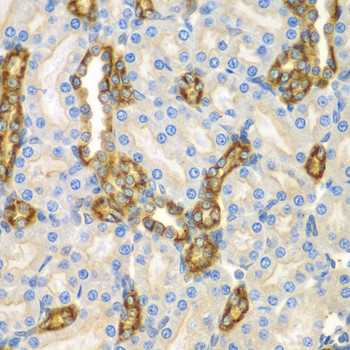
图: 1 / 2
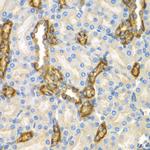
CNPY3 Antibody (PA5-96600) in IHC (P)
Immunohistochemistry analysis of CNPY3 in paraffin-embedded mouse kidney. Samples were incubated with CNPY3 Polyclonal antibody (Product # PA5-96600) using a dilution of 1:100 (40x lens). Perform microwave antigen retrieval with 10 mM PBS buffer pH 7.2 before commencing with IHC staining protocol.
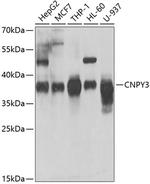
Please note: We are reviewing Western blot images included in the antibody testing data in our catalog, including those provided by third parties. Unless expressly labeled or annotated as “raw-unedited”, Western blot images included in the antibody testing data in our catalog may have been edited, optimized or otherwise adjusted for presentation.


产品信息
PA5-96600
应用
建议稀释比
已发表文章
产品规格
种属反应
Human,
Mouse
宿主/亚型
Rabbit
/ IgG
分类
Polyclonal
类型
Antibody
抗原
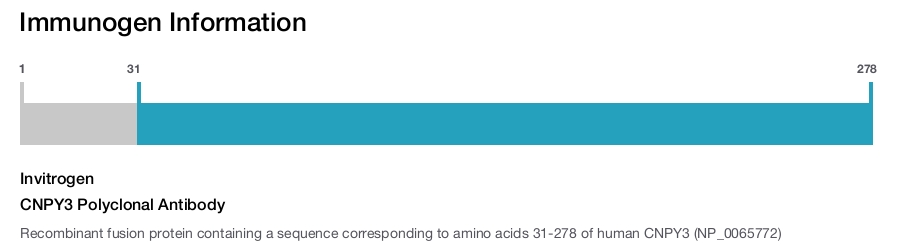
Recombinant fusion protein containing a sequence corresponding to amino acids 31-278 of human CNPY3 (NP_0065772)
偶联物
Unconjugated
Unconjugated
Unconjugated
形式
Liquid
浓度
0.49 mg/mL
规格
49 µg
纯化类型
Affinity Chromatography
保存液
PBS, pH 7.3, with 50% glycerol
内含物
0.02% sodium azide
保存条件
-20°C, Avoid Freeze/Thaw Cycles
运输条件
Ambient (domestic); Wet ice (international)
RRID
产品详细信息
Immunogen sequence: GPSQAGAEEN DWVRLPSKCE VCKYVAVELK SAFEETGKTK EVIGTGYGIL DQKASGVKYT KSDLRLIEVT ETICKRLLDY SLHKERTGSN RFAKGMSETF ETLHNLVHKG VKVVMDIPYE LWNETSAEVA DLKKQCDVLV EEFEEVIEDW YRNHQEEDLT EFLCANHVLK GKDTSCLAEQ WSGKKGDTAA LGGKKSKKKS SRAKAAGGRS SSSKQRKELG GLEGDPSPEE DEGIQKASPL THSPPDEL; Positive Samples: HepG2, MCF7, THP-1, HL-60, U-937; Cellular Location: Endoplasmic reticulum
靶标信息
PRAT4A is a novel protein belonging to the canopy family with a saposin B-type domain. It is an accessory molecule required for microbial recognition by Toll-like receptor (TLR), and mediates TLR dependent immune responses. Though the exact function of PRAT4A is still unknown, reports suggest that it is associated with the immature form of TLR4 and regulates the cell surface expression of this TLR. PRAT4A, a secreted protein, also has a role in TLR4 maturation and glycosylation. PRATA4 is usually present in endoplasmic reticulum and plays an active role in regulating the subcellular distribution and response of multiple TLRs and is required for both innate and adaptive immune responses.
仅用于科研。不用于诊断过程。未经明确授权不得转售。
篇参考文献 (0)
您是否在文献中引用过该产品?请点击下方按钮邮件告知我们。
生物信息学
蛋白别名: CAG repeat containing; CAG/CTG 5; canopy 3 homolog; CTG repeat protein 4a; expanded repeat-domain protein CAG/CTG 5; protein associated with TLR4; protein associated with toll-like receptor 4; protein associated with Toll-like receptor 4A; trinucleotide repeat-containing gene 5 protein; unnamed protein product
基因别名: 1600025D17Rik; 2410050O22Rik; CAG4A; DEE60; EIEE60; ERDA5; PRAT4A; TNRC5
UniProt ID: (Human) Q9BT09, (Mouse) Q9DAU1
Entrez Gene ID: (Human) 10695, (Mouse) 72029
Disclaimer

Clicking the images or links will redirect you to a website hosted by BenchSci that provides third-party scientific content. Neither the content nor the BenchSci technology and processes for selection have been evaluated by us; we are providing them as-is and without warranty of any kind, including for use or application of the Thermo Fisher Scientific products presented.

