Search
Invitrogen
CaV3.1 Polyclonal Antibody
{{$productOrderCtrl.translations['antibody.pdp.commerceCard.promotion.promotions']}}
{{$productOrderCtrl.translations['antibody.pdp.commerceCard.promotion.promocode']}}: {{promo.promoCode}} {{promo.promoTitle}} {{promo.promoDescription}}. {{$productOrderCtrl.translations['antibody.pdp.commerceCard.promotion.learnmore']}}
{{$ctrl.translations['antibody.pdp.skuNotes.additionalInformation']}}:
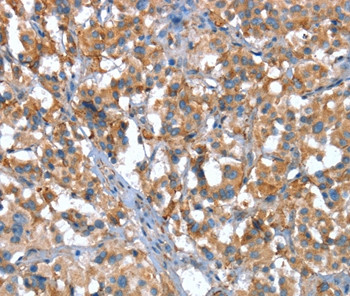
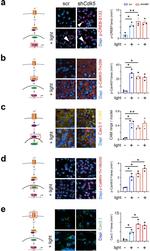
Please note: We are reviewing Western blot images included in the antibody testing data in our catalog, including those provided by third parties. Unless expressly labeled or annotated as “raw-unedited”, Western blot images included in the antibody testing data in our catalog may have been edited, optimized or otherwise adjusted for presentation.


产品信息
PA5-50635
产品规格
种属反应
Human
宿主/亚型
Rabbit
/ IgG
分类
Polyclonal
类型
Antibody
抗原
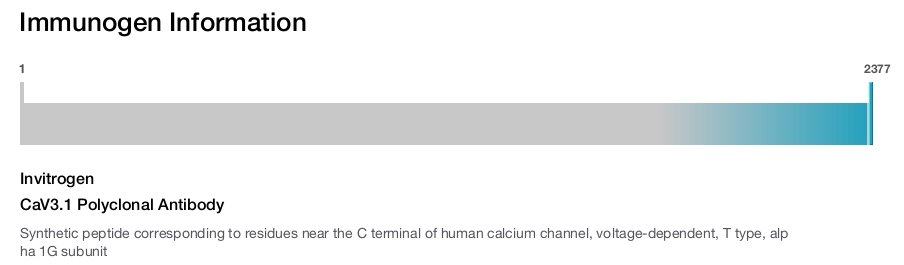
Synthetic peptide corresponding to residues near the C terminal of human calcium channel, voltage-dependent, T type, alpha 1G subunit
偶联物
Unconjugated
Unconjugated
Unconjugated
形式
Liquid
浓度
1.9 mg/mL
规格
190 µg
纯化类型
Antigen affinity chromatography
保存液
PBS, pH 7.4, with 40% glycerol
内含物
0.05% sodium azide
保存条件
-20°C
运输条件
Ambient (domestic); Wet ice (international)
RRID
产品详细信息
The antibody detects endogenous levels of total CACNA1G protein.
靶标信息
Voltage-dependent Ca2+ channels mediate Ca2+ entry into excitable cells in response to membrane depolarization, and they are involved in a variety of Ca2+-dependent processes, including muscle contraction, hormone or neurotransmitter release and gene expression. Calcium channels are highly diverse, multimeric complexes composed of an alpha-1 subunit, an intracellular beta subunit, a disulfide linked alpha-2/delta subunit and a transmembrane gamma subunit. Ca2+ currents are characterized on the basis of their biophysical and pharmacologic properties and include L-, N-, T-, P-, Q-, and R- types. T-type Ca2+ currents are activated and inactivated more rapidly and at more negative membrane potentials than other Ca2+ current types. T-type Ca2+ channels enhance odor sensitivity by lowering the threshold of spike generation in olfactory receptor cells (ORCs).
仅用于科研。不用于诊断过程。未经明确授权不得转售。
生物信息学
蛋白别名: Alpha1G-ae; Alpha1G-aef; Alpha1G-af; Alpha1G-bc; Alpha1G-bcd; Alpha1G-bce; Alpha1G-bcef; Alpha1G-be; CACNA1G-a; T-type; CACNA1G-b; T-type; calcium channel, voltage-dependent, T type, alpha 1G subunit; CaV T1; Cav3 1; cav3 1c; cav3.1c; low voltage-activated T-type calcium channel alpha-1 subunit Cav3.1; low-voltage-activated calcium channel; MGC117234; unnamed protein product; voltage-dependent calcium channel alpha 1G subunit; voltage-dependent T-type calcium channel alpha 1G subunit; voltage-gated calcium channel; voltage-gated calcium channel subunit alpha Cav3.1
基因别名: Ca(V)T.1; Cav3.1; NBR13; SCA42; SCA42ND
UniProt ID: (Human) O43497
Entrez Gene ID: (Human) 8913
ion channel activity
voltage-gated calcium channel activity
high voltage-gated calcium channel activity
low voltage-gated calcium channel activity
voltage-gated calcium channel activity involved in AV node cell action potential
voltage-gated calcium channel activity involved SA node cell action potential
scaffold protein binding
sinoatrial node development
ion transport
regulation of membrane potential
transmembrane transport
calcium ion import
calcium ion transmembrane transport
cardiac muscle cell action potential involved in contraction
SA node cell action potential
AV node cell action potential
SA node cell to atrial cardiac muscle cell signalling
AV node cell to bundle of His cell signaling
membrane depolarization during AV node cell action potential
membrane depolarization during SA node cell action potential
regulation of heart rate by cardiac conduction
calcium ion import across plasma membrane
Disclaimer

Clicking the images or links will redirect you to a website hosted by BenchSci that provides third-party scientific content. Neither the content nor the BenchSci technology and processes for selection have been evaluated by us; we are providing them as-is and without warranty of any kind, including for use or application of the Thermo Fisher Scientific products presented.

