Search
Disclaimer

Clicking the images or links will redirect you to a website hosted by BenchSci that provides third-party scientific content. Neither the content nor the BenchSci technology and processes for selection have been evaluated by us; we are providing them as-is and without warranty of any kind, including for use or application of the Thermo Fisher Scientific products presented.
AbboMax
Cytokeratin (HMW) Monoclonal Antibody (34bE12)
{{$productOrderCtrl.translations['antibody.pdp.commerceCard.promotion.promotions']}}
{{$productOrderCtrl.translations['antibody.pdp.commerceCard.promotion.viewpromo']}}
{{$productOrderCtrl.translations['antibody.pdp.commerceCard.promotion.promocode']}}: {{promo.promoCode}} {{promo.promoTitle}} {{promo.promoDescription}}. {{$productOrderCtrl.translations['antibody.pdp.commerceCard.promotion.learnmore']}}
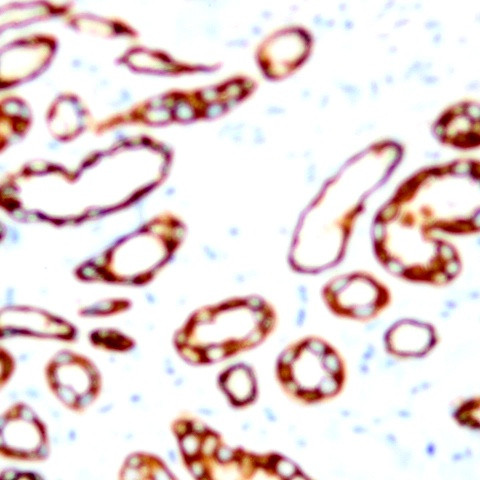
图: 1 / 1
Cytokeratin (HMW) Antibody (605-340) in IHC (P)
Immunohistochemistry: Human prostate carcinoma (FFPE) stained with Mouse anti- Cytokeratin (HMW) (Cat# 605-340) at 1:200 for 10 min @ RT. Staining of formalin-fixed tissue requires boiling tissue sections in 10 mM Citrate Buffer, pH 6.0 for 10 min followed by cooling at RT for 20 min.

产品信息
605-340
产品规格
种属反应
Human
宿主/亚型
Mouse
/ IgG1
分类
Monoclonal
类型
Antibody
克隆号
34bE12
抗原
A synthetic peptide of Cytokeratin (HMW)
偶联物
形式
Liquid
浓度
0.5 mg/mL
纯化类型
Protein A
保存液
PBS with proprietary stabilizer
内含物
0.01% sodium azide
保存条件
Store at 4°C short term. For long term storage, store at -20°C, avoiding freeze/thaw cycles.
运输条件
Ambient (domestic); Wet ice (international)
产品详细信息
Positive control: Skin
Cellular location: Cytoplasmic.
靶标信息
Keratins are heteropolymeric structural proteins that form the intermediate filament. Cytokeratins are intermediate filament keratins found in the intracytoplasmic cytoskeleton of epithelial tissue. There are two types of cytokeratins - the low weight, acidic type I and the high weight, basic type II. Cytokeratins are usually found in pairs - one type I and one type II. KRT1 regulates the activity of kinases such as PKC and SRC via binding to integrin beta-1 (ITB1) and the receptor of activated protein C kinase I (RACK1). In complex with C1QBP it is a high affinity receptor for kininogen-1/HMWK. KRT1 is expressed in the spinous and granular layers of the epidermis with family member KRT10. Mutations affecting the gene result in bullous congenital ichthyosiform erythroderma. KRT5 is specifically expressed in the basal layer of the epidermis with family member KRT14. Mutations affecting the gene result in epidermolysis bullosa simplex diseases. KRT10 plays a role in the establishment of the epidermal barrier on plantar skin. It also acts as a mediator of S.aureus adherence to desquamated nasal epithelial cells via clfB - thus it plays a role in nasal colonization. Mutations affecting the gene result in epidermolytic hyperkeratosis. KRT14's nonhelical tail domain is involved in promoting KRT5-KRT14 filaments to self-organize into large bundles and enhances the mechanical properties involved in resilience of keratin intermediate filaments in vitro. Mutations affecting the gene result in epidermolysis bullosa simplex.
仅用于科研。不用于诊断过程。未经明确授权不得转售。
篇参考文献 (0)
您是否在文献中引用过该产品?请点击下方按钮邮件告知我们。
生物信息学
蛋白别名: 58 kDa cytokeratin; 67 kDa cytokeratin; CK-1; CK-10; CK-14; CK-5; cytokeratin 1; cytokeratin 10; cytokeratin 14; Cytokeratin-1; Cytokeratin-10; Cytokeratin-14; Cytokeratin-5; epidermolysis bullosa simplex 2 Dowling-Meara/Kobner/Weber-Cockayne types; epidermolytic hyperkeratosis 1; Hair alpha protein; K1; K10; K14; K5; keratin 1, type II; keratin 10, type I; keratin 14, type I; keratin 5 (epidermolysis bullosa simplex, Dowling-Meara/Kobner/Weber-Cockayne types); keratin 5, type II; Keratin, type I cytoskeletal 10; Keratin, type I cytoskeletal 14; Keratin, type II cytoskeletal 1; Keratin, type II cytoskeletal 5; Keratin-1; Keratin-10; Keratin-14; Keratin-5; Type-II keratin Kb1; Type-II keratin Kb5
基因别名: BCIE; BIE; CK1; CK10; CK14; CK5; DDD; DDD1; EBS2; EBS3; EBS4; EHK; EHK1; EPPK; K1; K10; K14; K5; KPP; KRT1; KRT10; KRT14; KRT1A; KRT5; KRT5A; KRTA; NEPPK; NFJ
UniProt ID: (Human) P86104, (Human) P13645, (Human) P02533, (Human) P13647
Entrez Gene ID: (Human) 3848, (Human) 3858, (Human) 3861, (Human) 3852
complement activation, lectin pathway
retina homeostasis
response to oxidative stress
fibrinolysis
regulation of angiogenesis
negative regulation of inflammatory response
establishment of skin barrier
aging
epidermis development
response to zinc ion
response to ionizing radiation
epithelial cell differentiation
hemidesmosome assembly
hair cycle
intermediate filament bundle assembly
keratinocyte differentiation
cytoskeleton organization

