Search
Invitrogen
EAAC1 Polyclonal Antibody
{{$productOrderCtrl.translations['antibody.pdp.commerceCard.promotion.promotions']}}
{{$productOrderCtrl.translations['antibody.pdp.commerceCard.promotion.viewpromo']}}
{{$productOrderCtrl.translations['antibody.pdp.commerceCard.promotion.promocode']}}: {{promo.promoCode}} {{promo.promoTitle}} {{promo.promoDescription}}. {{$productOrderCtrl.translations['antibody.pdp.commerceCard.promotion.learnmore']}}
Additional Information:
{{banner.description}}
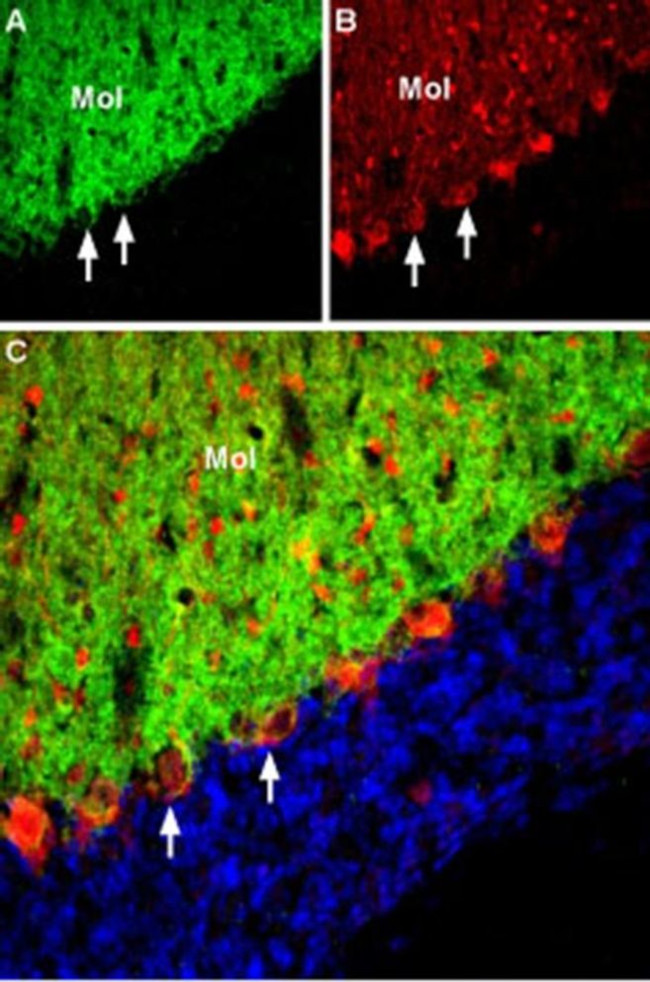
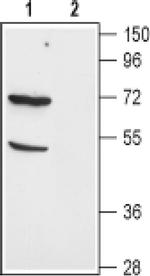
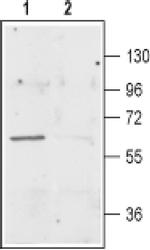


产品信息
PA5-77427
产品规格
宿主/亚型
Rabbit
/ IgG
分类
Polyclonal
类型
Antibody
抗原
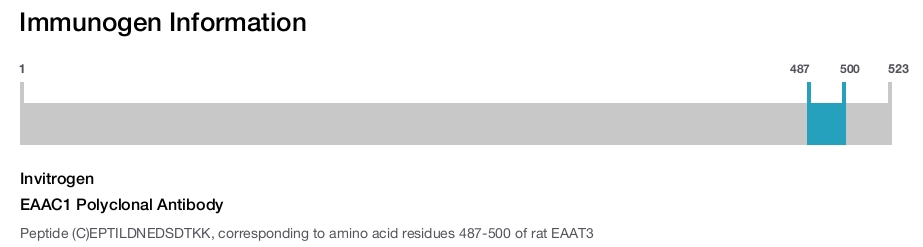
Peptide (C)EPTILDNEDSDTKK, corresponding to amino acid residues 487-500 of rat EAAT3
偶联物
Unconjugated
Unconjugated
Unconjugated
形式
Lyophilized
浓度
0.8 mg/mL
规格
40 µg
保存条件
-20°C
运输条件
Wet ice
RRID
产品详细信息
Product is shipped at room temperature as a lyophilized powder and should be stored at -20 °C upon receipt. Reconstitution: add 50 µL of deionized water.
靶标信息
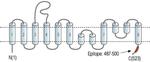
L-glutamate is the major excitatory neurotransmitter in mammalian central nervous systems. To maintain glutamate levels below excitoxic levels, excess glutamate at excitatory synaptic clefts is removed by ion-coupled glutamate transporters. Four glutamate transporters have been identified: the sodium-dependent GLAST-1, GLT-1, EAAC-1 and the chloride-dependent EAAT-4. EAAC-1 is expressed in the CNS and also found in kidney and small intestine. Structural features of glutamate transporters are believed to include eight membrane-spanning alpha-helices and a loop-pore structure which is unique among secondary transporters but may resemble loop-pores found in ion channels. A second distinctive structural feature is the presence of a highly amphipathic membrane-spanning helix that provides a hydrophilic path through the membrane. Mice with homozygous deletions of the EAAC-1 transporter gene develop dicarboxylic aminoaciduria and display reduced spontaneous locomotor activity although no neurodegeneration was observed over a period of 12 months.
仅用于科研。不用于诊断过程。未经明确授权不得转售。
篇参考文献 (0)
您是否在文献中引用过该产品?请点击下方按钮邮件告知我们。
Disclaimer

Clicking the images or links will redirect you to a website hosted by BenchSci that provides third-party scientific content. Neither the content nor the BenchSci technology and processes for selection have been evaluated by us; we are providing them as-is and without warranty of any kind, including for use or application of the Thermo Fisher Scientific products presented.

