Search
Invitrogen
EB1/EB2/EB3 Monoclonal Antibody (KT65)
{{$productOrderCtrl.translations['antibody.pdp.commerceCard.promotion.promotions']}}
{{$productOrderCtrl.translations['antibody.pdp.commerceCard.promotion.promocode']}}: {{promo.promoCode}} {{promo.promoTitle}} {{promo.promoDescription}}. {{$productOrderCtrl.translations['antibody.pdp.commerceCard.promotion.learnmore']}}
{{$ctrl.translations['antibody.pdp.skuNotes.additionalInformation']}}:
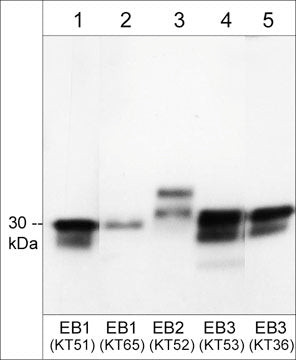
图: 1 / 1
EB1/EB2/EB3 Antibody (MA5-47713) in WB
Western blot of EB1/EB2/EB3 in mouse brain (lanes 1-5). The blot was probed with rat EB1 monoclonal antibody (Product # MA5-47663) (lane 1), EB1/EB2/EB3 monoclonal antibody (Product # MA5-47713) (lane 2), MAPRE2 monoclonal antibody (Product # MA5-47664) (lane 3), MAPRE3 monoclonal antibody (Product # MA5-47714) (lane 4), and anti-EB3 (lane 5). Then the antibodies were detected using goat anti-Rat IgG Light Chain specific: HRP.
Please note: We are reviewing Western blot images included in the antibody testing data in our catalog, including those provided by third parties. Unless expressly labeled or annotated as “raw-unedited”, Western blot images included in the antibody testing data in our catalog may have been edited, optimized or otherwise adjusted for presentation.

产品信息
MA5-47713
产品规格
种属反应
Human,
Mouse,
Rat
宿主/亚型
Rat
/ IgG2a
分类
Monoclonal
类型
Antibody
克隆号
KT65
抗原
Clone KT65 was generated from a GST fusion protein containing amino acids from the C-terminal region mouse EB1. This sequence is highly conserved in human and rat EB1.
偶联物
Unconjugated
Unconjugated
Unconjugated
形式
Liquid
浓度
1 mg/mL
规格
100 µg
纯化类型
Protein G
保存液
PBS
内含物
0.05% sodium azide
保存条件
Store at 4°C short term. For long term storage, store at -20°C, avoiding freeze/thaw cycles.
运输条件
Ambient (domestic); Wet ice (international)
RRID
产品详细信息
The antibody detects a 30 kDa* protein corresponding to the molecular mass of EB1 on SDS-PAGE immunoblots of human HeLa, mouse brain, and rat PC12 cells. The antibody also detects EB1 by immunocytochemistry in HeLa and A431 cells. The antibody may weakly detect endogenous EB2 and EB3 in some cells and tissues.
靶标信息
The microtubule (MT) plus-end is a crucial site for the regulation of MT dynamics and interactions by several groups of plus-end tracking proteins (+TIPs). These +TIPs form comet-like accumulations at the plus ends of MTs to regulate MT dynamics and interactions with organelles and macromolecular complexes. The +TIPs include diverse groups of proteins, such as motor and nonmotor proteins, MT polymerases and depolymerases as well as various regulatory and adaptor proteins. The CLIP-associated protein (CLASP) family includes CLASP1 and CLASP2 proteins, which are expressed as long (alpha) and short (beta) isoforms. Thse +TIPs conatin an N-terminal TOG domain, multiple TOG-like domains, and a basic and serine-rich motif (SxIP). The TOG domain facilitates interaction with tubulin dimers, while the SxIP motif promotes interaciton with EB1 and MTs. A C-terminal domain is involved in interaction with CLIPs, as well as several other proteins. CLASPs are MT stabilizing fators that localize to mitotic spindles, kinetochores, and the midbody. CLASPs are important for cell division, and may regulate cell migration and neuronal growth cone motility.
仅用于科研。不用于诊断过程。未经明确授权不得转售。
篇参考文献 (0)
您是否在文献中引用过该产品?请点击下方按钮邮件告知我们。
生物信息学
蛋白别名: adenomatosis polyposis coli binding protein Eb1; adenomatous polyposis coli-binding protein EB1; APC; APC binding protein; APC-binding protein EB1; APC-binding protein EB2; EB1 protein family member 3; EB3; EBF3; end-binding protein 1; end-binding protein 2; end-binding protein 3; MAPRE2; MAPRE3; Microtubule RP/EB; microtubule-associated protein RP/EB family member 2-like; RP3; T-cell activation protein, EB1 family; T-cell activation protein, EB1 family, member 2; unnamed protein product
基因别名: 5530600P05Rik; BIM1p; C820009F03Rik; CSCSC2; D18Abb1e; D2Ertd459e; EB1; EB2; EB3; EBF3; EBF3-S; RP1; RP3
UniProt ID: (Human) Q15691, (Human) Q15555, (Human) Q9UPY8, (Mouse) Q61166, (Rat) Q66HR2, (Mouse) Q8R001, (Rat) Q3B8Q0, (Mouse) Q6PER3, (Rat) Q5XIT1
Entrez Gene ID: (Human) 22919, (Human) 10982, (Human) 22924, (Mouse) 13589, (Rat) 114764, (Mouse) 212307, (Rat) 679221, (Mouse) 100732, (Rat) 298848
regulation of microtubule polymerization or depolymerization
regulation of microtubule polymerization
protein localization to microtubule
positive regulation of transcription, DNA-templated
behavioral response to cocaine
spindle assembly
positive regulation of dendritic spine morphogenesis
positive regulation of ARF protein signal transduction
positive regulation of keratinocyte migration
positive regulation of focal adhesion disassembly
establishment of mitotic spindle orientation
microtubule bundle formation
cell migration
negative regulation of microtubule polymerization
positive regulation of microtubule polymerization
microtubule polymerization
attachment of mitotic spindle microtubules to kinetochore
protein localization to centrosome
protein localization to mitotic spindle
protein localization to astral microtubule
positive regulation of cellular protein localization
non-motile cilium assembly
protein localization
Disclaimer

Clicking the images or links will redirect you to a website hosted by BenchSci that provides third-party scientific content. Neither the content nor the BenchSci technology and processes for selection have been evaluated by us; we are providing them as-is and without warranty of any kind, including for use or application of the Thermo Fisher Scientific products presented.

