Search
Abnova
EGF Monoclonal Antibody (2F1)
{{$productOrderCtrl.translations['antibody.pdp.commerceCard.promotion.promotions']}}
{{$productOrderCtrl.translations['antibody.pdp.commerceCard.promotion.viewpromo']}}
{{$productOrderCtrl.translations['antibody.pdp.commerceCard.promotion.promocode']}}: {{promo.promoCode}} {{promo.promoTitle}} {{promo.promoDescription}}. {{$productOrderCtrl.translations['antibody.pdp.commerceCard.promotion.learnmore']}}
Additional Information:
{{banner.description}}
产品信息
H00001950-M01J
产品规格
宿主/亚型
Mouse
/ IgG2b, kappa
分类
Monoclonal
类型
Antibody
克隆号
2F1
抗原
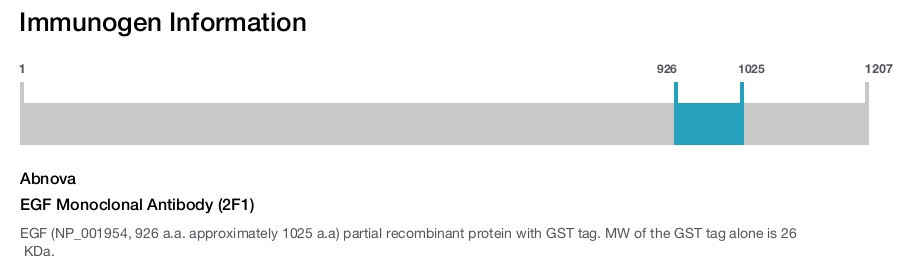
EGF (NP_001954, 926 a.a. approximately 1025 a.a) partial recombinant protein with GST tag. MW of the GST tag alone is 26 KDa.
偶联物
Unconjugated
Unconjugated
Unconjugated
形式
Liquid
浓度
See Label
规格
100 µg
保存条件
-20°C, Avoid Freeze/Thaw Cycles
运输条件
Ambient (domestic); Wet ice (international)
产品详细信息
Sequence of this protein is as follows: NASCTNTEGG YTCMCAGRLS EPGLICPDST PPPHLREDDH HYSVRNSDSE CPLSHDGYCL HDGVCMYIEA LDKYACNCVV GYIGERCQYR DLKWWKLRHA
Cell culture grade monoclonal antibodies are obtained by purifying "hybridoma culture medium" which completely eliminates any contamination of mice. They have high affinity, high purity, and no contamination.
靶标信息
EGF (Epidermal growth factor) exerts its actions by binding to the EGF Receptor, a 170 kDa protein kinase. Activation of EGFR initiates diverse cellular pathways in response to toxic environmental stimuli, or to EGF binding to the receptor, the EGFR forms homo- or heterodimers with other family members. Each dimeric receptor complex initiates a distinct signaling pathway by recruiting different Src homology 2 (SH2) containing effector proteins. EGF is far and wide expressed in kidney, cerebrum, prostrate and salivary glands. EGF acts as a potent mitogenic factor and the phosphorylated receptor recruits adapter proteins like GRB2 that activates complex downstream signaling cascades. EGF activates at least 4 major downstream signaling cascades including the RAS-RAF-MEK-ERK, PI3 kinase-AKT, PLCgamma-PKC and STAT modules. Research studies suggest the protein may also play important role in activating the NF-kappa-B signaling cascade. Defects in the EGGF gene are the cause of hypomagnesemia type 4 and dysregulation has been associated with the growth and progression of certain cancers.
仅用于科研。不用于诊断过程。未经明确授权不得转售。
篇参考文献 (0)
您是否在文献中引用过该产品?请点击下方按钮邮件告知我们。
Disclaimer

Clicking the images or links will redirect you to a website hosted by BenchSci that provides third-party scientific content. Neither the content nor the BenchSci technology and processes for selection have been evaluated by us; we are providing them as-is and without warranty of any kind, including for use or application of the Thermo Fisher Scientific products presented.

