Search
Invitrogen
FGFR5 Polyclonal Antibody
{{$productOrderCtrl.translations['antibody.pdp.commerceCard.promotion.promotions']}}
{{$productOrderCtrl.translations['antibody.pdp.commerceCard.promotion.promocode']}}: {{promo.promoCode}} {{promo.promoTitle}} {{promo.promoDescription}}. {{$productOrderCtrl.translations['antibody.pdp.commerceCard.promotion.learnmore']}}
{{$ctrl.translations['antibody.pdp.skuNotes.additionalInformation']}}:
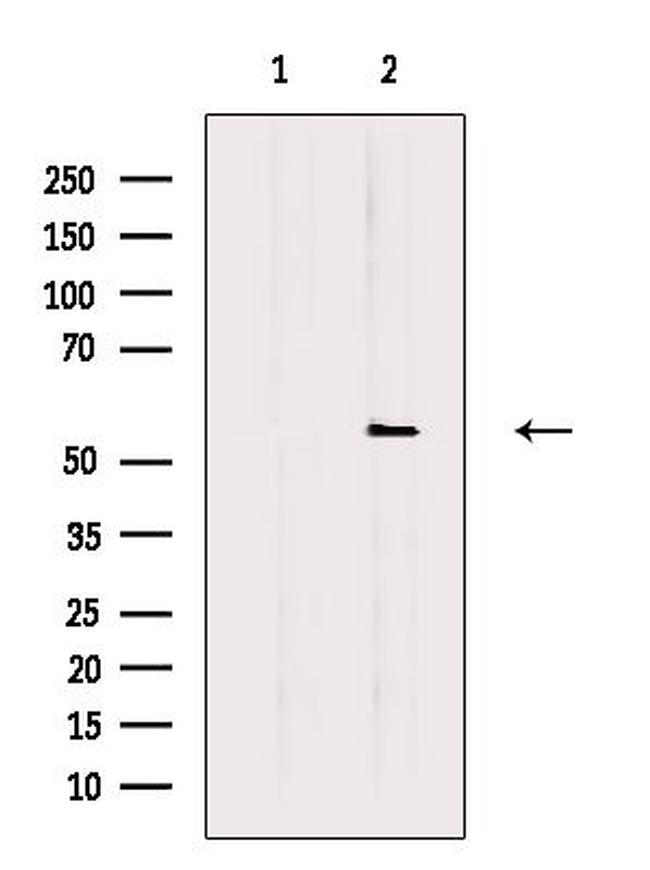
Please note: We are reviewing Western blot images included in the antibody testing data in our catalog, including those provided by third parties. Unless expressly labeled or annotated as “raw-unedited”, Western blot images included in the antibody testing data in our catalog may have been edited, optimized or otherwise adjusted for presentation.


产品信息
PA5-106797
产品规格
种属反应
Human,
Mouse
宿主/亚型
Rabbit
/ IgG
分类
Polyclonal
类型
Antibody
抗原
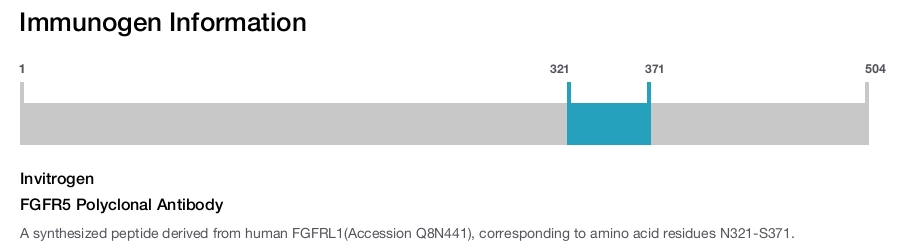
A synthesized peptide derived from human FGFRL1(Accession Q8N441), corresponding to amino acid residues N321-S371.
偶联物
Unconjugated
Unconjugated
Unconjugated
形式
Liquid
浓度
1 mg/mL
规格
100 µg
纯化类型
Affinity chromatography
保存液
PBS, pH 7.4, with 50% glycerol
内含物
0.02% sodium azide
保存条件
-20°C
运输条件
Ambient (domestic); Wet ice (international)
RRID
产品详细信息
Antibody detects endogenous levels of total FGRL1.
靶标信息
Acidic and basic fibroblast growth factors (FGFs) are members of a family of multifunctional polypeptide growth factors that stimulate proliferation of cells of mesenchymal, epithelial and neuro-ectodermal origin. Like other growth factors, FGFs act by binding and activating specific cell surface receptors. A total of six members of the FGF receptor family have been identified and cloned. These include the Flg receptor or FGFR-1, the BEK receptor or FGFR-2, FGFR-3, FGFR-4, FGFR-5 and FGFR-6. These receptors usually contain an extracellular ligand-binding region containing three immunoglobulin-like domains, a transmembrane domain and a cytoplasmic tyrosine kinase domain. However, FGFR-5 lacks the cytoplasmic kinase domain. FGFR-5 is expressed in a broad range of tissues, including kidney, brain and lung, but it is preferentially expressed in pancreas, where it may play a role in the regulation of some pancreatic function.
仅用于科研。不用于诊断过程。未经明确授权不得转售。
篇参考文献 (0)
您是否在文献中引用过该产品?请点击下方按钮邮件告知我们。
生物信息学
蛋白别名: FGF homologous factor receptor; FGF receptor-like protein 1; FGFR-like protein; FGFR5 beta; FGFR5 gamma; fibroblast growth factor receptor 5; unnamed protein product
基因别名: FGFR-5; FGFR5; FGFR5beta; FGFR5gamma; FHFR
UniProt ID: (Human) Q8N441, (Mouse) Q91V87
Entrez Gene ID: (Human) 53834, (Mouse) 116701
fibroblast growth factor receptor signaling pathway
cell-cell adhesion
skeletal system development
heart valve morphogenesis
cell surface receptor signaling pathway
negative regulation of cell proliferation
negative regulation of fibroblast growth factor receptor signaling pathway
regulation of cell proliferation
ventricular septum morphogenesis
diaphragm development
respiratory system development
Disclaimer

Clicking the images or links will redirect you to a website hosted by BenchSci that provides third-party scientific content. Neither the content nor the BenchSci technology and processes for selection have been evaluated by us; we are providing them as-is and without warranty of any kind, including for use or application of the Thermo Fisher Scientific products presented.

