Search
QED Bioscience
FPR1/2 Monoclonal Antibody (NFPR1)
{{$productOrderCtrl.translations['antibody.pdp.commerceCard.promotion.promotions']}}
{{$productOrderCtrl.translations['antibody.pdp.commerceCard.promotion.viewpromo']}}
{{$productOrderCtrl.translations['antibody.pdp.commerceCard.promotion.promocode']}}: {{promo.promoCode}} {{promo.promoTitle}} {{promo.promoDescription}}. {{$productOrderCtrl.translations['antibody.pdp.commerceCard.promotion.learnmore']}}
Additional Information:
{{banner.description}}


产品信息
30107-100UG
产品规格
种属反应
Human
宿主/亚型
Mouse
/ IgG1
分类
Monoclonal
类型
Antibody
克隆号
NFPR1
抗原
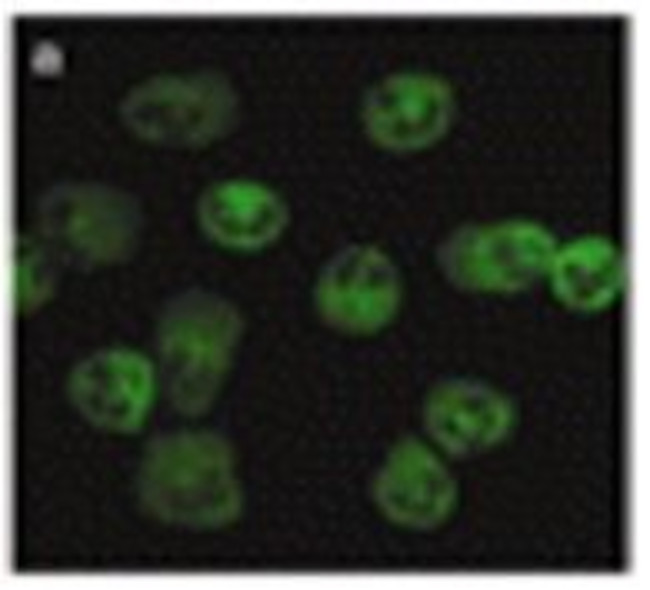
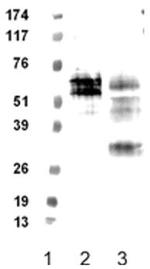
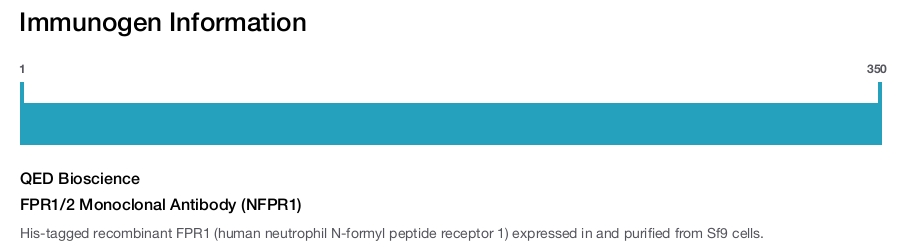
His-tagged recombinant FPR1 (human neutrophil N-formyl peptide receptor 1) expressed in and purified from Sf9 cells.
偶联物
Unconjugated
Unconjugated
Unconjugated
形式
Liquid
浓度
0.5-1.0 mg/mL
规格
100 µg
纯化类型
Protein A
保存液
PBS, pH 7.4
内含物
no preservative
保存条件
-20°C, Avoid Freeze/Thaw Cycles
运输条件
Ambient (domestic); Wet ice (international)
靶标信息
Formyl peptide receptors (FPR) are G protein-coupled receptors that are activated by different agonists included N- formylated peptides originating from bacteria and mitochondria. In humans, the FPR family includes the high affinity FPR1, the low affinity FPR2/ALX (previously known as FPRL1 or ALX) and FPR3. Human FPR1 is important for phagocyte chemotaxis, superoxide production, and degranulation, and helps direct phagocytes to sites of infection. Functional FPR1expression has been demonstrated on fibroblasts, bone marrow mesenchymal stem cells, A549 lung cells, HEP-G2 hepatoma cells, and on several types of epithelial cells. FPR2 (Formyl Peptide Receptor 2) is a Protein Coding gene. Diseases associated with FPR2 include Diamond-Blackfan Anemia 2 and Prion Disease. Among its related pathways are Class A/1 (Rhodopsin-like receptors) and GPCR downstream signalling. Gene Ontology (GO) annotations related to this gene include G protein-coupled receptor activity and N-formyl peptide receptor activity. An important paralog of this gene is FPR3.
仅用于科研。不用于诊断过程。未经明确授权不得转售。
篇参考文献 (0)
您是否在文献中引用过该产品?请点击下方按钮邮件告知我们。
生物信息学
蛋白别名: ALX; fMet-Leu-Phe receptor; fMLP receptor; FMLP-R-I; FMLP-related receptor I; formyl peptide receptor; Formyl peptide receptor-like 1; HM63; Lipoxin A4 receptor; lipoxin A4 receptor (formyl peptide receptor related); LXA4 receptor; N-formyl peptide receptor 1; N-formyl peptide receptor 2; N-formylpeptide chemoattractant receptor; RFP; unnamed protein product
基因别名: ALX; ALXR; FMLP; FMLP-R-II; FMLPX; FPR; FPR1; FPR2; FPR2A; FPRH1; FPRH2; FPRL1; HM63; LXA4R
UniProt ID: (Human) P21462, (Human) P25090
Entrez Gene ID: (Human) 2357, (Human) 2358
complement receptor mediated signaling pathway
chemotaxis
inflammatory response
cell communication
signal transduction
G-protein coupled receptor signaling pathway
adenylate cyclase-modulating G-protein coupled receptor signaling pathway
phospholipase C-activating G-protein coupled receptor signaling pathway
positive regulation of cytosolic calcium ion concentration
nitric oxide mediated signal transduction
signaling
microglial cell activation
immune response-regulating cell surface receptor signaling pathway
receptor-mediated endocytosis
cell adhesion
cell surface receptor signaling pathway
adenylate cyclase-inhibiting G-protein coupled receptor signaling pathway
calcium-mediated signaling
positive regulation of superoxide anion generation
defense response to bacterium
negative regulation of neuron apoptotic process
positive regulation of innate immune response
astrocyte activation
negative regulation of inflammatory response
positive regulation of phagocytosis
positive chemotaxis
positive regulation of protein kinase B signaling
positive regulation of ERK1 and ERK2 cascade
positive regulation of monocyte chemotaxis
dentinogenesis
cellular response to beta-amyloid
Disclaimer

Clicking the images or links will redirect you to a website hosted by BenchSci that provides third-party scientific content. Neither the content nor the BenchSci technology and processes for selection have been evaluated by us; we are providing them as-is and without warranty of any kind, including for use or application of the Thermo Fisher Scientific products presented.

