Search
Disclaimer

Clicking the images or links will redirect you to a website hosted by BenchSci that provides third-party scientific content. Neither the content nor the BenchSci technology and processes for selection have been evaluated by us; we are providing them as-is and without warranty of any kind, including for use or application of the Thermo Fisher Scientific products presented.
Invitrogen
GABRR1 (extracellular) Polyclonal Antibody
{{$productOrderCtrl.translations['antibody.pdp.commerceCard.promotion.promotions']}}
{{$productOrderCtrl.translations['antibody.pdp.commerceCard.promotion.viewpromo']}}
{{$productOrderCtrl.translations['antibody.pdp.commerceCard.promotion.promocode']}}: {{promo.promoCode}} {{promo.promoTitle}} {{promo.promoDescription}}. {{$productOrderCtrl.translations['antibody.pdp.commerceCard.promotion.learnmore']}}


产品信息
PA5-77405
产品规格
宿主/亚型
Rabbit
/ IgG
分类
Polyclonal
类型
Antibody
抗原
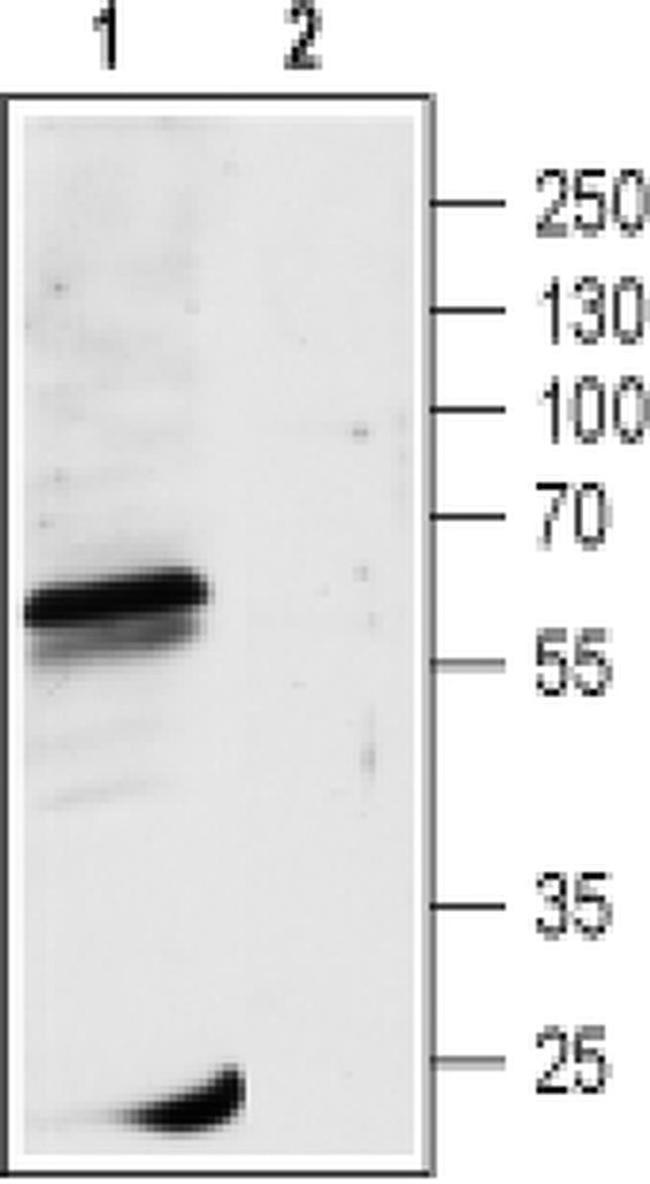
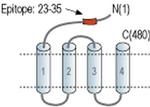
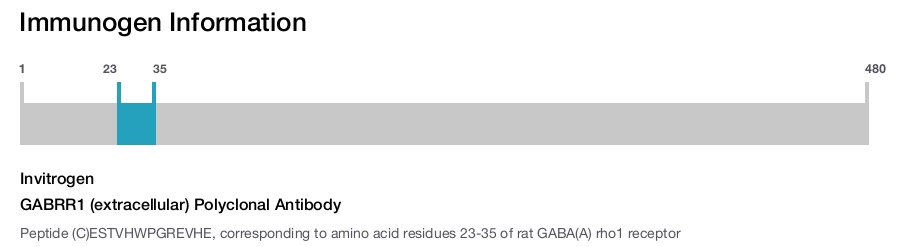
Peptide (C)ESTVHWPGREVHE, corresponding to amino acid residues 23-35 of rat GABA(A) rho1 receptor
偶联物
形式
Lyophilized
浓度
1 mg/mL
保存条件
-20°C
运输条件
Wet ice
RRID
产品详细信息
Product is shipped at room temperature as a lyophilized powder and should be stored at -20 °C upon receipt. Reconstitution: add 50 µL of deionized water.
靶标信息
GAD-65 and GAD-67, glutamate decarboxylases, function to catalyze the production of GABA (gamma-aminobutyric acid). In the central nervous system GABA functions as the main inhibitory transmitter by increasing a Cl- conductance that inhibits neuronal firing. GABA has been shown to activate both ionotropic (GABAA) and metabotropic (GABAB) receptors as well as a third class of receptors called GABAC. Both GABAA and GABAC are ligand-gated ion channels; however, they are structurally and functionally distinct. GABAC receptors (GABAC Rr) mediate rapid inhibitory neurotransmission in retina. Three human genes, r1 (GABRR1), r2 (GABRR2) and r3 (GABRR3), encode the three polypeptides that comprise this receptor. GABRR1 and GABRR2 are located close together, in a region of chromosome 6q that contains loci for inherited disorders of the eye, but GABRR3 maps to chromosome 3q11-q13.3. The r polypeptide genes, which are thought to share a common ancestor with GABA(A) receptor subunit genes, diverged at an early stage in the evolution of this gene family. The expression of GABAC Rr subunits is not restricted to the retina, but significant expression can also be detected in many other brain regions, especially in those belonging to the visual pathways.
仅用于科研。不用于诊断过程。未经明确授权不得转售。
篇参考文献 (0)
您是否在文献中引用过该产品?请点击下方按钮邮件告知我们。

