Search
Invitrogen
H4K17me1 Recombinant Rabbit Monoclonal Antibody (K01_4M64)
{{$productOrderCtrl.translations['antibody.pdp.commerceCard.promotion.promotions']}}
{{$productOrderCtrl.translations['antibody.pdp.commerceCard.promotion.promocode']}}: {{promo.promoCode}} {{promo.promoTitle}} {{promo.promoDescription}}. {{$productOrderCtrl.translations['antibody.pdp.commerceCard.promotion.learnmore']}}
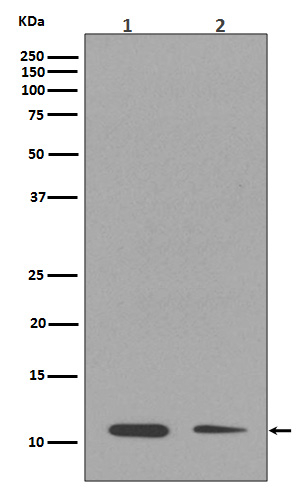
Please note: We are reviewing Western blot images included in the antibody testing data in our catalog, including those provided by third parties. Unless expressly labeled or annotated as “raw-unedited”, Western blot images included in the antibody testing data in our catalog may have been edited, optimized or otherwise adjusted for presentation.

产品信息
MA567409
产品规格
种属反应
Human,
Mouse
宿主/亚型
Rabbit
/ IgG
Expression System
HEK293F
分类
Recombinant Monoclonal
类型
Antibody
克隆号
K01_4M64
抗原
A synthesized peptide derived from human Histone H4 (mono methyl K16).
偶联物
Unconjugated
Unconjugated
Unconjugated
形式
Liquid
浓度
1 mg/mL
规格
100 µg
纯化类型
Protein A/G
保存液
PBS, pH 7.4, with 0.05% BSA, 50% glycerol, 150mM NaCl
内含物
0.02% sodium azide
保存条件
Store at 4°C short term. For long term storage, store at -20°C, avoiding freeze/thaw cycles.
运输条件
Ambient (domestic); Wet ice (international)
靶标信息
H4K17me1 refers to the monomethylation of lysine 17 on histone H4, a posttranslational modification that influences chromatin structure and gene regulation rather than a gene itself. Histone H4 is encoded by multiple H4 genes, for example the HIST1H4 family, and the K17 residue can be methylated by specific lysine methyltransferases, while demethylases can remove this mark. Functionally, H4K17me1 has been associated with modulation of nucleosome stability and transcriptional output, with context dependent roles in activating or repressing gene expression. Emerging studies link H4K17 methylation states to DNA damage responses and oncogenic pathways, though the precise writers, erasers, and readers for K17me1 are less well defined compared to more canonical marks such as H3K4me3 or H3K27me3. Detection typically relies on mass spectrometry or modification specific antibodies in ChIP based assays to map genomic distribution. Overall, H4K17me1 is an epigenetic mark whose biological significance is under active investigation, and it should be treated as a histone modification target rather than a single gene symbol.
仅用于科研。不用于诊断过程。未经明确授权不得转售。
篇参考文献 (0)
您是否在文献中引用过该产品?请点击下方按钮邮件告知我们。
Disclaimer

Clicking the images or links will redirect you to a website hosted by BenchSci that provides third-party scientific content. Neither the content nor the BenchSci technology and processes for selection have been evaluated by us; we are providing them as-is and without warranty of any kind, including for use or application of the Thermo Fisher Scientific products presented.

