Search
Invitrogen
HSF2 Polyclonal Antibody
{{$productOrderCtrl.translations['antibody.pdp.commerceCard.promotion.promotions']}}
{{$productOrderCtrl.translations['antibody.pdp.commerceCard.promotion.viewpromo']}}
{{$productOrderCtrl.translations['antibody.pdp.commerceCard.promotion.promocode']}}: {{promo.promoCode}} {{promo.promoTitle}} {{promo.promoDescription}}. {{$productOrderCtrl.translations['antibody.pdp.commerceCard.promotion.learnmore']}}
Additional Information:
{{banner.description}}
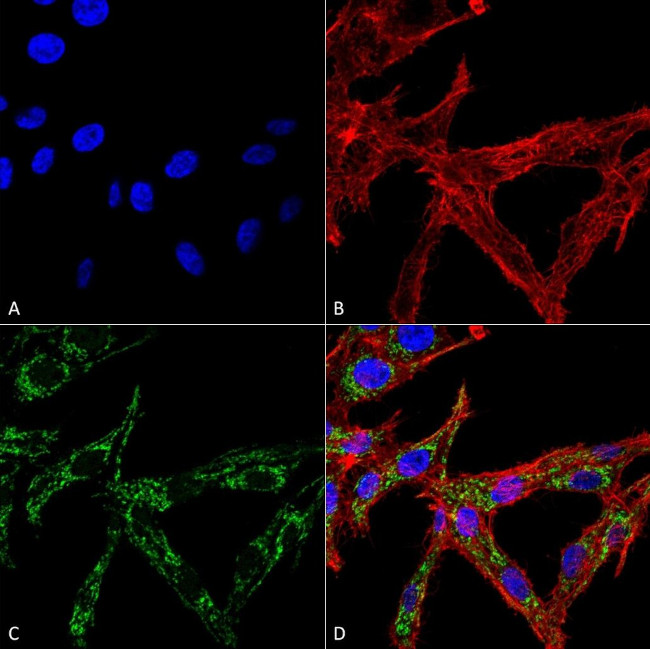
图: 1 / 2
HSF2 Antibody (PA5-77831) in ICC/IF
Immunofluorescent analysis of HSF2 in human colon carcinoma cell line (RKO). Sample was fixed with 4% formaldehyde (15 min at RT), incubated with HSF2 polyclonal antibody (Product # PA5-77831) using a dilution of 1:100 (1 hour at RT), and followed by Goat Anti-Rabbit 488, Phalloidin Texas Red and DAPI secondary antibody at a dilution of 1:100, 1:1000 (60 min at RT) and 1:5000 (5 min at RT). Images are shown as follows: A) DAPI nuclear stain, B) Phalloidin Texas Red F-Actin stain, C) HSF2 Antibody, D) Merged image. Magnification: 60x.


产品信息
PA5-77831
应用
建议稀释比
已发表文章
产品规格
宿主/亚型
Rabbit
/ IgG
分类
Polyclonal
类型
Antibody
抗原
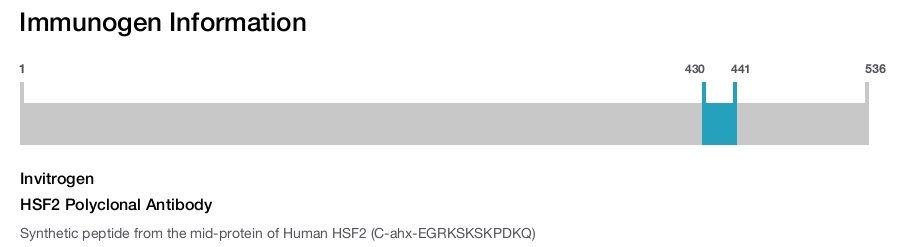
Synthetic peptide from the mid-protein of Human HSF2 (C-ahx-EGRKSKSKPDKQ)
偶联物
形式
Liquid
浓度
1 mg/mL
保存条件
-20°C
运输条件
Wet ice
RRID
产品详细信息
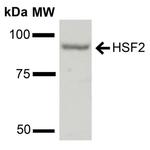
A 1:1,000 dilution of PA5-77831 was sufficient for detection of HSF2 in 15 µg of rat liver cell lysates by ECL immunoblot analysis using goat anti-rabbit IgG:HRP as the secondary antibody.|Detects approximately 90 kDa.
靶标信息
Prokaryotic and eukaryotic cells respond to thermal and chemical stress by inducing a group of genes collectively designated heat shock genes. In eukaryotes, this gene expression is regulated primarily at the transcription level. Heat shock transcription factors (HSF, also designated HSTF) 1 and 2 are involved in this regulation. HSF1 and HSF2 are upregulated by estrogen at both the mRNA and protein level. HSF1 is normally found as a monomer whose transcriptional activity is repressed by constitutive phosphorylation. Upon activation, HSF1 forms trimers, gains DNA binding activity and is translocated to the nucleus. HSF2 activity is associated with differentiation and development, and, like HSF1, binds DNA as a trimer. Both HSF1 and HSF2 are known to be induced by proteasome inhibitors of the ubiquitin pathway.
仅用于科研。不用于诊断过程。未经明确授权不得转售。
篇参考文献 (0)
您是否在文献中引用过该产品?请点击下方按钮邮件告知我们。
Disclaimer

Clicking the images or links will redirect you to a website hosted by BenchSci that provides third-party scientific content. Neither the content nor the BenchSci technology and processes for selection have been evaluated by us; we are providing them as-is and without warranty of any kind, including for use or application of the Thermo Fisher Scientific products presented.

