Search
GenScript
HVEM Monoclonal Antibody (10C6)
{{$productOrderCtrl.translations['antibody.pdp.commerceCard.promotion.promotions']}}
{{$productOrderCtrl.translations['antibody.pdp.commerceCard.promotion.viewpromo']}}
{{$productOrderCtrl.translations['antibody.pdp.commerceCard.promotion.promocode']}}: {{promo.promoCode}} {{promo.promoTitle}} {{promo.promoDescription}}. {{$productOrderCtrl.translations['antibody.pdp.commerceCard.promotion.learnmore']}}
Additional Information:
{{banner.description}}
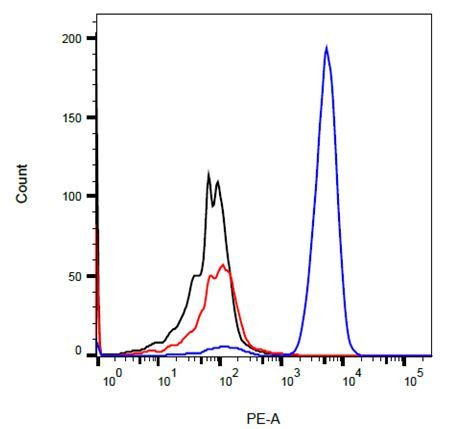
图: 1 / 1
HVEM Antibody (A01959-40) in Flow
Flow cytometric analysis of peripheral blood mononuclear cell (PBMCs) binding with Human HVEM Antibody(10C6), mAb, Mouse (GenScript, A01959; blue curve) or binding with an isotype control antibody (red curve), or binding with PBS solution as a negative control (black curve). Antibody working concentration: 1 µg/mL, 2.5x10⁵ cells/reaction. The signal was developed with R-PE conjugated anti-mouse IgG.

产品信息
A01959-40
产品规格
宿主/亚型
Mouse
/ IgG1
分类
Monoclonal
类型
Antibody
克隆号
10C6
抗原
Recombinant HVEM protein
偶联物
Unconjugated
Unconjugated
Unconjugated
形式
Lyophilized
规格
40 µg
保存条件
-20°C or -80°C if preferred
运输条件
Wet ice
产品详细信息
Reconstitute the lyophilized antibody with deionized water (or equivalent) to a final concentration of 0.5 mg/ml.
HVEM, also known as CD270, is a type 1 transmembrane protein. It is a member of the TNFR superfamily with a molecular weight of 30kDa. HVEM is expressed on hematopoietic cells such as T cells, B cells, dendritic cells, monocytes, neutrophils and NK cells. It participates in regulating lymphocyte activation and homeostasis in immune responses. HVEM activates NF-kB through the TNF-related cytokine LIGHT during T cell activation.
靶标信息
TNFRSF14 is a member of the TNF-receptor superfamily. TNFRSF14 was identified as a cellular mediator of herpes simplex virus (HSV) entry. Binding of HSV viral envelope glycoprotein D (gD) to TNFRSF14 has been shown to be part of the viral entry mechanism. The cytoplasmic region of TNFRSF14 was found to bind to several TRAF family members, which may mediate the signal transduction pathways that activate the immune response. Activation of the signal transduction pathway involving TNFRSF14 in T cells stimulates T cell proliferation and cytokine production, leading to inflammation and enhanced CTL-mediated tumor immunity, suggesting that these proteins may be useful as potential targets for controlling cellular immune responses. Multiple alternatively spliced transcript variants have been described, but the full-length nature of some of these TNFRSF14 variants have not been determined.
仅用于科研。不用于诊断过程。未经明确授权不得转售。
篇参考文献 (0)
您是否在文献中引用过该产品?请点击下方按钮邮件告知我们。
Disclaimer

Clicking the images or links will redirect you to a website hosted by BenchSci that provides third-party scientific content. Neither the content nor the BenchSci technology and processes for selection have been evaluated by us; we are providing them as-is and without warranty of any kind, including for use or application of the Thermo Fisher Scientific products presented.

