Search
Invitrogen
Intelectin 2 Monoclonal Antibody (747421)
{{$productOrderCtrl.translations['antibody.pdp.commerceCard.promotion.promotions']}}
{{$productOrderCtrl.translations['antibody.pdp.commerceCard.promotion.promocode']}}: {{promo.promoCode}} {{promo.promoTitle}} {{promo.promoDescription}}. {{$productOrderCtrl.translations['antibody.pdp.commerceCard.promotion.learnmore']}}
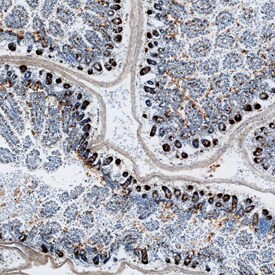
图: 1 / 2
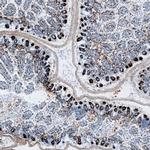
Intelectin 2 Antibody (MA5-24358) in IHC (F)
Immunohistochemical analysis of Intelectin 2 in perfusion fixed frozen sections of mouse intestine. Samples were incubated in Intelectin 2 monoclonal antibody (Product # MA5-24358) using a dilution of 25 µg/mL overnight at 4 °C. Tissue was stained using the Anti-Rat HRP-DAB Cell & Tissue Staining Kit (brown) and counterstained with hematoxylin (blue). Specific staining was localized to Paneth cells in intes... View More
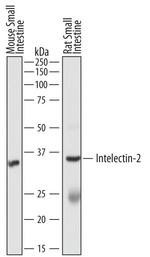
Please note: We are reviewing Western blot images included in the antibody testing data in our catalog, including those provided by third parties. Unless expressly labeled or annotated as “raw-unedited”, Western blot images included in the antibody testing data in our catalog may have been edited, optimized or otherwise adjusted for presentation.


产品信息
MA5-24358
产品规格
种属反应
Mouse
宿主/亚型
Rat
/ IgG1
分类
Monoclonal
类型
Antibody
克隆号
747421
抗原
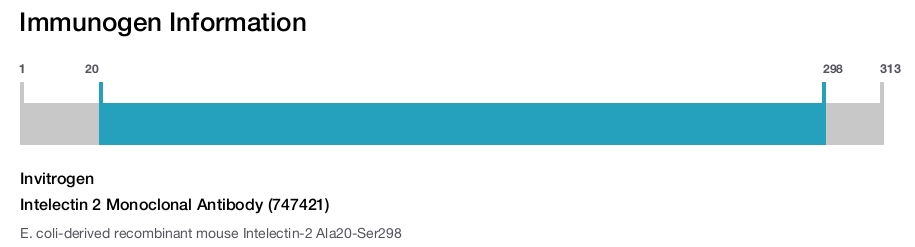
E. coli-derived recombinant mouse Intelectin-2 Ala20-Ser298
偶联物
Unconjugated
Unconjugated
Unconjugated
形式
Lyophilized
浓度
0.5 mg/mL
规格
100 µg
纯化类型
Protein A/G
保存液
PBS with 5% trehalose
内含物
No Preservative
保存条件
-20°C, Avoid Freeze/Thaw Cycles
运输条件
Ambient (domestic); Wet ice (international)
RRID
产品详细信息
Reconstitute in sterile PBS to a final concentration of 0.5 mg/mL.
靶标信息
Intelectin 2, encoded by the ITLN2 gene, is part of the intelectin protein family known for binding carbohydrates and playing roles in innate immunity. Intelectin 2 is characterized by its ability to specifically recognize galactofuranose residues on microbial surfaces, aiding in the immune system's detection and response to pathogenic bacteria and parasites. This protein is expressed predominantly in the small intestine and adipose tissue, where it contributes to mucosal immune defense and metabolic regulation. Intelectin 2 is involved in pathogen recognition, acting as an important component of the body's first line of defense against infections. It also participates in lipid metabolism, influencing glucose homeostasis and adipocyte function, which links it to metabolic disorders such as obesity and diabetes. Research continues to explore intelectin 2's potential as a biomarker for infectious and metabolic diseases, aiming to understand its mechanisms of action and interactions with other immune components.
仅用于科研。不用于诊断过程。未经明确授权不得转售。
篇参考文献 (0)
您是否在文献中引用过该产品?请点击下方按钮邮件告知我们。
生物信息学
蛋白别名: HL-2; intelectin 2; intelectin-2; Intelectin-b; mILN2; UNQ2789/PRO7179
基因别名: Itln1b; Itln2
UniProt ID: (Mouse) Q80ZA0
Entrez Gene ID: (Mouse) 493583
Disclaimer

Clicking the images or links will redirect you to a website hosted by BenchSci that provides third-party scientific content. Neither the content nor the BenchSci technology and processes for selection have been evaluated by us; we are providing them as-is and without warranty of any kind, including for use or application of the Thermo Fisher Scientific products presented.

