Search
Disclaimer

Clicking the images or links will redirect you to a website hosted by BenchSci that provides third-party scientific content. Neither the content nor the BenchSci technology and processes for selection have been evaluated by us; we are providing them as-is and without warranty of any kind, including for use or application of the Thermo Fisher Scientific products presented.
Invitrogen
KCNQ5 Polyclonal Antibody
{{$productOrderCtrl.translations['antibody.pdp.commerceCard.promotion.promotions']}}
{{$productOrderCtrl.translations['antibody.pdp.commerceCard.promotion.viewpromo']}}
{{$productOrderCtrl.translations['antibody.pdp.commerceCard.promotion.promocode']}}: {{promo.promoCode}} {{promo.promoTitle}} {{promo.promoDescription}}. {{$productOrderCtrl.translations['antibody.pdp.commerceCard.promotion.learnmore']}}

图: 1 / 3
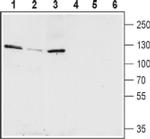
KCNQ5 Antibody (PA5-77651) in IHC (F)
Immunohistochemistry analysis of KCNQ5 in immersion-fixed frozen rat brain. A) Samples were probed with KCNQ5 polyclonal antibody (Product # PA5-77651) using a dilution of 1:100, and incubated with neuronal marker (green) (green). B) Stained hilar interneurons (green and red).



产品信息
PA5-77651
产品规格
宿主/亚型
Rabbit
/ IgG
分类
Polyclonal
类型
Antibody
抗原
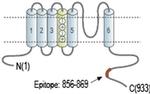
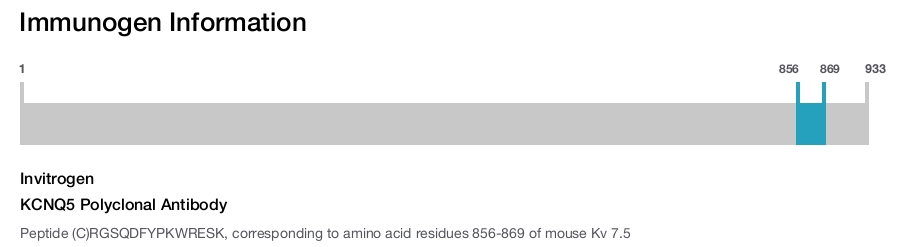
Peptide (C)RGSQDFYPKWRESK, corresponding to amino acid residues 856-869 of mouse Kv 7.5
偶联物
形式
Lyophilized
浓度
0.8 mg/mL
保存条件
-20°C
运输条件
Wet ice
RRID
产品详细信息
Product is shipped at room temperature as a lyophilized powder and should be stored at -20C upon receipt.
Reconstitute using 50 uL deionized water.
靶标信息
KCNQs are members of the voltage-dependent non-inactivating potassium channel family. Currently there are five known KNCQs (KCNQ1-5) found in the central nervous system. Studies have shown that KCNQ3 and KCNQ5 form heteromultimers that, when formed, substantially increase the M-current. Inhibition of M-current controls neuron excitability throughout the nervous system as well as the responsiveness to synaptic inputs. Genetic mutations in these proteins have been linked to disorders such as benign familial neonatal convulsions (BFNC), deafness, neuropathic pain and epilepsy. Voltage-dependent potassium channels are key regulators of the resting membrane potential and modulate the excitability of electrically active cells. The channels are usually tetrameric and can interact with auxiliary subunits that enhance or modify currents mediated by the pore-forming subunits.
仅用于科研。不用于诊断过程。未经明确授权不得转售。
篇参考文献 (0)
您是否在文献中引用过该产品?请点击下方按钮邮件告知我们。

