Search
Invitrogen
KCTD19 Polyclonal Antibody
{{$productOrderCtrl.translations['antibody.pdp.commerceCard.promotion.promotions']}}
{{$productOrderCtrl.translations['antibody.pdp.commerceCard.promotion.promocode']}}: {{promo.promoCode}} {{promo.promoTitle}} {{promo.promoDescription}}. {{$productOrderCtrl.translations['antibody.pdp.commerceCard.promotion.learnmore']}}
{{$ctrl.translations['antibody.pdp.skuNotes.additionalInformation']}}:
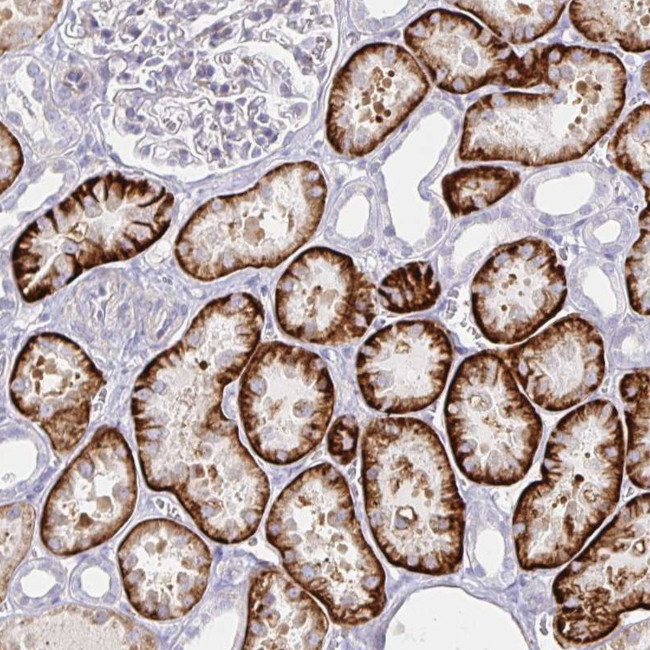
Please note: We are reviewing Western blot images included in the antibody testing data in our catalog, including those provided by third parties. Unless expressly labeled or annotated as “raw-unedited”, Western blot images included in the antibody testing data in our catalog may have been edited, optimized or otherwise adjusted for presentation.

产品信息
PA5-62774
产品规格
种属反应
Human
宿主/亚型
Rabbit
/ IgG
分类
Polyclonal
类型
Antibody
抗原
偶联物
Unconjugated
Unconjugated
Unconjugated
形式
Liquid
浓度
0.05 mg/mL
规格
5 µg
纯化类型
Antigen affinity chromatography
保存液
PBS, pH 7.2, with 40% glycerol
内含物
0.02% sodium azide
保存条件
Store at 4°C short term. For long term storage, store at -20°C, avoiding freeze/thaw cycles.
运输条件
Ambient (domestic); Wet ice (international)
RRID
产品详细信息
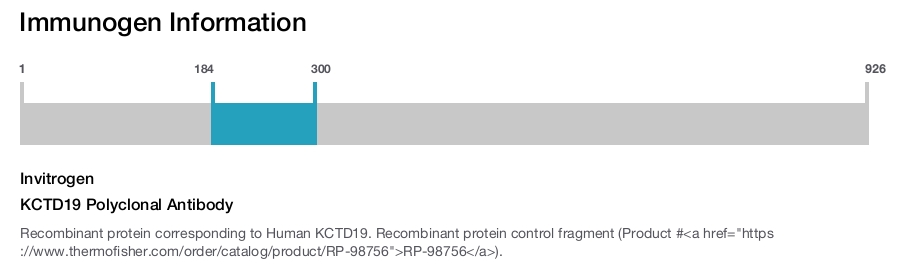
Immunogen sequence: KYPSLVTEDN LLWLAETVAL IECECSEFRF IVNFLRSQKI LLPDNFSNID VLEAEVEILE IPALTEAVRW YRMNMGGCSP TTCSPLSPGK GARTASLESV KPLYTMALGL LVKYPDS
Highest antigen sequence identity to the following orthologs: Mouse - 92%, Rat - 91%.
靶标信息
The KCTD19 (Potassium Channel Tetramerization Domain Containing 19) gene encodes a protein that plays a crucial role in meiotic chromosome organization and male fertility. KCTD19 is located on chromosome 5 in humans. The protein is known to interact with zinc finger protein 541 (ZFP541) and histone deacetylase 1 (HDAC1), highlighting its role in chromatin organization and transcription regulation during meiosis. Mutations or loss-of-function variants in KCTD19 have been implicated in non-obstructive azoospermia (NOA) and male infertility, as evidenced by studies in both human and mouse models. The gene's function in regulating the individualization of meiotic chromosomes is critical, and disruptions can lead to severe meiotic defects and spermatogenic failure.
仅用于科研。不用于诊断过程。未经明确授权不得转售。
篇参考文献 (0)
您是否在文献中引用过该产品?请点击下方按钮邮件告知我们。
生物信息学
蛋白别名: potassium channel tetramerisation domain containing 19; potassium channel tetramerization domain-containing protein 19; testicular tissue protein Li 101; unnamed protein product
UniProt ID: (Human) Q17RG1
Entrez Gene ID: (Human) 146212
Disclaimer

Clicking the images or links will redirect you to a website hosted by BenchSci that provides third-party scientific content. Neither the content nor the BenchSci technology and processes for selection have been evaluated by us; we are providing them as-is and without warranty of any kind, including for use or application of the Thermo Fisher Scientific products presented.

