Search
Invitrogen
KChIP2 Polyclonal Antibody
{{$productOrderCtrl.translations['antibody.pdp.commerceCard.promotion.promotions']}}
{{$productOrderCtrl.translations['antibody.pdp.commerceCard.promotion.viewpromo']}}
{{$productOrderCtrl.translations['antibody.pdp.commerceCard.promotion.promocode']}}: {{promo.promoCode}} {{promo.promoTitle}} {{promo.promoDescription}}. {{$productOrderCtrl.translations['antibody.pdp.commerceCard.promotion.learnmore']}}
Additional Information:
{{banner.description}}

产品信息
PA1-927
应用
建议稀释比
已发表文章
产品规格
已发表种属
Dog,
Mouse,
Rat
宿主/亚型
Rabbit
/ IgG
分类
Polyclonal
类型
Antibody
抗原
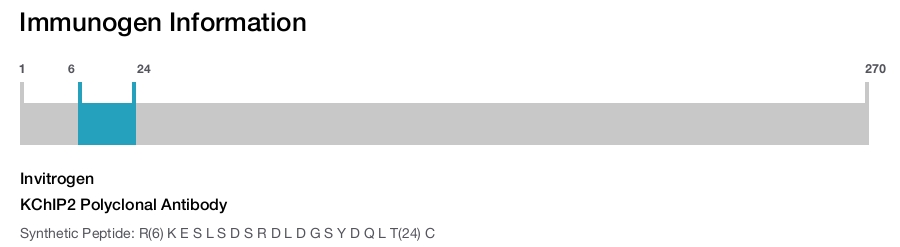
Synthetic Peptide: R(6) K E S L S D S R D L D G S Y D Q L T(24) C
偶联物
形式
Liquid
浓度
1 mg/mL
保存条件
-20°C, Avoid Freeze/Thaw Cycles
运输条件
Wet ice
RRID
产品详细信息
PA1-927 detects Kv channel interacting protein 2 (KChIP2) b and c from rat and rabbit samples as well as recombinant rat KChIP 2c protein. This antibody does not detect KChIP 2a.
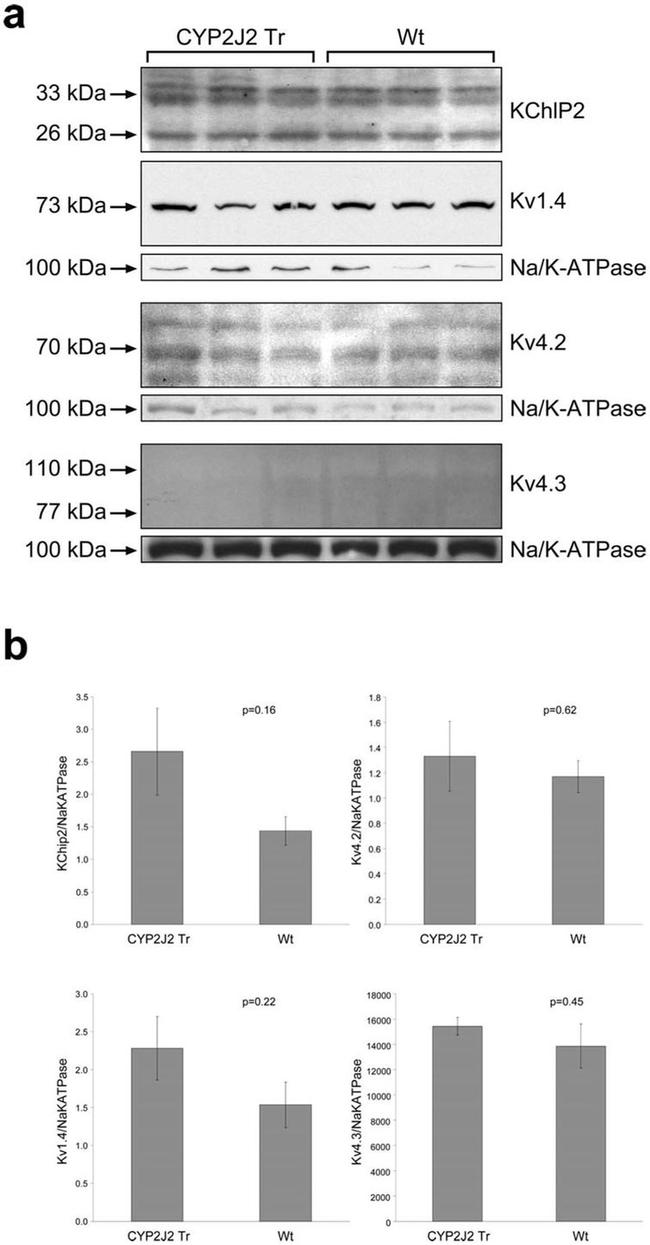
PA1-927 has been successfully used in Western blot procedures. By Western blot, this antibody detects ~33 and 26 kDa proteins representing KChIP2b and c, respectively, from rat ventricular myocyte whole cell lysate.
The PA1-927 synthetic peptide corresponds to amino acid residues 6-24 from human KChIP2. This sequence is completely conserved in mouse and rat. The PA1-927 immunizing peptide (Cat. # PEP-160) is available for use in neutralization and control experiments.
靶标信息
Voltage-gated potassium (Kv) channels are key components of the potassium currents in the heart and central nervous system. In the heart, Kv4 channels are involved in the repolarization phase of the action potential. In the brain however, these channels prevent reverse-propagation of action potentials. Found associated with Kv4 channels are a group of calcium-binding proteins termed KChIPs (Kv channel interacting proteins). KChIPs are small molecular weight proteins that bind to the cytoplasmic amino termini of Kv4 alpha-subunits and help to modulate its function. There are currently three known KChIPs; KChIP1 expressed in the brain; KChIP2 expressed in the brain, heart, and lung, and has three isoforms, a, b, and c; and KChIP3, also known as calsenilin and DREAM (downstream regulatory elements (DRE)-antagonist modulator) which is expressed in the brain and testis.
仅用于科研。不用于诊断过程。未经明确授权不得转售。
Disclaimer

Clicking the images or links will redirect you to a website hosted by BenchSci that provides third-party scientific content. Neither the content nor the BenchSci technology and processes for selection have been evaluated by us; we are providing them as-is and without warranty of any kind, including for use or application of the Thermo Fisher Scientific products presented.

