Search
Additional Information:
{{banner.description}}
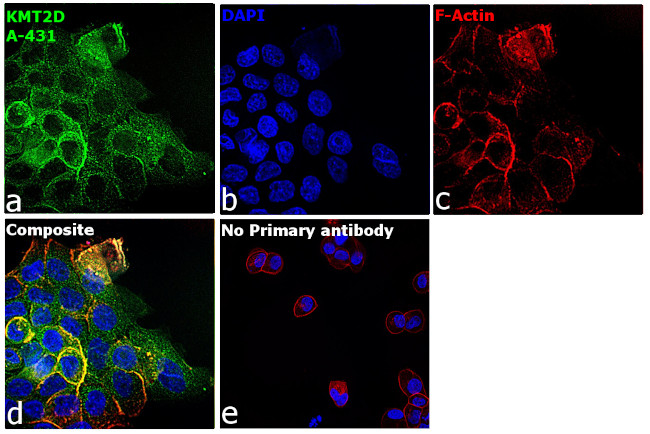
图: 1 / 3
KMT2D Antibody (710901) in ICC/IF
Immunofluorescence analysis of Histone-lysine N-methyltransferase 2D was performed using 70% confluent log phase A-431 cells. The cells were fixed with 4% paraformaldehyde for 10 minutes, permeabilized with 0.1% Triton™ X-100 for 15 minutes, and blocked with 2% BSA for 45 minutes at room temperature. The cells were labeled with KMT2D Recombinant Rabbit Superclonal™ Antibody (9HCLC) (Product # 710901) at 1:100 dilution in 0.1% BSA, incubated at 4 degree celsius overnight and then labeled with Donkey anti-Rabbit IgG (H+L) Highly Cross-Adsorb... View More
Please note: We are reviewing Western blot images included in the antibody testing data in our catalog, including those provided by third parties. Unless expressly labeled or annotated as “raw-unedited”, Western blot images included in the antibody testing data in our catalog may have been edited, optimized or otherwise adjusted for presentation.


产品信息
710901
产品规格
种属反应
Human
宿主/亚型
Rabbit
/ IgG
Expression System
Expi293
分类
Recombinant Superclonal
类型
Antibody
克隆号
9HCLC
抗原
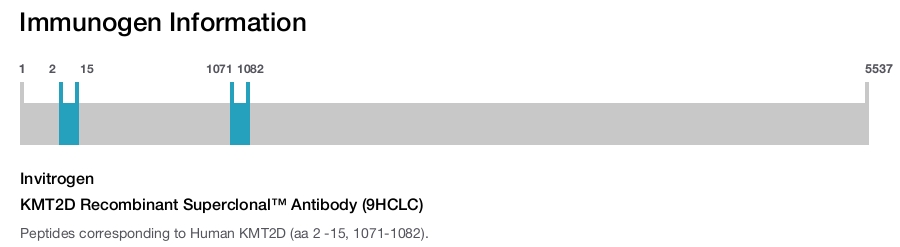
Peptides corresponding to Human KMT2D (aa 2 -15, 1071-1082).
偶联物
Unconjugated
Unconjugated
Unconjugated
形式
Liquid
浓度
0.5 mg/mL
规格
100 µg
纯化类型
Protein A
保存液
PBS, pH 7.2-7.4
内含物
0.09% sodium azide
保存条件
Store at 4°C short term. For long term storage, store at -20°C, avoiding freeze/thaw cycles.
运输条件
Wet ice
RRID
产品详细信息
This antibody is predicted to react with Monkey, Cat and Rat.
Recombinant rabbit Superclonal™ antibodies are unique offerings from Thermo Fisher Scientific. They are comprised of a selection of multiple different recombinant monoclonal antibodies, providing the best of both worlds - the sensitivity of polyclonal antibodies with the specificity of monoclonal antibodies - all delivered with the consistency only found in a recombinant antibody. While functionally the same as a polyclonal antibody - recognizing multiple epitope sites on the target and producing higher detection sensitivity for low abundance targets - a recombinant rabbit Superclonal™ antibody has a known mixture of light and heavy chains. The exact population can be produced in every lot, circumventing the biological variability typically associated with polyclonal antibody production. Note: Formerly called “Recombinant polyclonal antibody”, this product is now rebranded as “Recombinant Superclonal™ antibody”. The physical product and the performance remain unchanged.
靶标信息
KMT2D is a histone methyltransferase that methylates Lys-4 of histone H3 (H3K4me). H3K4me represents a specific tag for epigenetic transcriptional activation. KMT2D acts as a coactivator for estrogen receptors by being recruited by ESR1 and activating transcription. KMT2D is involved in chromatin organization, chormatin silencig, oocyte growth, oogenesis, and a positive regulation of cell proliferation. Mutations in the KMT2D gene cause Kabuki syndrome (KABUK1) which results in congential mental retardation syndrome.
仅用于科研。不用于诊断过程。未经明确授权不得转售。
篇参考文献 (0)
您是否在文献中引用过该产品?请点击下方按钮邮件告知我们。
生物信息学
蛋白别名: AAD10; ALL1-related protein; alternatively spliced; similarity to ALL-1 and Drosophila trithorax; histone-lysine N-methyltransferase MLL2; Kabuki make-up syndrome; lysine (K)-specific methyltransferase 2D; lysine N-methyltransferase 2D; myeloid/lymphoid or mixed-lineage leukemia 2; trinucleotide repeat containing 21
基因别名: AAD10; ALR; BCAHH; CAGL114; KABUK1; KMS; MLL2; MLL4; TNRC21
UniProt ID: (Human) O14686
Entrez Gene ID: (Human) 8085
transcription regulatory region sequence-specific DNA binding
transcriptional activator activity, RNA polymerase II transcription regulatory region sequence-specific binding
DNA binding
transcription coactivator activity
protein binding
histone methyltransferase activity (H3-K4 specific)
histone H3K4 monomethyltransferase activity
Disclaimer

Clicking the images or links will redirect you to a website hosted by BenchSci that provides third-party scientific content. Neither the content nor the BenchSci technology and processes for selection have been evaluated by us; we are providing them as-is and without warranty of any kind, including for use or application of the Thermo Fisher Scientific products presented.

