Search
Invitrogen
LRP1 Cluster III Polyclonal Antibody
{{$productOrderCtrl.translations['antibody.pdp.commerceCard.promotion.promotions']}}
{{$productOrderCtrl.translations['antibody.pdp.commerceCard.promotion.promocode']}}: {{promo.promoCode}} {{promo.promoTitle}} {{promo.promoDescription}}. {{$productOrderCtrl.translations['antibody.pdp.commerceCard.promotion.learnmore']}}
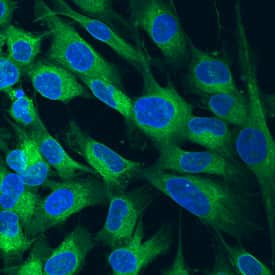
Please note: We are reviewing Western blot images included in the antibody testing data in our catalog, including those provided by third parties. Unless expressly labeled or annotated as “raw-unedited”, Western blot images included in the antibody testing data in our catalog may have been edited, optimized or otherwise adjusted for presentation.

产品信息
PA5-148911
产品规格
种属反应
Human
宿主/亚型
Sheep
/ IgG
分类
Polyclonal
类型
Antibody
抗原
Chinese hamster ovary cell line CHO-derived human LRP-1 Cluster III, Ser2522-Ile2941
偶联物
Unconjugated
Unconjugated
Unconjugated
形式
Lyophilized
浓度
0.2 mg/mL
规格
100 µg
纯化类型
Antigen affinity chromatography
保存液
PBS with trehalose
内含物
no preservative
保存条件
Store at 4°C short term. For long term storage, store at -20°C, avoiding freeze/thaw cycles.
运输条件
Ambient (domestic); Wet ice (international)
RRID
产品详细信息
Reconstitute at 0.2 mg/mL in sterile PBS.
靶标信息
LRP1 (Low-Density Lipoprotein Receptor-Related Protein 1) Cluster III is a specific domain within the LRP1 gene, which encodes a large endocytic receptor involved in various physiological processes, including lipid metabolism, signal transduction, and cellular homeostasis. LRP1 is a multifunctional receptor that binds and internalizes a wide range of ligands, including lipoproteins, proteases, and extracellular matrix proteins. Cluster III of LRP1 is one of its four ligand-binding domains and plays a crucial role in mediating interactions with specific ligands, thereby influencing receptor function. This domain is important for the clearance of amyloid-beta in the brain, which is relevant to Alzheimer's disease, as well as for the regulation of protease activity and the modulation of cell signaling pathways that impact cell migration, proliferation, and survival. Dysregulation or mutations in LRP1, including its Cluster III domain, have been implicated in various diseases, such as cardiovascular disorders, neurodegenerative diseases, and certain cancers. Understanding the structure and function of LRP1 Cluster III is essential for developing targeted therapeutic strategies aimed at modulating its activity to treat related diseases. Research into LRP1 Cluster III provides valuable insights into the receptor's diverse roles in health and disease and its potential as a therapeutic target.
仅用于科研。不用于诊断过程。未经明确授权不得转售。
篇参考文献 (0)
您是否在文献中引用过该产品?请点击下方按钮邮件告知我们。
Disclaimer

Clicking the images or links will redirect you to a website hosted by BenchSci that provides third-party scientific content. Neither the content nor the BenchSci technology and processes for selection have been evaluated by us; we are providing them as-is and without warranty of any kind, including for use or application of the Thermo Fisher Scientific products presented.

