Search
Invitrogen
LZTFL1 Polyclonal Antibody
{{$productOrderCtrl.translations['antibody.pdp.commerceCard.promotion.promotions']}}
{{$productOrderCtrl.translations['antibody.pdp.commerceCard.promotion.promocode']}}: {{promo.promoCode}} {{promo.promoTitle}} {{promo.promoDescription}}. {{$productOrderCtrl.translations['antibody.pdp.commerceCard.promotion.learnmore']}}
{{$ctrl.translations['antibody.pdp.skuNotes.additionalInformation']}}:
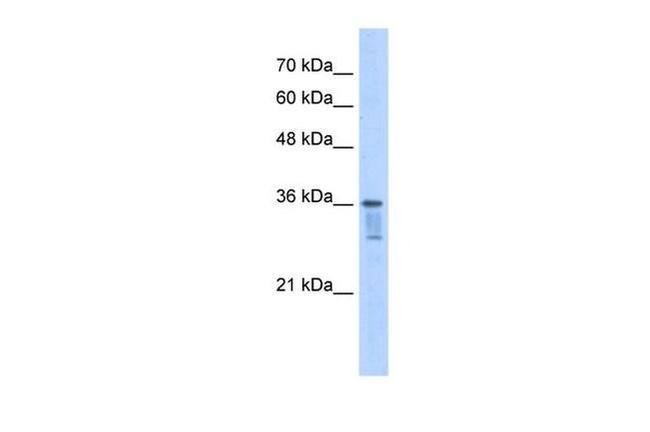

Please note: We are reviewing Western blot images included in the antibody testing data in our catalog, including those provided by third parties. Unless expressly labeled or annotated as “raw-unedited”, Western blot images included in the antibody testing data in our catalog may have been edited, optimized or otherwise adjusted for presentation.

产品信息
PA5-43167
产品规格
种属反应
Human
宿主/亚型
Rabbit
/ IgG
分类
Polyclonal
类型
Antibody
抗原
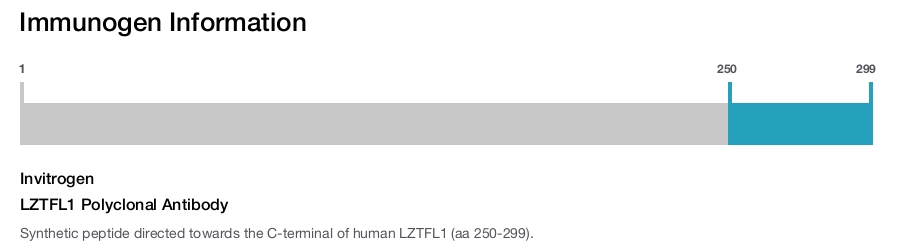
Synthetic peptide directed towards the C-terminal of human LZTFL1 (aa 250-299).
偶联物
Unconjugated
Unconjugated
Unconjugated
形式
Liquid
浓度
1 mg/mL
规格
100 µg
纯化类型
Protein A
保存液
PBS with 2% sucrose
内含物
0.09% sodium azide
保存条件
-20°C, Avoid Freeze/Thaw Cycles
运输条件
Ambient (domestic); Wet ice (international)
RRID
产品详细信息
Peptide sequence: VQEQLHMAEK ELEKKFQQTA AYRNMKEILT KKNDQIKDLR KRLAQYEPED
Sequence homology: Cow: 100%; Dog: 86%; Guinea Pig: 79%; Horse: 93%; Human: 100%; Mouse: 100%; Pig: 100%; Rabbit: 93%; Rat: 100%; Zebrafish: 92%
靶标信息
LZTFL1, also known as Leucine Zipper Transcription Factor-Like 1, is situated on the chromosomal region 3p21.3, which is frequently deleted in various cancers, including kidney cancer. It acts as a tumor suppressor by destabilizing AKT, a key protein in cell growth pathways, thus inhibiting tumor cell growth. Additionally, LZTFL1 has been implicated in the epithelial-mesenchymal transition in COVID-19, suggesting a role in viral response pathways. It is associated with Bardet-Biedl syndrome (BBS) and interacts with IFT27, a regulator of sperm flagellum formation, affecting spermatogenesis and male fertility. Knockout models show a phenotype of obesity, retinal degeneration, and abnormal cilia development, highlighting its role in normal ciliary function. The gene has two transcript isoforms and is part of a transcriptional map covering 250 kb, making it a subject of extensive genetic research.
仅用于科研。不用于诊断过程。未经明确授权不得转售。
篇参考文献 (0)
您是否在文献中引用过该产品?请点击下方按钮邮件告知我们。
生物信息学
Disclaimer

Clicking the images or links will redirect you to a website hosted by BenchSci that provides third-party scientific content. Neither the content nor the BenchSci technology and processes for selection have been evaluated by us; we are providing them as-is and without warranty of any kind, including for use or application of the Thermo Fisher Scientific products presented.

