Search
Disclaimer

Clicking the images or links will redirect you to a website hosted by BenchSci that provides third-party scientific content. Neither the content nor the BenchSci technology and processes for selection have been evaluated by us; we are providing them as-is and without warranty of any kind, including for use or application of the Thermo Fisher Scientific products presented.
Invitrogen
Laminin Polyclonal Antibody
{{$productOrderCtrl.translations['antibody.pdp.commerceCard.promotion.promotions']}}
{{$productOrderCtrl.translations['antibody.pdp.commerceCard.promotion.viewpromo']}}
{{$productOrderCtrl.translations['antibody.pdp.commerceCard.promotion.promocode']}}: {{promo.promoCode}} {{promo.promoTitle}} {{promo.promoDescription}}. {{$productOrderCtrl.translations['antibody.pdp.commerceCard.promotion.learnmore']}}

图: 1 / 4
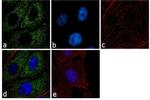
Laminin Antibody (PA5-16287) in ICC/IF
Immunofluorescence analysis of Laminin was performed using 70% confluent log phase PC-3 cells. The cells were fixed with 4% paraformaldehyde for 10 minutes, permeabilized with 0.1% Triton™ X-100 for 10 minutes, and blocked with 1% BSA for 1 hour at room temperature. The cells were labeled with Laminin Rabbit Polyclonal Antibody (Product # PA5-16287) at 1:250 dilution in 0.1% BSA and incubated for 3 hours at room temperature and then labeled with Goat anti-Rabbit IgG (Heavy Chain) Superclonal™ Secondary Antibody, Alexa Fluor® 488 conjugate ... View More


产品信息
PA5-16287
应用
建议稀释比
已发表文章
产品规格
已发表种属
Human,
Mouse,
Pig,
Rat,
Zebrafish
宿主/亚型
Rabbit
/ IgG
分类
Polyclonal
类型
Antibody
抗原
Laminin isolated from a rat yolk sac tumor cell line
偶联物
形式
Liquid
保存条件
4°C
运输条件
Wet ice
RRID
产品详细信息
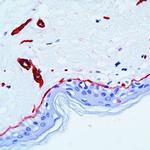
This antibody labels basement membrane laminin proteins surrounding normal vessels, glands, muscles, nerves, fat and decidual cells separating these from abutting connective tissues.
靶标信息
Laminin is a crucial glycoprotein that plays a significant role in the extracellular matrix, particularly within the basement membrane. It is composed of three subunits: alpha, beta, and gamma chains. These chains are disulfide-linked polypeptides that together form a heterotrimer, resembling the shape of a cross. The human genome encodes 11 genetically distinct laminin chains, which combine to form over 14 different laminin isoforms, each with specific tissue distributions and functions. Laminins can bind to other laminin molecules, as well as integrins and other matrix proteins, providing structural support and influencing cell differentiation, migration, and adhesion. These glycoproteins are vital during early embryonic development, where they contribute to the formation of basement membrane-like structures, even in the absence of type IV collagen. The evolutionary origin of laminin gene families can be traced back to early branching animals, providing insights into metazoan gene family development.
仅用于科研。不用于诊断过程。未经明确授权不得转售。

