Search
Proteintech
MPZ/P0 Polyclonal Antibody
{{$productOrderCtrl.translations['antibody.pdp.commerceCard.promotion.promotions']}}
{{$productOrderCtrl.translations['antibody.pdp.commerceCard.promotion.viewpromo']}}
{{$productOrderCtrl.translations['antibody.pdp.commerceCard.promotion.promocode']}}: {{promo.promoCode}} {{promo.promoTitle}} {{promo.promoDescription}}. {{$productOrderCtrl.translations['antibody.pdp.commerceCard.promotion.learnmore']}}
Additional Information:
{{banner.description}}



产品信息
10572-1-AP
应用
建议稀释比
已发表文章
产品规格
种属反应
Human,
Mouse,
Rat
已发表种属
Human,
Mouse,
Rat,
Xenopus
宿主/亚型
Rabbit
/ IgG
分类
Polyclonal
类型
Antibody
抗原
MPZ,P0 Fusion Protein Ag0848 (1-258 aa encoded by BC006491)
偶联物
形式
Liquid
浓度
0.19 mg/mL
规格
28.5 µg
纯化类型
Antigen affinity chromatography
保存液
PBS, pH 7.3, with 50% glycerol
内含物
0.02% sodium azide
保存条件
-20°C
运输条件
Wet ice (domestic); Dry ice (international)
产品详细信息
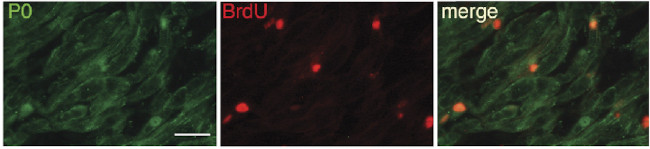
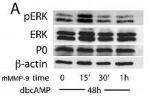
This antibody can recognize endogenous MPZ, and can be used as a marker of myelinating Schwann cells.
Immunogen sequence: MLRAPAPAP AMAPGAPSSS PSPILAVLLF SSLVLSPAQA IVVYTDREVH GAVGSRVTLH CSFWSSEWVS DDISFTWRYQ PEGGRDAISI FHYAKGQPYI DEVGTFKERI QWVGDPRWKD GSIVIHNLDY SDNGTFTCDV KNPPDIVGKT SQVTLYVFEK VPTRYGVVLG AVIGGVLGVV LLLLLLFYVV RYCWLRRQAA LQRRLSAMEK GKLHKPGKDA SKRGRQTPVL YAMLDHSRST KAVSEKKAKG LGESRKDKK (1-258 aa encoded by BC006491 )
靶标信息
Zero, also known as myelin protein zero (MPZ) is a Type 1 integral membrane glycoprotein that mediates adhesion of spiraling wraps of the myelin sheath in order to ensure stable synaptic transmission. Zero protein encompasses approximately 50% of total protein in the sheath scaffolding in contribution to structural integrity of peripheral myelin. Zero guides the compact myelin wrapping process through glycine zipper packing interface-dependent dimer and tetramer formation. Mutations (e.g. G134R) can abrogate multimer formation, cause demyelinating neuropathies, and are known to contribute to conditions that include Charcot-Marie-Tooth disease. Zero cytoplasmic domain undergoes serine and tyrosine phosphorylation, which appears to be prevalent during peak nerve myelination. Zero transcript is moderate in brain, abundant in thymus and most abundant in white matter of the CNS.
仅用于科研。不用于诊断过程。未经明确授权不得转售。
生物信息学
蛋白别名: 28 kda major peripheral myelin protein; Charcot-Marie-Tooth neuropathy 1B; MPP; Myelin peripheral protein; Myelin protein P0; Myelin protein zero; myelin protein zero (Charcot-Marie-Tooth neuropathy 1B); unnamed protein product
基因别名: CHM; CHN2; CMT1; CMT1B; CMT2I; CMT2J; CMT4E; CMTDI3; CMTDID; DSS; HMSNIB; MPP; MPZ; P-zero; P0
UniProt ID: (Human) P25189, (Rat) P06907, (Mouse) P27573
Entrez Gene ID: (Human) 4359, (Rat) 24564, (Mouse) 17528
Disclaimer

Clicking the images or links will redirect you to a website hosted by BenchSci that provides third-party scientific content. Neither the content nor the BenchSci technology and processes for selection have been evaluated by us; we are providing them as-is and without warranty of any kind, including for use or application of the Thermo Fisher Scientific products presented.

