Search
Disclaimer

Clicking the images or links will redirect you to a website hosted by BenchSci that provides third-party scientific content. Neither the content nor the BenchSci technology and processes for selection have been evaluated by us; we are providing them as-is and without warranty of any kind, including for use or application of the Thermo Fisher Scientific products presented.
Invitrogen
NRG3 (extracellular) Polyclonal Antibody
{{$productOrderCtrl.translations['antibody.pdp.commerceCard.promotion.promotions']}}
{{$productOrderCtrl.translations['antibody.pdp.commerceCard.promotion.viewpromo']}}
{{$productOrderCtrl.translations['antibody.pdp.commerceCard.promotion.promocode']}}: {{promo.promoCode}} {{promo.promoTitle}} {{promo.promoDescription}}. {{$productOrderCtrl.translations['antibody.pdp.commerceCard.promotion.learnmore']}}
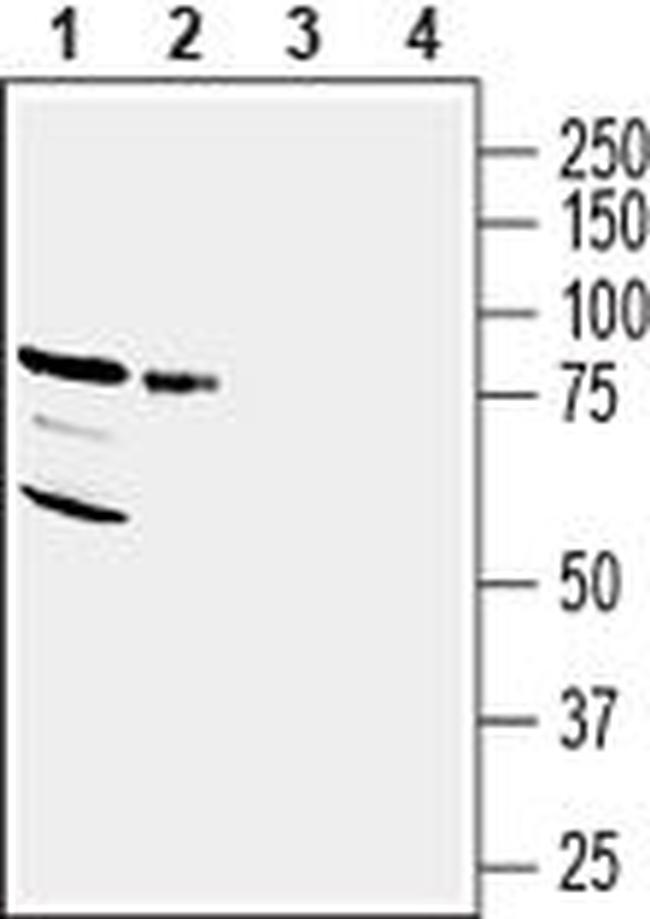
图: 1 / 2
NRG3 (extracellular) Antibody (PA5-111860) in WB
Western Blot analysis of NRG3 was performed in human MCF-7 breast adenocarcinoma cell lysate (lanes 1 and 3) and human MDA-MB-231 breast adenocarcinoma cell lysate (lanes 2 and 4). Lane 1,2: NRG3 (extracellular) Antibody (Product # PA5-111860) at a dilution of 1:200. Lane 3,4: NRG3 (extracellular) Antibody preincubated with the negative control antigen.


产品信息
PA5-111860
产品规格
宿主/亚型
Rabbit
/ IgG
分类
Polyclonal
类型
Antibody
抗原
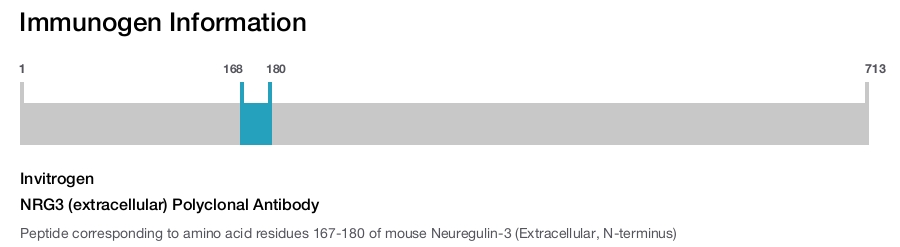
Peptide corresponding to amino acid residues 167-180 of mouse Neuregulin-3 (Extracellular, N-terminus)
偶联物
形式
Lyophilized
浓度
0.8 mg/mL
保存条件
-20°C
运输条件
Wet ice
RRID
产品详细信息
Reconstitute antibody with 50 µL of double distilled water (DDW). The reconstituted solution can be stored at 4 degrees C for up to 1 week. For longer periods, small aliquots should be stored at -20 degrees C. Avoid multiple freezing and thawing. Centrifuge all antibody preparations before use (10000 x g 5 min).
Peptide sequence is: (C)RFPGHRV PIRASPR
Homology: Human, rat amino acid residues are identical.
靶标信息
This gene is a member of the neuregulin gene family. This gene family encodes ligands for the transmembrane tyrosine kinase receptors ERBB3 and ERBB4 - members of the epidermal growth factor receptor family. Ligand binding activates intracellular signaling cascades and the induction of cellular responses including proliferation, migration, differentiation, and survival or apoptosis. This gene encodes neuregulin 3. NRG3 has been shown to activate the tyrosine phosphorylation of its cognate receptor, ERBB4, and is thought to influence neuroblast proliferation, migration and differentiation by signalling through ERBB4. NRG3 also promotes mammary differentiation during embryogenesis. Linkage studies have implicated this gene as a susceptibility locus for schizophrenia and schizoaffective disorder. Alternative splicing results in multiple transcript variants encoding distinct isoforms. Additional transcript variants have been described but their biological validity has not been verified.
仅用于科研。不用于诊断过程。未经明确授权不得转售。
篇参考文献 (0)
您是否在文献中引用过该产品?请点击下方按钮邮件告知我们。

