Search
Abnova
OR8B8 Polyclonal Antibody, MaxPab™
{{$productOrderCtrl.translations['antibody.pdp.commerceCard.promotion.promotions']}}
{{$productOrderCtrl.translations['antibody.pdp.commerceCard.promotion.promocode']}}: {{promo.promoCode}} {{promo.promoTitle}} {{promo.promoDescription}}. {{$productOrderCtrl.translations['antibody.pdp.commerceCard.promotion.learnmore']}}
{{$ctrl.translations['antibody.pdp.skuNotes.additionalInformation']}}:
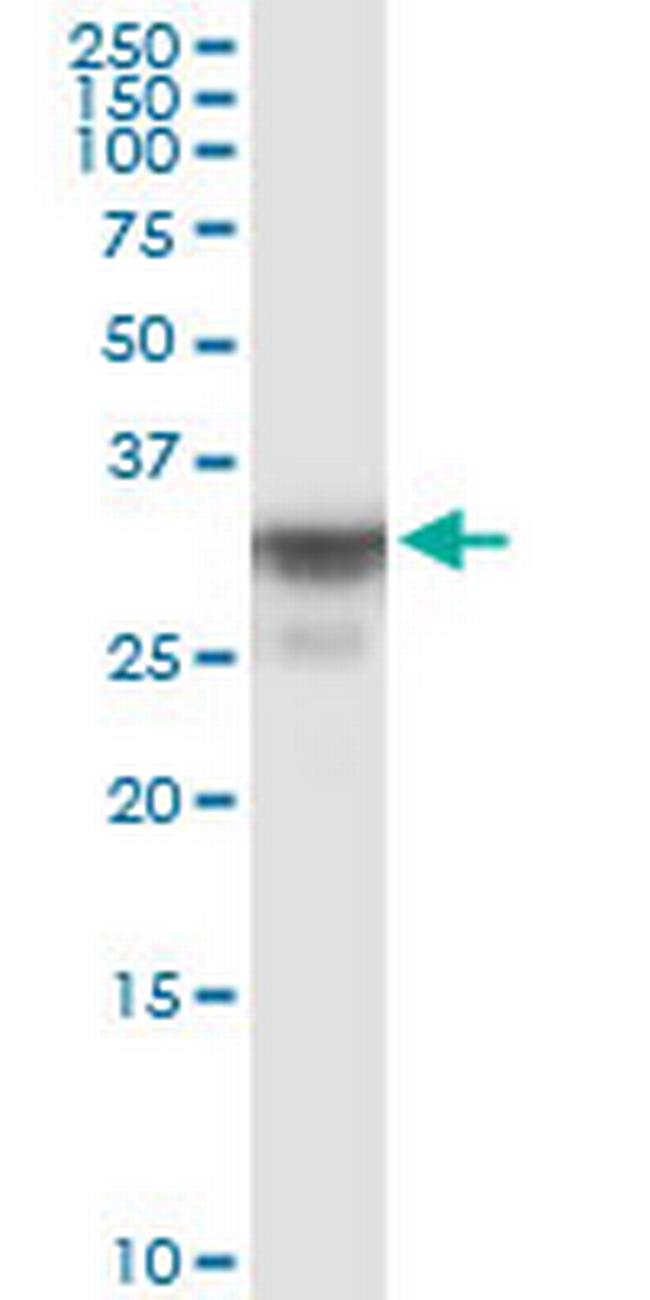
Please note: We are reviewing Western blot images included in the antibody testing data in our catalog, including those provided by third parties. Unless expressly labeled or annotated as “raw-unedited”, Western blot images included in the antibody testing data in our catalog may have been edited, optimized or otherwise adjusted for presentation.

产品信息
H00026493-B01P
产品规格
种属反应
Human
宿主/亚型
Mouse
/ IgG
分类
Polyclonal
类型
Antibody
抗原
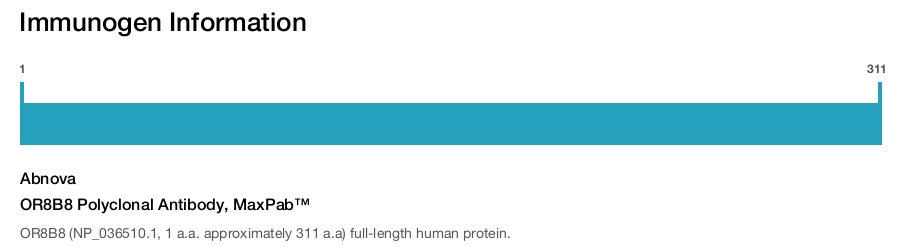
OR8B8 (NP_036510.1, 1 a.a. approximately 311 a.a) full-length human protein.
偶联物
Unconjugated
Unconjugated
Unconjugated
形式
Liquid
浓度
0.5 mg/mL
规格
50 µg
纯化类型
Protein A
保存液
PBS, pH 7.4
内含物
no preservative
保存条件
-20°C, Avoid Freeze/Thaw Cycles
运输条件
Ambient (domestic); Wet ice (international)
产品详细信息
Product may be used with Western Blot (Cell lysate).
The Isotype of this product is composed of an IgG Mixture.
Immunogen sequence: MAAENSSFVT QFILAGLTDQ PGVQIPLFFL FLGFYVVTVV GNLGLITLIR LNSHLHTPMY FFLYNLSFID FCYSSVITPK MLMSFVLKKN SISYAGCMTQ LFFFLFFVVS ESFILSAMAY DRYVAICNPL LYMVTMSPQV CFLLLLGVYG MGFAGAMAHT ACMMGVTFCA NNLVNHYMCD ILPLLECACT STYVNELVVF VVVGIDIGVP TVTIFISYAL ILSSIFHIDS TEGRSKAFST CSSHIIAVSL FFGSGAFMYL KPFSLLAMNQ GKVSSLFYTT VVPMLNPLIY SLRNKDVKVA LKKILNKNAF S
靶标信息
Olfactory receptors interact with odorant molecules in the nose, to initiate a neuronal response that triggers the perception of a smell. The olfactory receptor proteins are members of a large family of G-protein-coupled receptors (GPCR) arising from single coding-exon genes. Olfactory receptors share a 7-transmembrane domain structure with many neurotransmitter and hormone receptors and are responsible for the recognition and G protein-mediated transduction of odorant signals. The olfactory receptor gene family is the largest in the genome. The nomenclature assigned to the olfactory receptor genes and proteins for this organism is independent of other organisms.
仅用于科研。不用于诊断过程。未经明确授权不得转售。
篇参考文献 (0)
您是否在文献中引用过该产品?请点击下方按钮邮件告知我们。
生物信息学
蛋白别名: olfactory receptor OR11-316; olfactory receptor TPCR85; olfactory-like receptor JCG8
基因别名: TPCR85
UniProt ID: (Human) Q15620
Entrez Gene ID: (Human) 26493
Disclaimer

Clicking the images or links will redirect you to a website hosted by BenchSci that provides third-party scientific content. Neither the content nor the BenchSci technology and processes for selection have been evaluated by us; we are providing them as-is and without warranty of any kind, including for use or application of the Thermo Fisher Scientific products presented.

