Search
GenScript
Obinutuzumab Polyclonal Antibody
{{$productOrderCtrl.translations['antibody.pdp.commerceCard.promotion.promotions']}}
{{$productOrderCtrl.translations['antibody.pdp.commerceCard.promotion.viewpromo']}}
{{$productOrderCtrl.translations['antibody.pdp.commerceCard.promotion.promocode']}}: {{promo.promoCode}} {{promo.promoTitle}} {{promo.promoDescription}}. {{$productOrderCtrl.translations['antibody.pdp.commerceCard.promotion.learnmore']}}
Additional Information:
{{banner.description}}
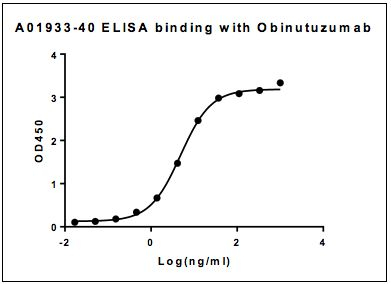
图: 1 / 1
Obinutuzumab Antibody (A01933-40) in ELISA
ELISA binding of Anti-Obinutuzumab Antibody, pAb, Rabbit (GenScript, A01933-40) with Obinutuzumab. Coating antigen: Obinutuzumab, 1 µg/mL. Anti-Obinutuzumab Antibody, pAb, Rabbit (GenScript, A01933-40) dilution start from 1,000 ng/mL, EC50= 4.845 ng/mL.

产品信息
A01933-40
产品规格
种属反应
Human
宿主/亚型
Rabbit
/ IgG
分类
Polyclonal
类型
Antibody
抗原
Obinutuzumab
偶联物
Unconjugated
Unconjugated
Unconjugated
形式
Lyophilized
规格
40 µg
纯化类型
Antigen affinity chromatography
保存液
PBS, pH 7.4
内含物
0.02% sodium azide
保存条件
-20°C, Avoid Freeze/Thaw Cycles
运输条件
Ambient (domestic); Wet ice (international)
产品详细信息
Reconstitute the lyophilized antibody with deionized water (or equivalent) to a final concentration of 0.5 mg/mL.
Obinutuzumab is a humanized anti-CD20 monoclonal antibody, originated by GlycArt Biotechnology AG and developed by Roche as a cancer treatment. It was approved under the trade name Gazyva by the US FDA in 2013, and as Gazyvaro by the EMA in Europe, for the treatment of chronic lymphocytic leukemia in combination with chemotherapy in treatment-naive patients, and as a second line treatment for follicular lymphoma. Obinutuzumab is a fully humanized monoclonal antibody that binds to an epitope on CD20 that partially overlaps with the epitope recognized by rituximab. Obinutuzumab binds to CD20 on B cells and causes these cells to be destroyed by engaging the adaptive immune system, directly activating intracellular apoptosis pathways, and activating the complement system.
Upon reconstitution, it can be stored for 2-3 weeks at 2-8 °C or for up to 12 months at -20 °C or below.
靶标信息
CD20 is a non-glycosylated surface phosphoprotein that has a molecular weight range of 33-37 kDa depending on the degree of phosphorylation. CD20 is expressed on mature and most malignant B cells, in a subpopulation of T lymphocytes and follicular dendritic cells. CD20 expression on B cells is synchronous with the expression of surface IgM and it regulates transmembrane calcium conductance, cell cycle progression and B-cell proliferation. CD20 is also associated with lipid rafts, but the intensity of this association depends on extracellular triggering, employing CD20 conformational change, and/or BCR (B cell antigen receptor) aggregation. After the receptor ligation, BCR and CD20 colocalize and then rapidly dissociate before BCR endocytosis, whereas CD20 remains at the cell surface. CD20 serves as a useful target for antibody-mediated therapeutic depletion of B cells, as it is expressed at high levels on most B-cell malignancies, but does not become internalized or shed from the plasma membrane following monoclonal antibody treatment. Diseases associated with CD20 dysfunction include Ms4a1-related common variable immune deficiency.
仅用于科研。不用于诊断过程。未经明确授权不得转售。
篇参考文献 (0)
您是否在文献中引用过该产品?请点击下方按钮邮件告知我们。
生物信息学
蛋白别名: APY; ATOPY; B-lymphocyte antigen CD20; B-lymphocyte cell-surface antigen B1; B-lymphocyte surface antigen B1; Bp35; CD20; CD20 antigen; CD20 receptor; Fc epsilon receptor I beta chain; Fc Fragment of IgE high affinity I receptor for beta polypeptide; FCER1B; High affinity immunoglobulin epsilon receptor subunit beta; IgE Fc receptor subunit beta; IGEL; IGER; IGHER; LEU16; Leukocyte surface antigen Leu-16; Ly44; Membrane-spanning 4-domains subfamily A member 1; membrane-spanning 4-domains, subfamily A, member 1; MGC3969; unnamed protein product
基因别名: B1; Bp35; CD20; CVID5; FMC7; LEU-16; MS4A1; S7
UniProt ID: (Human) P11836
Entrez Gene ID: (Human) 931
store-operated calcium entry
humoral immune response
cell surface receptor signaling pathway
response to bacterium
B cell differentiation
B cell proliferation
B cell activation
B cell receptor signaling pathway
protein tetramerization
calcium ion import into cytosol
positive regulation of calcium ion import across plasma membrane
Disclaimer

Clicking the images or links will redirect you to a website hosted by BenchSci that provides third-party scientific content. Neither the content nor the BenchSci technology and processes for selection have been evaluated by us; we are providing them as-is and without warranty of any kind, including for use or application of the Thermo Fisher Scientific products presented.

