Search
Proteintech
PARP6 Polyclonal Antibody
{{$productOrderCtrl.translations['antibody.pdp.commerceCard.promotion.promotions']}}
{{$productOrderCtrl.translations['antibody.pdp.commerceCard.promotion.viewpromo']}}
{{$productOrderCtrl.translations['antibody.pdp.commerceCard.promotion.promocode']}}: {{promo.promoCode}} {{promo.promoTitle}} {{promo.promoDescription}}. {{$productOrderCtrl.translations['antibody.pdp.commerceCard.promotion.learnmore']}}
Additional Information:
{{banner.description}}


产品信息
16945-1-AP
产品规格
种属反应
Human,
Mouse,
Rat
宿主/亚型
Rabbit
/ IgG
分类
Polyclonal
类型
Antibody
抗原
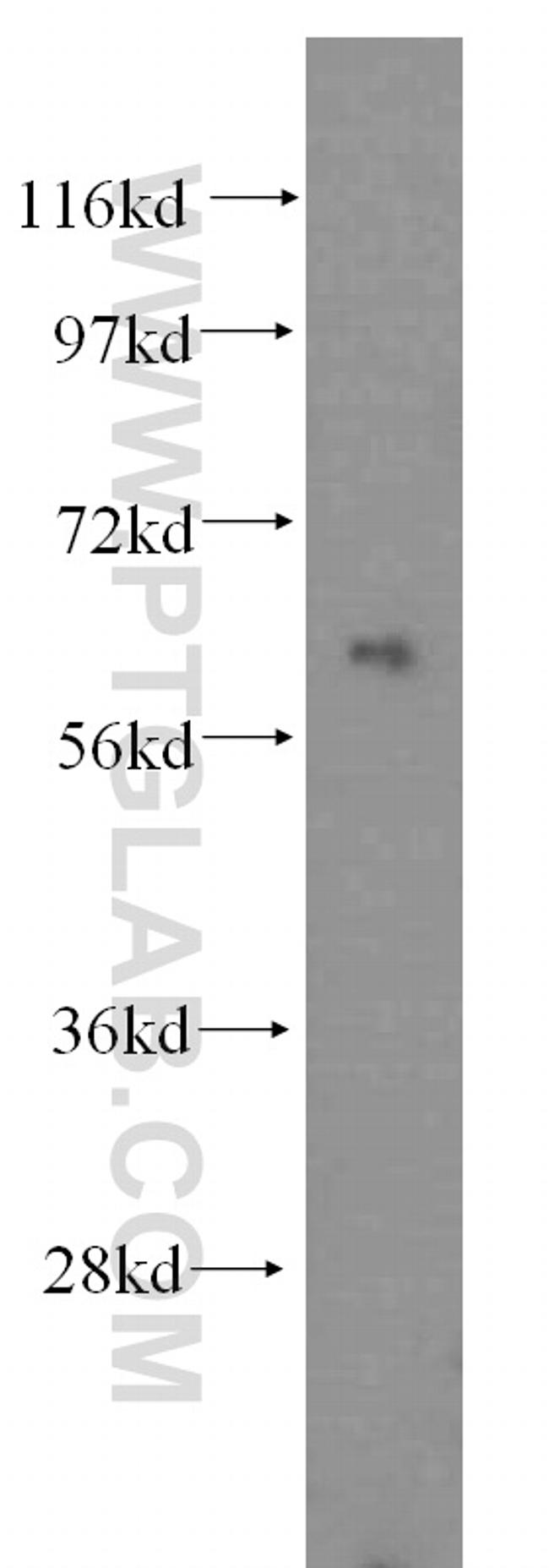
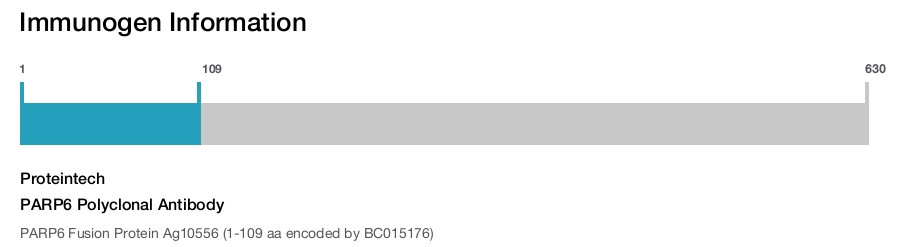
PARP6 Fusion Protein Ag10556 (1-109 aa encoded by BC015176)
偶联物
形式
Liquid
浓度
0.17 mg/mL
规格
25.5 µg
纯化类型
Antigen affinity chromatography
保存液
PBS, pH 7.3, with 50% glycerol
内含物
0.02% sodium azide
保存条件
-20°C
运输条件
Wet ice (domestic); Dry ice (international)
产品详细信息
Immunogen sequence: MGKGQHRMP SKDELVQRYN RMNTIPQTRS IQSRFLQSRN LNCIALCEVI TSKDLQKHGN IWVCPVSDHV CTRFFFVYED GQVGDANINT QDPKIQKEIM RVIGTQVYTN (1-109 aa encoded by BC015176)
靶标信息
Poly(ADP-ribosyl)ation is an immediate DNA-damage-dependent post-translational modification of histones and other nuclear proteins that contributes to the survival of injured proliferating cells. Poly(ADP-ribose) polymerases (PARPs) now constitute a large family of 18 proteins, encoded by different genes and displaying a conserved catalytic domain in which PARP-1 (113 kDa), the founding member, and PARP-2 (62 kDa) are so far the sole enzymes whose catalytic activity has been shown to be immediately stimulated by DNA strand breaks. A large repertoire of sequences encoding novel PARPs now extends considerably the field of poly(ADP-ribosyl)ation reactions to various aspects of the cell biology including cell proliferation and cell death. Some of these new members interact with each other, share common partners and common subcellular localizations suggesting possible fine tuning in the regulation of this post-translational modification of proteins.
仅用于科研。不用于诊断过程。未经明确授权不得转售。
篇参考文献 (0)
您是否在文献中引用过该产品?请点击下方按钮邮件告知我们。
生物信息学
蛋白别名: ADP-ribosyltransferase diphtheria toxin-like 17; ARTD17; MIEREN, class I; MIEREN, class II; PARP-6; Poly [ADP-ribose] polymerase 6; Protein mono-ADP-ribosyltransferase PARP6; unnamed protein product
基因别名: 1700119G14Rik; 2310028P13Rik; 3110038K10Rik; ARTD17; C030013N01Rik; PARP-6; PARP-6-B1; PARP-6-C; PARP6; pART17; RGD1310937
UniProt ID: (Human) Q2NL67, (Mouse) Q6P6P7
Entrez Gene ID: (Human) 56965, (Mouse) 67287, (Rat) 300759
NAD+ ADP-ribosyltransferase activity
transferase activity
transferase activity, transferring glycosyl groups
nucleotidyltransferase activity
kinase binding
protein serine/threonine kinase activator activity
NAD+-protein-cysteine ADP-ribosyltransferase activity
NAD+-protein-aspartate ADP-ribosyltransferase activity
molecular_function
Disclaimer

Clicking the images or links will redirect you to a website hosted by BenchSci that provides third-party scientific content. Neither the content nor the BenchSci technology and processes for selection have been evaluated by us; we are providing them as-is and without warranty of any kind, including for use or application of the Thermo Fisher Scientific products presented.

