Search
Invitrogen
PCYT2 Polyclonal Antibody
{{$productOrderCtrl.translations['antibody.pdp.commerceCard.promotion.promotions']}}
{{$productOrderCtrl.translations['antibody.pdp.commerceCard.promotion.viewpromo']}}
{{$productOrderCtrl.translations['antibody.pdp.commerceCard.promotion.promocode']}}: {{promo.promoCode}} {{promo.promoTitle}} {{promo.promoDescription}}. {{$productOrderCtrl.translations['antibody.pdp.commerceCard.promotion.learnmore']}}
Additional Information:
{{banner.description}}
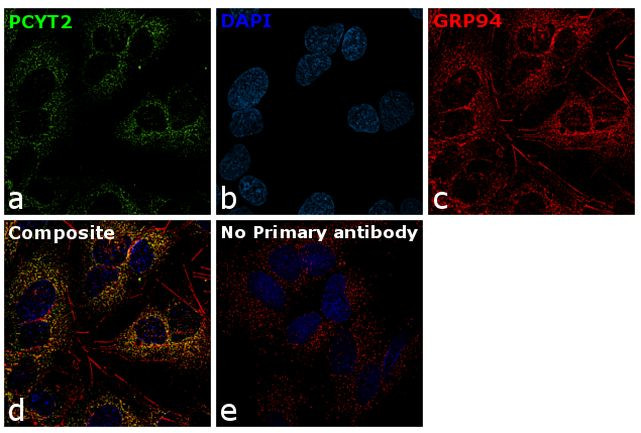
图: 1 / 2
PCYT2 Antibody (PA1-545) in ICC/IF
Immunofluorescence analysis of PCYT2 was performed using 70% confluent log phase Hep G2 cells. The cells were fixed with 4% paraformaldehyde for 10 minutes, permeabilized with 0.1% Triton™ X-100 for 15 minutes, and blocked with 1% BSA for 1 hour at room temperature. The cells were labeled with PCYT2 Polyclonal Antibody (Product # PA1-545) at 5 µg/mL in 0.1% BSA, incubated at 4 degree Celsius overnight and then labeled with Goat anti-Rabbit IgG (Heavy Chain) Superclonal™ Secondary Antibody, Alexa Fluor® 488 conjugate (Product # A27034) at a... View More
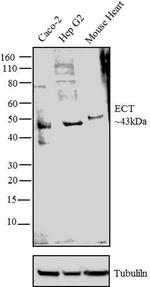
Please note: We are reviewing Western blot images included in the antibody testing data in our catalog, including those provided by third parties. Unless expressly labeled or annotated as “raw-unedited”, Western blot images included in the antibody testing data in our catalog may have been edited, optimized or otherwise adjusted for presentation.


产品信息
PA1-545
产品规格
种属反应
Human,
Mouse,
Non-human primate,
Rat
宿主/亚型
Rabbit
/ IgG
分类
Polyclonal
类型
Antibody
抗原
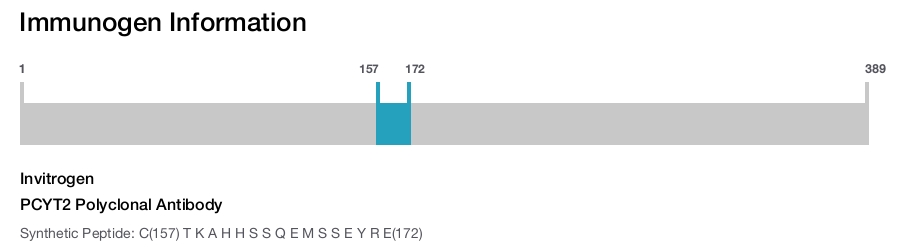
Synthetic Peptide: C(157) T K A H H S S Q E M S S E Y R E(172)
偶联物
Unconjugated
Unconjugated
Unconjugated
形式
Liquid
浓度
0.4 mg/mL
规格
100 µg
纯化类型
Affinity chromatography
保存液
tris with glycine, 1mg/mL BSA
内含物
0.02% thimerosal
保存条件
-20°C, Avoid Freeze/Thaw Cycles
运输条件
Ambient (domestic); Wet ice (international)
RRID
产品详细信息
PA1-545 detects ethanolaminephosphate cytidyltransferase (ECT) protein in human, rat, mouse and non-human primate samples.
PA1-545 has successfully been used in Western blot procedures. By Western blot, this antibody detects an ~50 kDa protein representing ECT from C3H/10T1/2 cell lysates.
PA1-545 immunizing peptide corresponds to amino acid residues 157-172 from human ECT protein. This immunizing peptide (PEP-241) can be used for neutralization and control experiments.
靶标信息
ECT (ethanolaminephosphate cytidyltransferase) is an important regulatory enzyme in the pathway for phosphatidylethanolamine (PE) biosynthesis. PE functions in cell signalling, membrane fusion, platelet activation, and cell cycle progression. Specialized forms of PE exist as plasmologens, natural cannabinoid anadimade, and glycosylated PE. The ECT enzyme acts in the second of three catalysis steps to produce CDP-ethanolamine from phosphoethanolamine (P-Etn). Study of ECT could help determine the role of plasmologens in disease, specifically lipid disorders such as peroxisomal diseases as well as neuronal degeneration associated with Alzheimer's disease.
⚠WARNING: This product can expose you to chemicals including mercury, which is known to the State of California to cause birth defects or other reproductive harm. For more information go to www.P65Warnings.ca.gov.
仅用于科研。不用于诊断过程。未经明确授权不得转售。
篇参考文献 (0)
您是否在文献中引用过该产品?请点击下方按钮邮件告知我们。
生物信息学
蛋白别名: CTP:phopshoethanolamine cytidylyltransferase; CTP:phosphoethanolamine cytidylyltransferase; PCYT2; phosphorylethanolamine transferase; unnamed protein product
基因别名: 1110033E03Rik; ET; SPG82
UniProt ID: (Human) Q99447, (Rat) O88637, (Mouse) Q922E4
Entrez Gene ID: (Human) 5833, (Rat) 89841, (Mouse) 68671
Disclaimer

Clicking the images or links will redirect you to a website hosted by BenchSci that provides third-party scientific content. Neither the content nor the BenchSci technology and processes for selection have been evaluated by us; we are providing them as-is and without warranty of any kind, including for use or application of the Thermo Fisher Scientific products presented.

