Search
Invitrogen
PDE2A Recombinant Rabbit Monoclonal Antibody (201)
{{$productOrderCtrl.translations['antibody.pdp.commerceCard.promotion.promotions']}}
{{$productOrderCtrl.translations['antibody.pdp.commerceCard.promotion.promocode']}}: {{promo.promoCode}} {{promo.promoTitle}} {{promo.promoDescription}}. {{$productOrderCtrl.translations['antibody.pdp.commerceCard.promotion.learnmore']}}
{{$ctrl.translations['antibody.pdp.skuNotes.additionalInformation']}}:
产品信息
MA5-30734
产品规格
种属反应
Human
宿主/亚型
Rabbit
/ IgG
Expression System
HEK293 cells
分类
Recombinant Monoclonal
类型
Antibody
克隆号
201
抗原
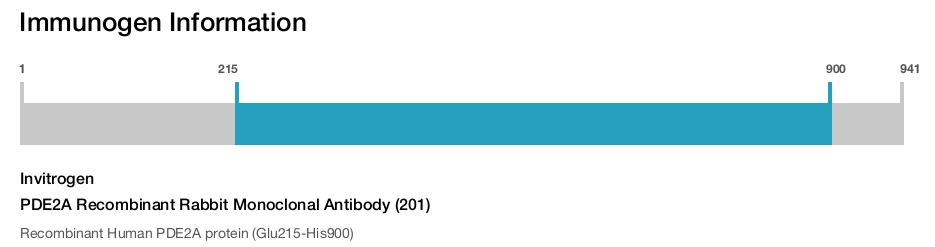
Recombinant Human PDE2A protein (Glu215-His900)
偶联物
Unconjugated
Unconjugated
Unconjugated
形式
Liquid
浓度
1 mg/mL
规格
100 µg
纯化类型
Protein A
保存液
PBS
内含物
no preservative
保存条件
Store at 4°C short term. For long term storage, store at -20°C, avoiding freeze/thaw cycles.
运输条件
Ambient (domestic); Wet ice (international)
RRID
产品详细信息
This product is preservative free. It is recommended to add sodium azide to avoid contamination (final concentration 0.05%-0.1%).
Recombinant rabbit monoclonal antibodies are produced using in vitro expression systems. The expression systems are developed by cloning in the specific antibody DNA sequences from immunoreactive rabbits. Then, individual clones are screened to select the best candidates for production. The advantages of using recombinant rabbit monoclonal antibodies include: better specificity and sensitivity, lot-to-lot consistency, animal origin-free formulations, and broader immunoreactivity to diverse targets due to larger rabbit immune repertoire.
This antibody has specificity for Human PDE2A.
靶标信息
PDE2A (phosphodiesterase 2A) is a 100 kD cyclic nucleotide phosphodiesterase (PDE) and three isoforms of PDE2A have been reported (PDE2A1, PDE2A2 and PDE2A3) which arise from a single gene by alternative splicing events. PDE2A can degrade both cAMP and cGMP, but degrades cGMP with greater efficacy. PDE2A is expressed in a variety of tissue types, with greatest expression in the brain, where it is localized in the cerebellum and neocortex. PDE2A has been implicated in penile erectile dysfunction and in the regulation of fluid and inflammatory cell transport across the endothelial cell barrier.
仅用于科研。不用于诊断过程。未经明确授权不得转售。
篇参考文献 (0)
您是否在文献中引用过该产品?请点击下方按钮邮件告知我们。
生物信息学
蛋白别名: cGMP-stimulated phosphodiesterase 1; cGMP-stimulated phosphodiesterase 2; cGMP-stimulated phosphodiesterase 4; cyclic GMP-stimulated phosphodiesterase; PDE2A1; PDE2A2; PED2A4; phosphodiesterase 2A, cGMP-stimulated; unnamed protein product
基因别名: CGS-PDE; cGSPDE; IDDPADS; PDE2A1; PED2A4
UniProt ID: (Human) O00408
Entrez Gene ID: (Human) 5138
magnesium ion binding
3',5'-cyclic-nucleotide phosphodiesterase activity
3',5'-cyclic-AMP phosphodiesterase activity
cGMP-stimulated cyclic-nucleotide phosphodiesterase activity
protein binding
phosphoric diester hydrolase activity
zinc ion binding
cAMP binding
cGMP binding
TPR domain binding
phosphate ion binding
identical protein binding
protein homodimerization activity
3',5'-cyclic-GMP phosphodiesterase activity
negative regulation of transcription from RNA polymerase II promoter
heart valve development
ventricular septum development
signal transduction
adenylate cyclase-inhibiting G-protein coupled receptor signaling pathway
positive regulation of gene expression
negative regulation of cGMP-mediated signaling
regulation of mitochondrion organization
monocyte differentiation
aorta development
cellular response to macrophage colony-stimulating factor stimulus
negative regulation of vascular permeability
positive regulation of vascular permeability
cGMP catabolic process
positive regulation of inflammatory response
establishment of endothelial barrier
cellular response to mechanical stimulus
cellular response to cAMP
cellular response to cGMP
cellular response to xenobiotic stimulus
cellular response to transforming growth factor beta stimulus
cellular response to granulocyte macrophage colony-stimulating factor stimulus
negative regulation of adenylate cyclase-activating G protein-coupled receptor signaling pathway
negative regulation of cAMP/PKA signal transduction
cellular response to 2,3,7,8-tetrachlorodibenzodioxine
Disclaimer

Clicking the images or links will redirect you to a website hosted by BenchSci that provides third-party scientific content. Neither the content nor the BenchSci technology and processes for selection have been evaluated by us; we are providing them as-is and without warranty of any kind, including for use or application of the Thermo Fisher Scientific products presented.

