Search
Invitrogen
PIGF Polyclonal Antibody
{{$productOrderCtrl.translations['antibody.pdp.commerceCard.promotion.promotions']}}
{{$productOrderCtrl.translations['antibody.pdp.commerceCard.promotion.viewpromo']}}
{{$productOrderCtrl.translations['antibody.pdp.commerceCard.promotion.promocode']}}: {{promo.promoCode}} {{promo.promoTitle}} {{promo.promoDescription}}. {{$productOrderCtrl.translations['antibody.pdp.commerceCard.promotion.learnmore']}}
Additional Information:
{{banner.description}}
产品信息
PA5-68270
产品规格
宿主/亚型
Rabbit
/ IgG
分类
Polyclonal
类型
Antibody
抗原
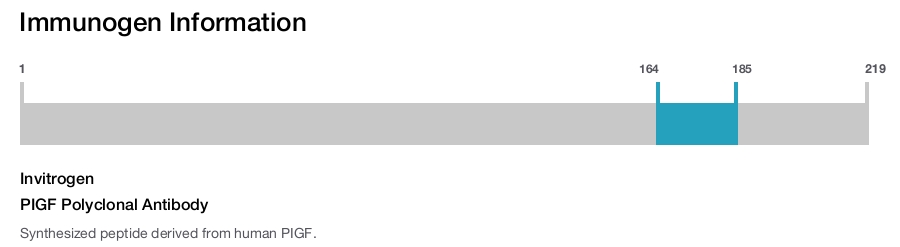
Synthesized peptide derived from human PIGF.
偶联物
Unconjugated
Unconjugated
Unconjugated
形式
Liquid
浓度
1 mg/mL
规格
100 µg
保存条件
-20°C
运输条件
Wet ice
RRID
产品详细信息
Predicted to react with Mouse samples.
靶标信息
Phosphatidylinositol-glycans(PIGs) aremulti-passtransmembrane proteins that localize to the endoplasmicreticulum. PIGs exhibitvariousfunctions but all are crucial for the biosynthesis of the glycosylphosphatidylinositol (GPI) anchor. Some PIG proteins are components of the GPI transamidase complex and play a role in the recognition of either the GPI attachmentsignal or the lipid portion of GPI. Other PIGs belong to the glycosyltransferase complex and function in the transfer of N-acetylglucosamine (GlcNAc) to phosphatidyli nositol (PI). A variety of other PIGs play distinct rolesin GPIsynthesis. PIG-F functions as an auxiliary subunit of ethanolamine phosphate (EtNP) transferases. It associates with PIG-O and isrequired for its expression and stability. Together these two PIGs function as an EtNP transferase and catalyze the transfer of EtNP to the third mannose (Man-3) of GPI. Amutation in the gene encoding PIG-F may result in a block of EtNP addition to Man-3 and lead to an absence of GPI-anchored proteins.
仅用于科研。不用于诊断过程。未经明确授权不得转售。
篇参考文献 (0)
您是否在文献中引用过该产品?请点击下方按钮邮件告知我们。
Disclaimer

Clicking the images or links will redirect you to a website hosted by BenchSci that provides third-party scientific content. Neither the content nor the BenchSci technology and processes for selection have been evaluated by us; we are providing them as-is and without warranty of any kind, including for use or application of the Thermo Fisher Scientific products presented.

