Search
Proteintech
PIGT Polyclonal Antibody
{{$productOrderCtrl.translations['antibody.pdp.commerceCard.promotion.promotions']}}
{{$productOrderCtrl.translations['antibody.pdp.commerceCard.promotion.viewpromo']}}
{{$productOrderCtrl.translations['antibody.pdp.commerceCard.promotion.promocode']}}: {{promo.promoCode}} {{promo.promoTitle}} {{promo.promoDescription}}. {{$productOrderCtrl.translations['antibody.pdp.commerceCard.promotion.learnmore']}}
Additional Information:
{{banner.description}}
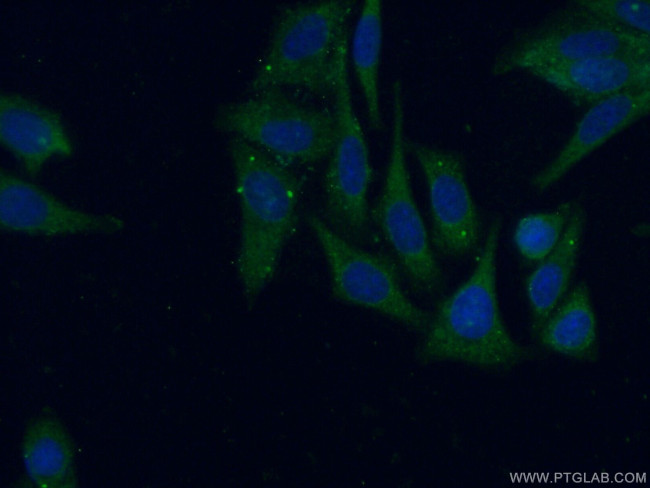


产品信息
16906-1-AP
应用
建议稀释比
已发表文章
产品规格
种属反应
Human,
Mouse
宿主/亚型
Rabbit
/ IgG
分类
Polyclonal
类型
Antibody
抗原
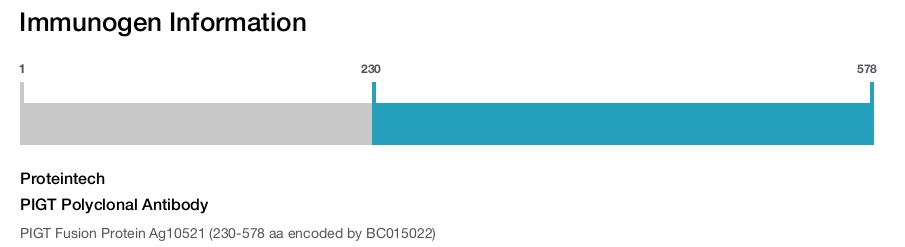
PIGT Fusion Protein Ag10521 (230-578 aa encoded by BC015022)
偶联物
形式
Liquid
浓度
0.13 mg/mL
规格
19.5 µg
纯化类型
Antigen affinity chromatography
保存液
PBS, pH 7.3, with 50% glycerol
内含物
0.02% sodium azide
保存条件
-20°C
运输条件
Wet ice (domestic); Dry ice (international)
产品详细信息
Immunogen sequence: RCTSISWEL RQTLSVVFDA FITGQGKKDW SLFRMFSRTL TEPCPLASES RVYVDITTYN QDNETLEVHP PPTTTYQDVI LGTRKTYAIY DLLDTAMINN SRNLNIQLKW KRPPENEAPP VPFLHAQRYV SGYGLQKGEL STLLYNTHPY RAFPVLLLDT VPWYLRLYVH TLTITSKGKE NKPSYIHYQP AQDRLQPHLL EMLIQLPANS VTKVSIQFER ALLKWTEYTP DPNHGFYVSP SVLSALVPSM VAAKPVDWEE SPLFNSLFPV SDGSNYFVRL YTEPLLVNLP TPDFSMPYNV ICLTCTVVAV CYGSFYNLLT RTFHIEEPRT GGLAKRLANL IRRARGVPPL (230-578 aa encoded by BC015022)
靶标信息
PIGT is a protein that is involved in glycosylphosphatidylinositol (GPI)-anchor biosynthesis. The GPI-anchor is a glycolipid found on many blood cells and serves to anchor proteins to the cell surface. This protein is an essential component of the multisubunit enzyme, GPI transamidase. GPI transamidase mediates GPI anchoring in the endoplasmic reticulum, by catalyzing the transfer of fully assembled GPI units to proteins. This gene encodes a protein that is involved in glycosylphosphatidylinositol (GPI)-anchor biosynthesis. The GPI-anchor is a glycolipid found on many blood cells and serves to anchor proteins to the cell surface. This protein is an essential component of the multisubunit enzyme, GPI transamidase. GPI transamidase mediates GPI anchoring in the endoplasmic reticulum, by catalyzing the transfer of fully assembled GPI units to proteins.
仅用于科研。不用于诊断过程。未经明确授权不得转售。
篇参考文献 (0)
您是否在文献中引用过该产品?请点击下方按钮邮件告知我们。
生物信息学
蛋白别名: FLJ41596; GPI transamidase component PIG-T; GPI transamidase subunit; GPI-anchor transamidase component PIGT; MGC8909; Neuronal development-associated protein 7; neurotrophin-regulated neuronal development-associated protein; Phosphatidylinositol-glycan biosynthesis class T protein; unnamed protein product
基因别名: 2510012P17Rik; 4930534E15Rik; CGI-06; MCAHS3; NDAP; Ndap7; PIG-T; PIGT; PNH2; PSEC0163; UNQ716/PRO1379
UniProt ID: (Human) Q969N2, (Mouse) Q8BXQ2
Entrez Gene ID: (Human) 51604, (Mouse) 78928
Disclaimer

Clicking the images or links will redirect you to a website hosted by BenchSci that provides third-party scientific content. Neither the content nor the BenchSci technology and processes for selection have been evaluated by us; we are providing them as-is and without warranty of any kind, including for use or application of the Thermo Fisher Scientific products presented.

