Search
Invitrogen
PLLP Polyclonal Antibody
{{$productOrderCtrl.translations['antibody.pdp.commerceCard.promotion.promotions']}}
{{$productOrderCtrl.translations['antibody.pdp.commerceCard.promotion.viewpromo']}}
{{$productOrderCtrl.translations['antibody.pdp.commerceCard.promotion.promocode']}}: {{promo.promoCode}} {{promo.promoTitle}} {{promo.promoDescription}}. {{$productOrderCtrl.translations['antibody.pdp.commerceCard.promotion.learnmore']}}
Additional Information:
{{banner.description}}

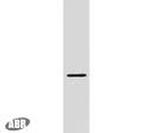
Please note: We are reviewing Western blot images included in the antibody testing data in our catalog, including those provided by third parties. Unless expressly labeled or annotated as “raw-unedited”, Western blot images included in the antibody testing data in our catalog may have been edited, optimized or otherwise adjusted for presentation.

产品信息
PA1-086
产品规格
宿主/亚型
Rabbit
/ IgG
分类
Polyclonal
类型
Antibody
抗原
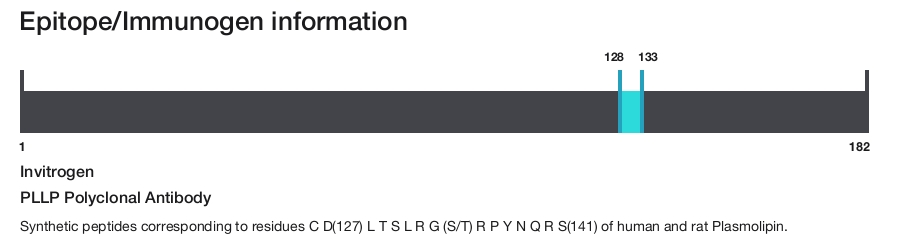
Synthetic peptides corresponding to residues C D(127) L T S L R G (S/T) R P Y N Q R S(141) of human and rat Plasmolipin.
偶联物
Unconjugated
Unconjugated
Unconjugated
形式
Liquid
浓度
1 mg/mL
规格
100 µg
保存条件
-20°C, Avoid Freeze/Thaw Cycles
运输条件
Wet ice
RRID
产品详细信息
PA1-086 detects plasmolipin from rat and human samples.
PA1-086 has been successfully used in Western blot procedures. By Western blot, this antibody detects an ~18 kDa protein representing plasmolipin from rat kidney tissue extract.
The PA1-086 immunogen is a synthetic peptides corresponding to residues C D(127) L T S L R G (S/T) R P Y N Q R S(141) of human and rat Plasmolipin. This peptide (Cat. # PEP-250) can be used for neutralization and control experiments.
靶标信息
Plasmolipin is an 18 kDa membrane-bound proteolipid that belongs to the tetraspan (4TM) family, a rapidly growing group of myelin-associated proteins. Many of these proteins could be linked to human hereditary demyelinating neuropathies. Studies indicate that plasmolipin is a component of the cytoskeletal structure and has been localized to the apical surface of tubular epithelial cells. It has been shown that, upon addition to lipid bilayers, plasmolipin induces formation of ion channels that are both voltage-dependent and potassium-specific. Plasmolipin was originally isolated from kidney tissue. Subsequently, it has been shown to be widely expressed, not only being present in kidney, but also in the nervous system, thymus, testis, lung, and thyroid gland.
仅用于科研。不用于诊断过程。未经明确授权不得转售。
篇参考文献 (0)
您是否在文献中引用过该产品?请点击下方按钮邮件告知我们。
Disclaimer

Clicking the images or links will redirect you to a website hosted by BenchSci that provides third-party scientific content. Neither the content nor the BenchSci technology and processes for selection have been evaluated by us; we are providing them as-is and without warranty of any kind, including for use or application of the Thermo Fisher Scientific products presented.

