Search
Bethyl Laboratories
PNUTS Polyclonal Antibody
{{$productOrderCtrl.translations['antibody.pdp.commerceCard.promotion.promotions']}}
{{$productOrderCtrl.translations['antibody.pdp.commerceCard.promotion.promocode']}}: {{promo.promoCode}} {{promo.promoTitle}} {{promo.promoDescription}}. {{$productOrderCtrl.translations['antibody.pdp.commerceCard.promotion.learnmore']}}
{{$ctrl.translations['antibody.pdp.skuNotes.additionalInformation']}}:
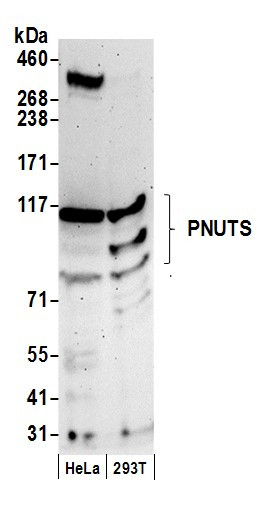
图: 1 / 2
PNUTS Antibody (A300-440A) in WB
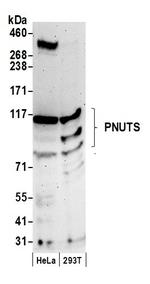
Detection of human PNUTS by western blot. Samples: Whole cell lysate (50 µg) from HeLa and HEK293T cells prepared using NETN lysis buffer. Antibody: Affinity purified rabbit anti-PNUTS antibody (Product # A300-440A) (lot A300-440A-1) used for WB at 0.2 µg/mL. Detection: Chemiluminescence with an exposure time of 3 minutes.
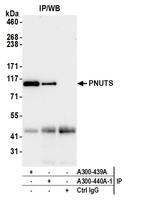
Please note: We are reviewing Western blot images included in the antibody testing data in our catalog, including those provided by third parties. Unless expressly labeled or annotated as “raw-unedited”, Western blot images included in the antibody testing data in our catalog may have been edited, optimized or otherwise adjusted for presentation.


产品信息
A300-440A
产品规格
种属反应
Human
宿主/亚型
Rabbit
/ IgG
分类
Polyclonal
类型
Antibody
抗原
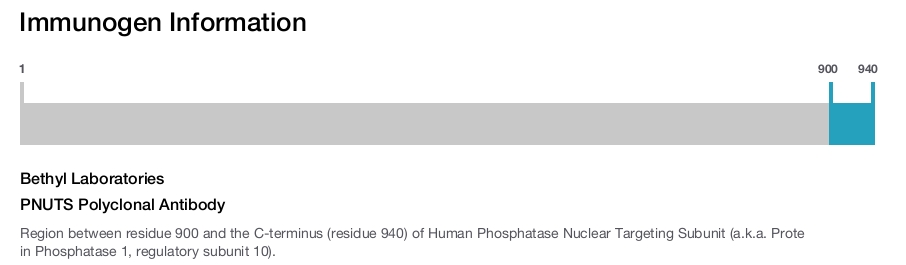
Region between residue 900 and the C-terminus (residue 940) of Human Phosphatase Nuclear Targeting Subunit (a.k.a. Protein Phosphatase 1, regulatory subunit 10).
偶联物
Unconjugated
Unconjugated
Unconjugated
形式
Liquid
浓度
1 mg/mL
规格
100 µg
纯化类型
Antigen affinity chromatography
保存液
tris citrate/phosphate, pH 7-8
内含物
0.09% sodium azide
保存条件
4°C
运输条件
Ambient (domestic); Wet ice (international)
产品详细信息
The recommended shelf life for this product is 1 year from date of receipt.
Based on 100% sequence identity, this antibody is predicted to react with Mouse, Rat, Pig, Monkey and Chimpanzee
靶标信息
RNA polymerases transcribe nuclear genes for ribosomal RNA, thus representing ribosomal biogenesis. RNA polymerase I (Pol I) is located in the nucleolus and transcribes class I genes, which code for large ribosomal RNA. Different subunits of the Pol I transcription machinery are targets of various physiological stimuli, which suggests that multiple signaling pathways are involved in carrying out Pol I transcription. RPA40 and RPA16 are subunits of Pol I that associate with each other at an early stage of RNA polymerase I assembly. RPA40 is essential for the function and integrity of the complex and is also an essential subunit of RNA polymerase III (Pol III). RPA40, RPA16 and RPA135 encode the three subunits of RNA polymerase I, respectively. RPA194 is the largest subunit of RNA Pol I and is not a component of Pol II and Pol III.
仅用于科研。不用于诊断过程。未经明确授权不得转售。
篇参考文献 (0)
您是否在文献中引用过该产品?请点击下方按钮邮件告知我们。
生物信息学
蛋白别名: HLA-C associated transcript 53; MHC class I region proline-rich protein CAT53; phosphatase 1 nuclear targeting subunit; PNUTSPP1R10; PP1-binding protein of 114 kDa; protein phosphatase 1, regulatory (inhibitor) subunit 10; testis tissue sperm-binding protein Li 67n
基因别名: CAT53; FB19; p99; PNUTS; PP1R10; R111
UniProt ID: (Human) Q96QC0
Entrez Gene ID: (Human) 5514
promoter clearance from RNA polymerase II promoter
protein import into nucleus
negative regulation of cardiac muscle cell apoptotic process
positive regulation of telomere maintenance
positive regulation of transcription elongation from RNA polymerase II promoter
negative regulation of transcription elongation from RNA polymerase II promoter
protein stabilization
negative regulation of mitotic DNA damage checkpoint
positive regulation of termination of RNA polymerase II transcription, poly(A)-coupled
Disclaimer

Clicking the images or links will redirect you to a website hosted by BenchSci that provides third-party scientific content. Neither the content nor the BenchSci technology and processes for selection have been evaluated by us; we are providing them as-is and without warranty of any kind, including for use or application of the Thermo Fisher Scientific products presented.

